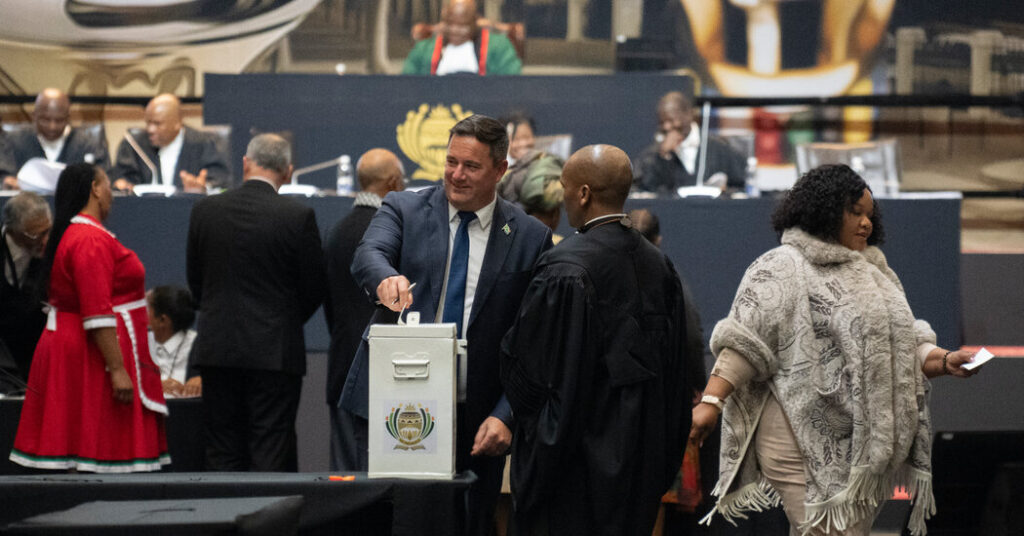
The leader of the second largest party in South Africa’s government announced on Wednesday that he would not seek re-election, casting uncertainty over the direction of the country’s fragile governing coalition.
The politician, John Steenhuisen, is finishing his second term at the helm of the Democratic Alliance, a party whose market-driven economic approach has helped boost investor confidence in the country since it joined a coalition government with the dominant, left-leaning African National Congress two years ago.
Mr. Steenhuisen, who serves as agriculture minister, has recently faced criticism over allegations that he misspent party funds on Uber Eats deliveries and other personal expenses and that he mishandled an outbreak of foot-and-mouth disease that has ravaged the country’s livestock industry. An internal party investigation cleared him of wrongdoing in the credit card expenditures, but he remains under inquiry over allegations that he brought the party into disrepute.
On Wednesday, he said he would focus full-time on battling the outbreak.
Mr. Steenhuisen, 49, has been an ardent supporter of keeping the governing coalition together, even as the Democratic Alliance and the A.N.C. have clashed bitterly over policies and sharing power.
While it is considered unlikely that the Democratic Alliance’s next leader would push to leave the government, some within the party have agitated for a more forceful approach against what they see as the A.N.C.’s refusal to compromise on key policy issues like national health insurance coverage and land seizures. The Democratic Alliance wants to keep health insurance mostly private and opposes the government taking land without providing compensation.
If Mr. Steenhuisen’s departure as party leader causes a protracted battle within his party, some analysts fear what that could mean for the stability of the government at a pivotal moment. South Africa has been buoyed by signs of economic momentum but also is grappling with tensions with the Trump administration over the U.S. President’s contention that the South African government discriminates against the country’s white minority.
Mr. Steenhuisen’s troubles began after he forced the removal of one of his party’s leaders, Dion George, from a government post last November. That led to an internal party investigation of Mr. Steenhuisen over allegations that he used his party credit card to pay for Uber Eats, fancy hotel stays and car rentals. Mr. George has since resigned from the party.
Mr. Steenhuisen, who became the Democratic Alliance’s leader in 2019, shepherded the party into the national government for the first time in 2024, when the A.N.C. failed to win an absolute majority in the election for the first time since the end of apartheid 30 years earlier.
His most notable moment in government came when he joined a South African delegation to the Oval Office last year and made an impassioned statement to President Trump, assuring him that South Africa would keep extremist politicians at bay so long as his party is in government.
“South Africa today is a profoundly better country than it was on the eve of the 2024 general elections,” Mr. Steenhuisen said Wednesday in announcing his decision not to seek re-election. “A major part of the reason is because I delivered on my pledge to turn the D.A. into a party of national government.”
While he has overseen significant electoral gains by his party at the local level, Mr. Steenhuisen was unable to shake the party’s reputation as one that caters to the interests of South Africa’s white minority. Most of the party’s top leaders are white, and several Black members have fallen out with the party leadership and left the party .
Geordin Hill-Lewis, the mayor of Cape Town, is widely considered the favorite to win the election to replace Mr. Steenhuisen when the Democratic Alliance holds its conference in April.
Zimasa Matiwane contributed reporting from Johannesburg.
John Eligon is the Johannesburg bureau chief for The Times, covering a wide range of events and trends that influence and shape the lives of ordinary people across southern Africa.
The post South African Party Leader Bows Out, Stirring Fears for Government’s Future appeared first on New York Times.