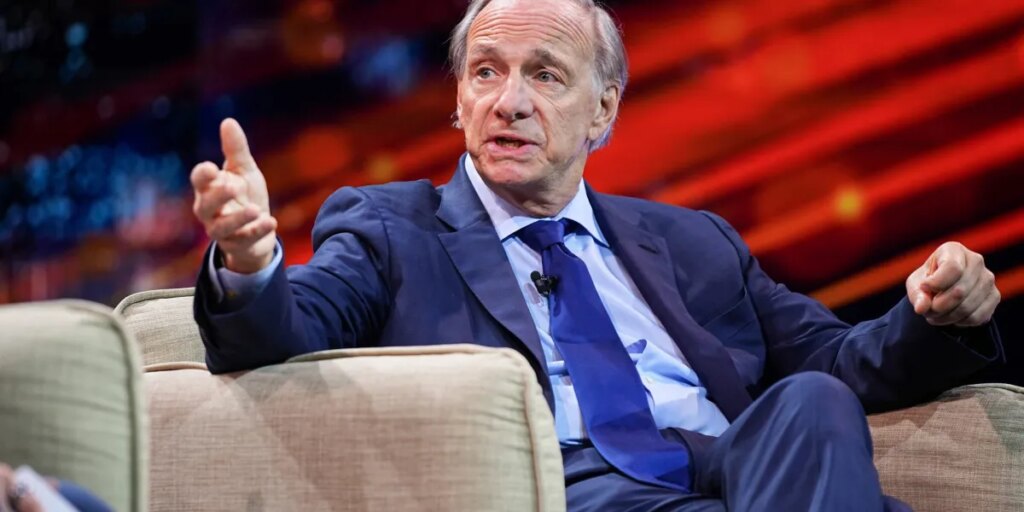
The world is facing threats not of a cold war or just a trade war, but a capital war where money is being weaponized, according to billionaire hedge fund manager Ray Dalio. He suggested one asset would be the safest to invest in during volatile times.
The Bridgewater Associates founder said in an interview at the World Governments Summit in Dubai on Tuesday the world is on the cusp of widespread conflict where—instead of ammunition—countries attack each other through the means of controlling the flow of money, such as leveraging debt ownership.
“We are on the brink,” Dalio said. “That means not in, but it means we are quite close to [a capital war], and it would be very easy to go over the brink into a capital war, because there are mutual fears.”
Dalio attributes this escalating discord to President Donald Trump’s recent threats to take over or purchase Greenland from Denmark, which analysts believe weakened the alliance formed through the North Atlantic Treaty Organization (NATO). He said this friction could create fear in European holders of U.S. securities, bonds, and stock, that they could be sanctioned. That anxiety could, in turn, create “reciprocal fear” the U.S. would not be able to get crucial foreign funding, Dalio said.
Dalio’s broader warnings about volatile global markets echoes a similar message he made during the World Economic Forum in Davos, Switzerland, last month. In a conversation with Kamal Ahmed, Fortune’s executive editorial director for the U.K. and Europe, Dalio warned of a breakdown in the world’s monetary order. Specifically, he said, the world is at a point in a larger cycle in which the U.S.’s power is eroding, in large part due to the immense $38 trillion national debt. This breakdown has been exacerbated by geopolitical tensions and technological changes, Dalio warned.
“Let’s not be naive and say, ‘Oh, we’re breaking the rule-based system,’” he said. “It’s gone.”
Global tensions and ‘Sell America’ mode
Indeed, markets entered “Sell America” mode following Trump’s push for Greenland, throttling the U.S. dollar and sharply increasing the yield on five-year Treasury bonds, signaling concerns about increased government debt supply. Danish pension fund AkademikerPension confirmed it would exit U.S. Treasuries by the end of January because U.S. government finances were no longer sustainable. Swedish pension fund Alecta similarly cut its holdings. The selloff also coincided with a probe into Federal Reserve chair Jerome Powell, which perturbed global investors over the potential of a loss of Fed independence. The assets have since recovered.
European investors make up the vast majority of the U.S.-denominated asset holders, accounting for 80% of foreign buyers of U.S. Treasures between April and November 2025, according to Citi data.
Recent trade moves indicate Trump is interested in America’s global standing. Following a landmark trade deal between the European Union and India, Trump inked his own agreement with Indian Prime Minister Narendra Modi, lowering tariffs from 25% to 18% after India agreed to stop buying Russian oil.
Dalio noted capital wars emerge during broader conflicts, citing the U.S.’s entrance into World War II, when the U.S. froze Japan’s assets in an attempt to gain control over the country and its eastward expansion without military force. He saw an “analogous situation” today between the U.S. and China and Europe.
A Nixon-era throwback to gold
During this period of global fiscal tensions, Dalio said gold remains the safest asset to invest in. The value of gold is often inversely related to the value of the dollar because when the dollar is weak, it is cheaper and in higher demand for foreign buyers. Following a record-crushing rally, gold and silver saw a historic selloff before finally stabilizing.
“In reserve currencies, gold is the second largest reserve currency,” Dalio said. He added monetary policy-makers would still call gold “the safest money in this kind of environment.”
“Gold is up about 65% from a year ago, and down about 16% from its high,” Dalio said. “I think people make the mistake of thinking, is it going to go up and down, and should I buy it?”
Dalio compared today to 1971, when former President Richard Nixon did away with the gold standard. In the early 1970s, inflation and massive debt loads and government spending rocked investor confidence in the dollar, leaving gold as an effective hedge. Dalio previously advocated for investors to have gold as 15% of their portfolio.
“Because gold is a diversifier, when the bad times come along it does uniquely well, and when the good times are prosperous, less so, [but] it’s an effective diversifier,” Dalio said on Tuesday. “I’d say the most important thing is [to] have a well-diversified portfolio.”
The post Ray Dalio warns the world is ‘on the brink’ of a capital war of weaponizing money—and gold is the best way for people to protect themselves appeared first on Fortune.


