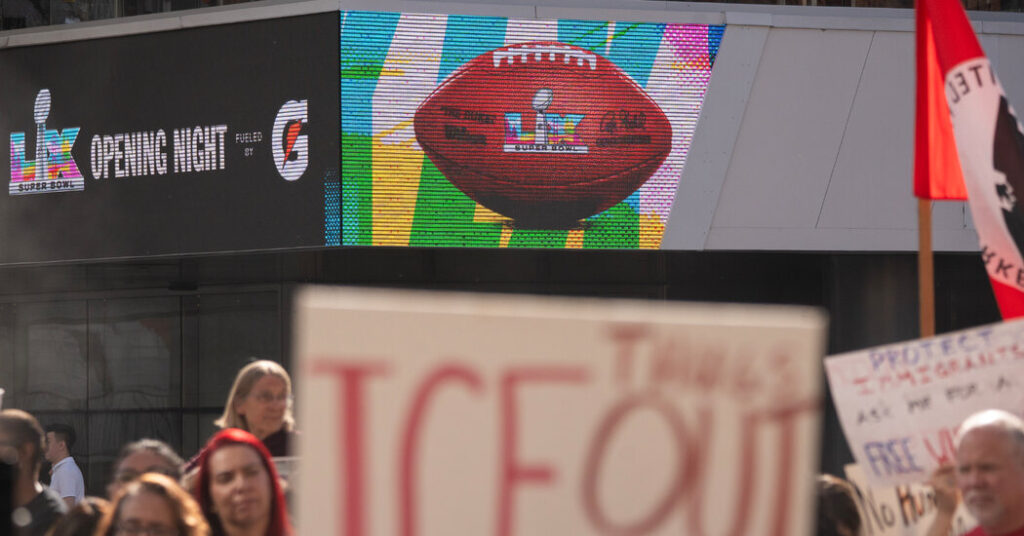
In the San Francisco Bay Area, Super Bowl week is drawing thousands of football fans, international attention for the halftime performer Bad Bunny — and fears of an immigration crackdown.
City councils across the Bay Area, which is heavily Democratic, have passed a flurry of ordinances in recent weeks declaring their jurisdictions “ICE-free zones” in an attempt to block federal agents from using local resources. Immigrant rights groups have trained hundreds of volunteers to report and legally observe federal activity, and plan to dispatch them to monitor Levi’s Stadium in Santa Clara, as well as heavily immigrant neighborhoods.
While government officials and the National Football League said on Tuesday that they were not expecting an immigration enforcement raid this week in the Bay Area, local residents remained skeptical after the killings of two people by federal agents and other turmoil in Minneapolis over the past month.
“It feels like a present danger,” said Jaasiel Torres, 18, who attended a demonstration in San Jose on Monday aimed at deterring federal agents from raiding the region.
Many immigrant rights groups began ramping up their preparations in September, when the N.F.L. announced that Bad Bunny, the Puerto Rican rapper who has criticized President Trump, would be the halftime performer. At the time, Corey Lewandowski, a top Department of Homeland Security adviser, said that Mr. Trump had directed Immigration and Customs Enforcement to be at the game and that the Super Bowl would not become a haven for illegal immigrants.
Organizers have planned various demonstrations this week in the Bay Area. They will protest in San Francisco, where many visitors are staying and some Super Bowl activities are planned, and in the San Jose region about 45 minutes south, where the game will be played on Sunday.
The Bay Area has so far avoided large-scale immigration raids like those seen in Minneapolis, Chicago and Los Angeles over the past year. In October, President Trump dispatched agents to the region to prepare for a surge, but he called off the operation before it began, thanks in part to the intervention of powerful tech executives and Mayor Daniel Lurie of San Francisco.
But the mere staging of federal agents last fall was enough to spur advocacy groups to redouble their response efforts. Huy Tran, executive director at SIREN, a nonprofit immigrant rights group based in San Jose, said that ICE directives could change at any moment.
“We need to stay ready,” he said. “For our purposes, ICE is here.”
Mr. Tran said that his organization has trained 1,200 people over the past year to respond to federal immigration raids in various ways. This week, the group is organizing dispatchers to alert community members and lawyers to provide legal aid, and will have volunteers patrolling areas around Levi’s Stadium where they think there may be more risk.
Other groups have encouraged volunteers to stake out corners where immigrant day laborers seek work, such as Home Depot parking lots and car washes, to show their support and offer protection in case of raids. Federal agents targeted such locations last year in Los Angeles.
Federal officials and the N.F.L. sought on Tuesday to assure residents that they did not expect a greater Department of Homeland Security presence than usually exists for the Super Bowl or fan events.
“There’s no planned ICE enforcement activities,” Cathy Lanier, chief security officer with the N.F.L., said on Tuesday. “We are confident of that.”
Tricia McLaughlin, a spokeswoman for the Department of Homeland Security, said she would not disclose details of the operation but that the agency was working with local and federal partners to ensure the game would be safe. She did imply, however, that people without legal status were still subject to enforcement.
“Super Bowl security will entail a whole of government response conducted in-line with the U.S. Constitution,” she said in an email. “Those who are here legally and are not breaking other laws have nothing to fear.”
Over the past few months, a number of local jurisdictions, including Santa Clara County, the City of San Jose and Alameda County have passed ordinances banning federal officials from using city and county property for immigration enforcement operations. San Francisco officials are likely to consider a similar measure later this month, after Super Bowl activities have concluded.
Officials said that they were locking gates and erecting barriers as well as “No ICE” signage to try to prevent federal agents from staging in those places.
“Our message is, don’t use our public properties to do your work,” said Sylvia Arenas, a Santa Clara supervisor who spearheaded her county’s measure, which was approved in December. “We are not friendly. Just because we’re a government doesn’t mean we’re all friendly and in the same family here.”
It’s unclear how the local anti-ICE laws would be enforced, however. Otto Lee, president of the Santa Clara County Board of Supervisors, suggested that ICE agents who enter county property or break local laws would be arrested, though other officials said that was unlikely. Some Bay Area officials said that their city or county would sue the federal government if agents tried to stage operations on their jurisdiction’s property.
But Erwin Chemerinsky, a constitutional law professor at the University of California, Berkeley, said he did not think the ordinances would hold up in court. He said that states and cities cannot pass laws that impede the federal government’s ability to carry out its orders.
Scott Cummings, a law professor at the University of California, Los Angeles, said there were cases decided under the 10th Amendment, which protects state sovereignty, that affirmed that the federal government can’t force states and cities to cooperate with enforcing federal law, including the use of state and local property.
“The cities and counties here would have a pretty strong argument under this precedent,” he said.
On Monday, immigrant rights groups protested across the street from a Super Bowl week kickoff event at the San Jose McEnery Convention Center, holding signs that said “California melts ICE” and “No human being is illegal” as drivers honked in support. Several people lifted into the air a hand-painted banner that said “ICE OUT OF THE BAY.”
Casey Satterlund, 36, pushed a stroller carrying her 1-year-old daughter while holding an “ICE OUT” sign. Ms. Satterlund, who lives in San Jose, said that she was terrified by the violence in Minneapolis and wanted to voice her support for her diverse community. More than 40 percent of Santa Clara County residents are foreign-born.
“I’m worried about the future for my kids and my country and my neighbors,” she said.
Jeff Rosen, the Santa Clara County district attorney, said his office was prepared to investigate and possibly file charges if federal agents used excessive force. He said that he and local law enforcement agencies have been meeting for months to talk through how to respond to different scenarios in which residents might be harmed by federal agents in ways that have occurred elsewhere.
“I am praying that there is not any violence during the Super Bowl,” Mr. Rosen said.
Peter Ortiz, a San Jose city councilman, said that he worried that large-scale enforcement actions could traumatize his city and harm its economy. It is the first time in 10 years that the Super Bowl will be in the Bay Area, but Mr. Ortiz said that he wouldn’t attend or watch the game.
“I’m going to be protesting outside,” he said.
Soumya Karlamangla is a Times reporter who covers California. She is based in the Bay Area.
The post Officials Say ICE Won’t Conduct a Super Bowl Surge. The Bay Area Is Skeptical. appeared first on New York Times.