About a year ago, a very nice family moved into the rental home next door. We have shared food and invited them to our pool in the summer, and we always exchange greetings from yard to yard.
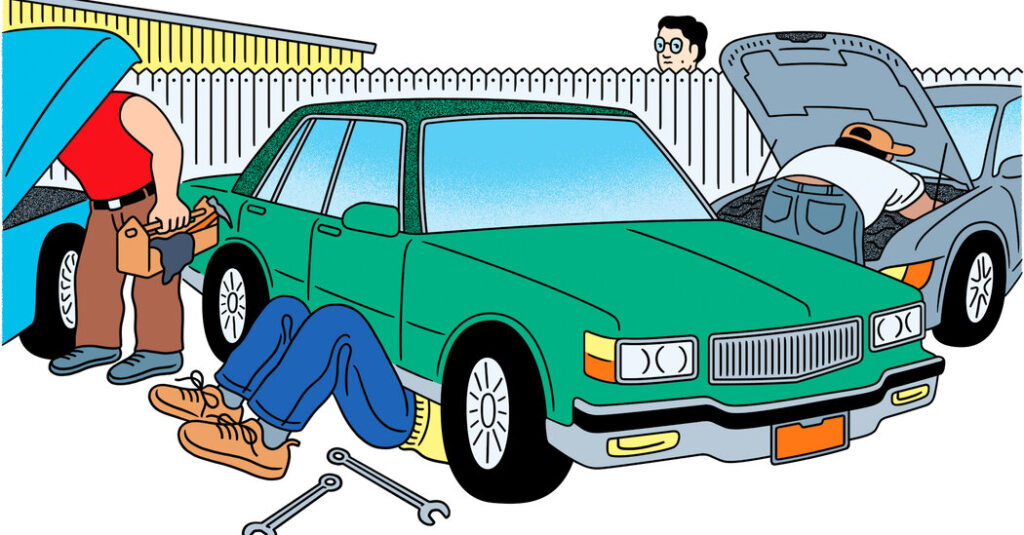
About six months ago, the father’s auto-shop location apparently became unavailable. He and his mechanics now work on cars in their yard and driveway. At times, 15 cars line their driveway and fill the front yard, in obvious states of repair — hoods up, engines removed. This “shade tree” business practice is illegal in our city, and the number of cars and the manner in which they are parked violates city codes. We and our neighbors worry it’s driving down the property value of adjacent homes, and we plan to sell within a few years.
I’m uncomfortable raising this with the family because I doubt they can do much without losing income. Moving to a new garage would obviously be costly. And if I talk to them and the outcome is unsatisfactory, I’d be the obvious culprit for any report to the city. Our friendly terms would disappear.
I’m also reluctant to report because the family is from Venezuela. (They mentioned having green cards, though I never asked.) I’m afraid that even a code violation could draw attention from ICE, which has an aggressive, unpleasant presence in my city. Thoughts? — Name Withheld
From the Ethicist:
As your letter illustrates, when people are alienated from the government in one domain, the alienation readily spills over into others. And so you’re understandably pulled in two directions here. Protecting neighbors is a value you rightly give weight to, especially at a time when there’s a widespread fear that federal power is being exercised without meaningful restraint. At the same time, the stakes for you and others on the block can’t be dismissed.
What you’re describing goes beyond unsightliness. Auto repair, at this sort of scale, can put heavy metals, oils and solvents into runoff. Municipalities regulate this sort of thing for a reason. Right now, one household’s workaround is making everyone else on the street worse off.
You say that you don’t want to raise the issue with this family and harsh the neighborly vibe you enjoy. But what would really be unneighborly is failing to alert them. As things stand, anyone on your block could blow the whistle — either to the city (as a code violation) or to the landlord/property manager (as a lease violation). Looking out for the family means telling them that what they’re doing could invite scrutiny, so that they have a chance to head this off.
As it happens, municipal-code complaints, being on the civil-administrative side of things, aren’t generally the kind of thing that summons ICE. (With respect to practices in your jurisdiction: Ask around.) And the landlord could insist that the residence not be turned into an auto-repair site without escalating further. But I also appreciate that in a moment like this, the margin for error may feel perilously thin.
A neighborly move might be to approach the family with someone from another household on the block. The aim would be to make sure they grasp that the situation leaves them vulnerable to complaints and to consequences they may not anticipate. Let them know that you and others appreciate their presence — but not all those vehicles under repair.
A Bonus Question
My 23-year-old daughter hasn’t heard from her father in years. I divorced him when she was 5; the last time she spoke with him was when she was 16. Lately, she has been expressing more interest in understanding him. She recently visited her paternal grandfather, who said he hasn’t seen or heard from him in years either. Her aunt said the same and told my daughter she occasionally looks for him.
I did a quick search of public records and found police reports documenting his transient life and evidence of mental illness. The reports are, unsurprisingly, unflattering. I don’t believe my daughter knows how to search public records, but when she does, she’s likely to come across these reports.
What is my responsibility in sharing this information with her? Do I withhold it unless she asks, or do I tell her, knowing that discovering it on her own could be traumatic? I also fear that if she later asks whether I knew and hadn’t told her, the omission could be traumatic as well. — Name Withheld
From the Ethicist:
Your daughter is an adult, and she’s entitled to know the truth about her biological father. Plainly, she has questions to which you have the answers. The possibility that she’ll find the answers upsetting isn’t a reason to withhold them. And it will erode trust if you keep her in the dark about public information that she’ll eventually figure out how to obtain.
What you can do is to help her process the revelation by preparing her, by being around to provide context and care. Instead of dumping all the details immediately, you might start with the bigger picture, not least his apparent struggles with mental illness and instability, and let her signal how much detail she wants. Once she knows the basic situation, she’ll want someone to talk with as she decides what to do next. Waiting until she figures out that she can do public-record searches is not a good option; a painful discovery could well become a lonely one as well.
Readers Respond
The previous question was from a reader who recently realized that her family’s “origin story” could not be true, and wondered whether she should keep that discovery to herself. She wrote:
“I grew up proud of my Polish American heritage, listening to stories about the perilous journeys of family members — not distant ancestors, but my own maternal grandparents, aunts and uncles — as they made their way from war-ravaged Europe to America in 1950. … They shaped how I understood myself and my place in the world. As I grew older, I read many authoritative historical accounts of World War II, and things about my family’s history began to seem … off. Now in middle age, I’ve come to the hard realization that the stories I was told cannot be true. … My question is whether I should ask my mother about it and gently reveal what I have discovered. Or do I just keep my truth to myself? I suspect there is nothing to gain, but I am feeling very lost and unsettled. — Name Withheld”
In his response, the Ethicist noted:
“Ernest Renan, the 19th-century historian, observed that ‘forgetting, and I would even say historical error, is a crucial factor in the creation of a nation.’ He wasn’t being cynical. He believed that nations require a selective, simplified, often mythologized past to sustain a coherent identity. Family stories can be a bit like that. The social and psychological work they do can come at the expense of accuracy. … Your verdict that these stories ‘cannot be true’ may be historically justified, but it’s worth thinking about what they signified. … For some people, these narratives are identity scaffolding; for others, they’re closer to folklore. So proceed with deliberation and care. But the importance of the stories to your family isn’t a reason to stay silent; it’s a reason not to. In matters of significance, it’s generally better to live in the light of truth. … What you have to gain is the possibility of living more honestly.”
(Reread the full question and answer here.)
⬥
Ask your mother about your family’s emigration from Poland. You deserve to know the truth about your family, and she may or may not be able to clarify the story. Too many of us wait until our elders are gone and then kick ourselves for not asking the questions that now haunt us. Don’t let that happen to you. — Mark
⬥
Myths and legends are part of the human character. Did Paul Bunyan really have Babe the Blue Ox? Did George Washington really chop down that cherry tree? Does it matter? Your family is important. The back story is not. The legend can hold you together. Don’t tamper with it. — Jimmy
⬥
A similar experience played out in my family about 15 years ago. My sister began working as an archivist at the state library, and after poking around in our family’s genealogical and historical records, we realized that stories about our family’s history in the United States (including our racial background) were at least partly false or exaggerated. My siblings and I knew that sharing this with my mother’s family would only cause them to dig in their heels, so we chose to shrug our shoulders and avoid bringing it up. We know the truth and won’t perpetuate the stories to future generations. — Cam
⬥
My family also had a founding story accepted as true by all of us. As it happens, there are documents relevant to the story in archives that are easily accessible. I read the documents and discovered that the family myth was off in several key respects. A cousin, curious about another founding story, accidentally discovered that a revered ancestor (renowned for his honesty) was actually involved in a legitimate business with a famous gangster. We both circulated our findings to all our cousins. Everyone’s response: “Gee, that’s kind of interesting.” Followed by silence. Accurate historical facts had absolutely no impact on our family’s identity or solidarity. — Richard
⬥
Family origin stories are a form of folklore. They tell you what the people in your family thought was important to teach younger people about how to be a good person and how to overcome difficulties. They are not academic histories and are not meant to convey literal truth. Your pride in being the descendant of people who conquered the mountains in their lives helped you become the person you are today. You can become the family historian and try to interview elders to tease truth from these tales, but that doesn’t, and maybe shouldn’t, take the folklore out of circulation. Literal truth and the stories we tell to help the next generation become better and stronger can exist side by side. — Janis
The post My Neighbors Are Running an Auto Shop in Their Driveway. What Should I Do? appeared first on New York Times.