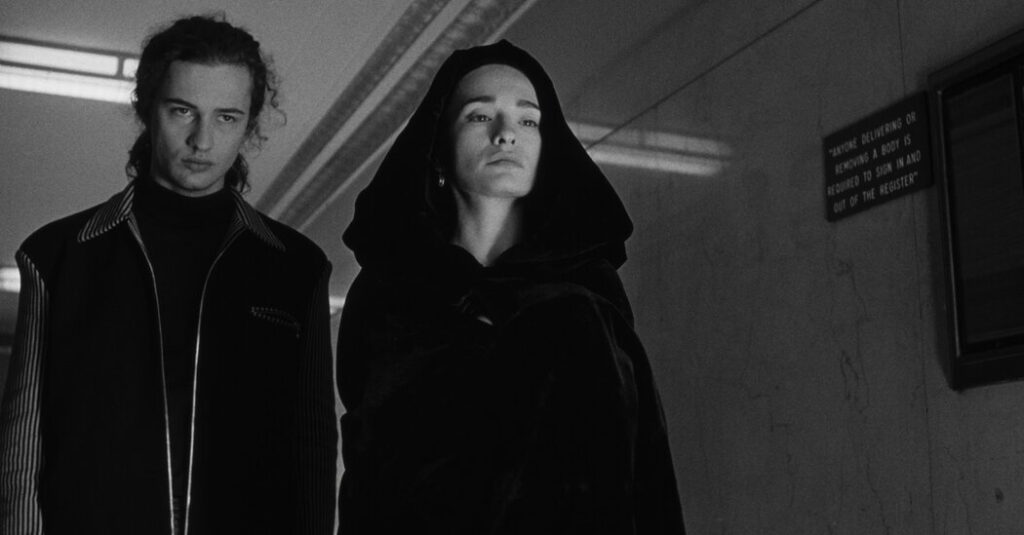
A stylish mash-up with an offbeat cast, Michael Almereyda’s 1995 film “Nadja” takes its title from André Breton’s surrealist novel of Parisian happenstances and transposes the premise of the 1936 chestnut “Dracula’s Daughter” to ungentrified, if elegantly black-and-white, NoHo.
The movie is a triumph of low-budget filmmaking, which, shot in part with a toy PXL camcorder and newly restored in 4K, will shimmer for a week on the screen at Brooklyn Academy of Music.
Having departed Romania for Lower Manhattan, Nadja (Elina Lowensohn, herself Romanian-born and at the time a star of New York indies) regards the city as even “more exciting after midnight.” Caped and cowled, she trawls downtown bars for prey which, given her chic, mysterious allure, she has little difficulty in attracting.
Still, not quite the free spirit of her literary namesake, Nadja is suffering an identity crisis. The death of her emotionally distant father (a count whose long string of names includes Ceausescu and ends with an alternate pronunciation of “Dracula”) inspires her to change her life or at least reestablish contact with her estranged twin brother, Edgar (Jared Harris), a lapsed vampire who lies ill in Brooklyn, cared for by the innocent Cassandra (Suzy Amis).
“Nadja,” which was R-rated, appeared a dozen years into the AIDS crisis, and some saw it as reflecting the epidemic. Vampires are inevitably linked with sexually transmitted disease (Bram Stoker’s “Dracula” has been called the great 19th-century syphilis novel) but three decades after its original release, Almereyda’s film seems even more concerned with dysfunctional family ties.
The Dracula kids are entangled with the enemy Van Helsing clan headed by Peter Fonda, who plays the veteran vampire hunter in an Edwardian suit and a longhaired fright wig. (“When he wheels his bicycle into a hallway, bicycle clips attached to his trousers, he has come a long way from ‘Easy Rider,’” Caryn James noted in her sympathetic New York Times review.) Van Helsing’s clueless nephew (Martin Donovan) is married to Nadja’s equally hapless victim (Galaxy Craze), a normie who keeps a pet tarantula. Edgar’s nurse is a long-lost Van Helsing. (The vaguely incestuous feel is accentuated by the executive producer David Lynch’s cameo as keeper of the crypt.)
“Nadja” is very much a neighborhood film. Almereyda’s use of desolate downtown locations is reminiscent of Martin Scorsese’s in “After Hours” (1985). NoHo alleyways provide an instant netherworld and the illuminated windows of the old Tower Records on Broadway and East 4th Street are a notable effect. “The dead travel fast,” Van Helsing warns, and indeed, the woods of Transylvania feel but a subway ride away.
A child, perhaps meant to be a young werewolf, hops through the underbrush in a Mouseketeer cap. It seems a non sequitur, but once back on native soil, Nadja waxes nostalgic, confessing she’d been “homesick without knowing it.” As though replaying the film in her head, she explains that she found America “too confusing,” a realm of “too many possibilities.”
The fog never lifts. “Nadja,” which was shot by Jim Denault, is as much an atmosphere as movie. At once literal and fantastic, often droll and at times rhapsodic, it ultimately appeals more to the eye than the mind. That’s not a complaint.
Nadja
Through Feb. 12 at Brooklyn Academy of Music; bam.org.
The post In ‘Nadja,’ Dracula’s Daughter Goes Downtown appeared first on New York Times.