The U.S. aid cuts in Afghanistan were as sudden as they were brutal. Even after the U.S. withdrawal and the end of the war in 2021, the United States continued pouring money into Afghanistan. From the 2021 Taliban takeover until last year, Washington had provided nearly $1 billion annually — over a third of all aid flowing into one of the world’s poorest countries. That funding has all but evaporated with the dismantling of the U.S. Agency for International Development.
The agency’s programs once helped clear landscapes scarred by war and mines, diversify crops and keep millions from hunger. Four million children are now at risk of dying from malnutrition, according to the World Food Program, the most in a quarter-century.
“The U.S. withdrawal exacerbated an already bad situation,” said Sherine Ibrahim, a former head of the Afghanistan office of the International Rescue Committee, which received three-quarters of its funding from the U.S. government. “No other donor has stepped in and no one will in those proportions.”
Nearly 450 health centers closed because of the cuts, including a tiny white building in the drought-stricken village of Nalej, where Malika Ghullami safely gave birth to two children in past years and was pregnant again with twins last year.
After the midwife and nutritionist left Nalej, however, Ms. Ghullami had to be driven on a spine-jarring dirt track to another clinic more than an hour away when she felt the first labor pains one morning this winter.
One twin was stillborn, and the other survived only a few hours.
While other factors may have contributed, Ms. Ghullami also blamed her inability to go to the distant clinic for regular checkups. Other mothers in Nalej’s area recounted losing children after struggling to reach distant clinics, and nurses say they are treating more women who lost blood during long journeys or delivered in taxis.
“They were solving our issues,” Ms. Ghullami, 34, said of the staff in the now-shuttered clinic in Nalej. “Now we’re left on our own.”
While funding has shrunk, needs have increased. More than 2.8 million Afghan refugees were expelled or forcibly returned from Iran and Pakistan last year and now live in communities struggling to absorb them. Two deadly earthquakes that struck the country last summer and fall left thousands homeless, often in isolated valleys.
Other international institutions, the Afghan government and private businesses have tried to fill the gap, but they are nowhere close to matching the size of American aid. The crisis has been exacerbated by smaller but still painful reductions in aid from European countries.
“We can only provide them with cash,” said Naimatullah Ulfat, a government official in the southern province of Kandahar. “The food, the clothes and other forms of assistance nongovernmental organizations were providing, we can’t. It’s going to be very difficult.”
The Trump administration has resumed sending aid to some crisis-hit countries, but not Afghanistan. A bill currently in the Senate would bar the State Department and U.S.-backed international organizations from funding humanitarian programs that might benefit the Taliban, even indirectly.
Hundreds of Health Centers Wiped Out
The isolated province of Daikundi has lost many of its health clinics to the U.S. aid cuts.
The clinic in Nalej, surrounded by parched fields of almond and mulberry trees, was a lifeline for 850 families. The villagers say its closure has hurt children the most.
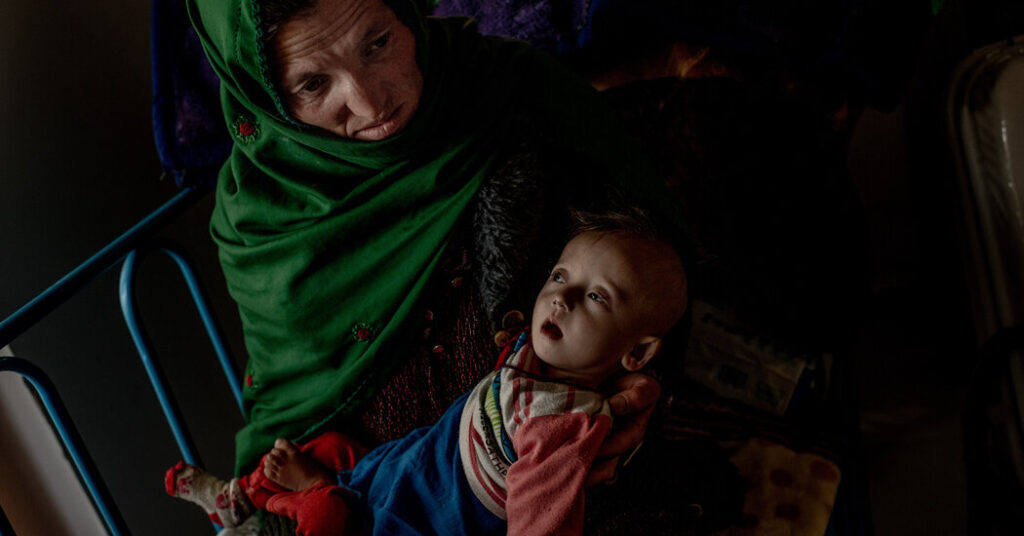
Zakia, 3 months old, has been vomiting since birth and her condition is deteriorating, said her mother, Sharifa Khawari. For weeks, she hoped her husband would bring back enough money from the coal mine where he worked to finance a taxi ride to the nearest clinic. But she said his pay was barely enough to put food on the table.
The loss of the clinic erased years of monitoring that had saved children’s lives.
“When I was giving birth, we were losing babies,” said Nik Bakht, Ms. Khawari’s mother-in-law. “One would hope that younger mothers these days wouldn’t face that.”
Other clinics are struggling to stay open. Benazir Muhammadi, 32, a nurse at a clinic run by an Afghan nonprofit, MOVE, in a remote valley of Daikundi, worked without pay for three months after U.S. funds ran out. The clinic had to let go of its nutritionist.
“Proximity health care centers are an absolute necessity,” she said. “You simply cannot wait when you’re about to deliver.”
Rising Malnutrition
In 2024, the United States funded over half of Afghanistan’s nutrition and agricultural programs. Food insecurity has skyrocketed since last year’s cuts. More than 17 million Afghans — 40 percent of the population — now face acute levels of hunger, two million more than last year.
Seven provinces face critical food insecurity, the final stage before famine, according to the Integrated Food Security Phase Classification, a group of international organizations that the United Nations and aid agencies rely on to monitor global hunger. None were at this level a year ago.
Malnutrition is also hitting cities, affecting the most vulnerable — the very young, sick and elderly — first, as it does elsewhere. Muhammad Ali, 9 months old, was one of a dozen toddlers wailing or dozing in a Kabul nutrition ward on a recent morning. He was too weak to ingest milk, said his mother, Karima Malikzada. Her husband’s meager income as a housekeeper means they often eat only once a day.
Afghanistan is projected to lose 5 percent of its national income in 2026 as donors slash aid, according to the Center for Global Development. Researchers warn that will have long-term consequences for children, causing malnutrition that will stunt their development.
“That is a 20 to 30-year impact, not a one-year budget decision,” said Mohammad Mustafa Raheal, a research fellow at Lund University in Sweden who studies humanitarian aid delivery in Afghanistan. “You can’t just ‘switch the aid back on’ later and undo that damage.”
One Shock After Another
The aid cuts have also crippled the response to natural disasters. Months after a summer earthquake killed over 2,200 people in eastern Afghanistan, families whose homes had collapsed still live in tents battered by freezing winds — a mosaic of white dots amid destroyed villages and cornfields.
On a recent morning in Kunar Province, an International Rescue Committee team of a half-dozen health professionals visited Badgor, an isolated village hit by the quake. It was the last mobile team that the organization has kept operating since the cuts, which forced it to disband 33 others. Under a large parasol blocking the winter sun, one of its members examined children who arrived with fever, chest pains and diarrhea. Tuberculosis cases were ballooning; so was despair.
“The aftermath of the earthquake weighs on them,” Sameena Khan Sadat, a mental health counselor, said in between consultations. “They think about it day and night, but we don’t have medication for PTSD or depression.”
Humanitarian groups also face an increasingly hostile environment. The Taliban have barred Afghan women from working in U.N. offices while also diverting the remaining aid to supportive communities, according to SIGAR, an independent agency established by Congress to oversee U.S.-funded projects in Afghanistan.
“The Taliban use every means at their disposal, including force, to ensure that aid goes where they want it to go, as opposed to where donors intend,” SIGAR wrote in a report last year.
Humanitarian workers say aid cuts have hampered their ability to survey the needs of Afghanistan’s population. A major concern remains the returnees from Iran and Pakistan.
At the Pakistan border on a recent morning, a trickle of Afghans passed a U.N. sign reading “Welcome to your sweet country.” Most nonprofit offices there were closed.
“The cuts hit us hardest just as returns and needs increased,” said Ahmad Shah Irshad, a U.N. refugee agency supervisor at a sprawling transit center with hundreds of tents and shelters near the border. “We don’t know what 2026 will be made of.”
Elian Peltier is an international correspondent for The Times, covering Afghanistan and Pakistan.
The post In Afghanistan, a Trail of Hunger and Death Behind U.S. Aid Cuts appeared first on New York Times.