When American forces grabbed Venezuela’s president last month and laid claim to the country’s vast oil reserves, it quickly reverberated in the coastal city of Pascagoula, Miss.
Pascagoula is home to a Chevron refinery that’s one of a handful in the United States that has been processing Venezuela’s heavy crude oil into gasoline, diesel and jet fuel.
Some residents have long complained about air pollution from the 60-year-old facility. They now worry that more Venezuelan oil may be headed to Pascagoula, worsening the pollution they say they are already struggling with.
That’s giving fresh momentum to an unusual proposal by people who live nearby. They’re asking Chevron and other industrial facilities in the city to buy their homes. So far, the company has been noncommittal.
“We’re not against you. We’re not against your employees,” said Barbara Weckesser, co-founder of a group leading the buyout effort, told a Chevron representative at a community meeting in January, cornering him in a historic ballroom dotted with Chevron posters.
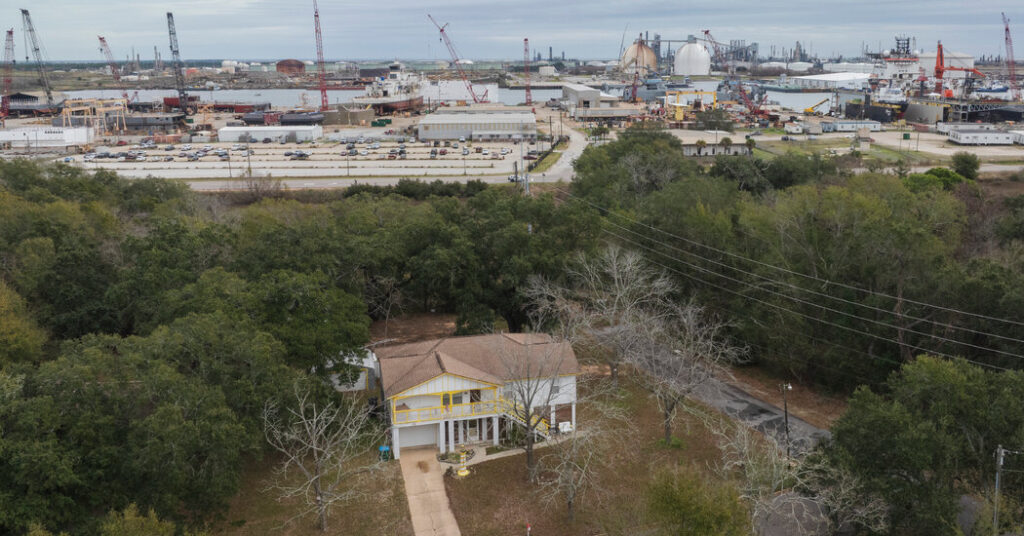
But she did not feel safe in her home in Cherokee Forest, she said, a neighborhood nestled between moss-covered oak trees and marshes of the Mississippi Sound and the refinery, as well as a giant shipyard on the horizon. “We deserve some health, to get the residents that want to be moved out, moved out,” she said.
“I appreciate the information,” the Chevron representative, Ross Allen, told her.
Cherokee Forest is a neighborhood where the salt tang of the Gulf meets the occasional scent of “acid, strong enough to take your breath,” as Ms. Weckesser puts it. Squat homes, many raised on stilts, sit quietly across from a sprawling industrial park, anchored by Chevron, that dominates the coastline. The refinery’s own monitors show periodic spikes in benzene, a carcinogen.
Chevron is the only American company that has continued drilling for oil in Venezuela in recent years, under a special license. As the U.S. government asserts control over Venezuelan production, Chevron is expected to benefit quickly.
Venezuela’s reserves, thought to be the world’s largest, are mostly a thick, heavy oil containing more sulfur and carbon than conventional crude. It requires more energy to extract and refine, making it costlier and dirtier to produce.
President Trump has described Venezuelan oil as “probably the dirtiest in the world.”
Residents say Chevron stands to earn windfall profits from a potential surge of Venezuelan oil into its refineries, money that would help cover their relocation costs. At a White House meeting of oil executives this month, the Chevron vice chairman, Mark Nelson, said the company was prepared to increase production in Venezuela by 50 percent in the next two years.
Chevron had already applied to expand the refinery before the Trump administration’s actions in Venezuela.
Jason Gabelman, an analyst at TD Cowen, an investment bank, estimates that Chevron could see its annual cash flow grow as much as $700 million from increased production in Venezuela.
Mr. Allen, the Chevron representative, said the company “supports efforts to improve quality of life and resilience of the communities around our operations and we have participated in a variety of community discussions about restoration and enhancement of the Cherokee Forest neighborhood.” Chevron remained “open to ways we can collaborate,” he said. “Our employees live in Pascagoula, too, and Chevron will remain an engaged, positive partner.”
Buyouts are rare but not unheard-of. In 2020, Marathon Petroleum announced a $5 million initiative to buy homes in a Detroit neighborhood to create a “green buffer” between the refinery and remaining homes. The Cherokee Forest residents’ proposal also aims to turn their neighborhood, about a mile from the refinery, into forest and marshland as a buffer.
The concerns in Pascagoula underscore the ripple effects of America’s extraordinary effort to seize control of Venezuelan oil production. The Trump administration is pushing for U.S. oil companies to lead a reconstruction of Venezuela’s dilapidated infrastructure. It has blockaded vessels bound for China and elsewhere, prioritizing shipments to refineries along what the Trump administration now calls the Gulf of America.
In recent years, 20 to 30 percent of Chevron’s Venezuelan oil shipments to the United States arrived at Pascagoula, according to Kpler, a global oil monitoring service. Last year, Pascagoula received roughly 10 million barrels from Venezuela, the data shows.
While analysts say it remains unclear how much more Venezuelan oil might ultimately reach the United States, the Chevron refinery in Pascagoula is one of the main Gulf Coast refineries positioned to quickly take more of it. The refinery’s specialized “coker units” can cook the heavy oil at extreme temperatures to crack and refine big molecules into smaller ones.
Refining sulfur-heavy crude uses more energy for heating and processing. That results in higher emissions of planet-warming gases, as well as hazardous air pollutants, research has shown. It also leaves behind petcoke, a solid fuel sold to cement makers and other industrial facilities. Studies have found that petcoke contains heavy metals and other pollutants that can escape during storage and transport.
Chevron says the refinery is fitted with emissions-control equipment like scrubbers and leakproof valves, and runs inspection programs to prevent hazardous materials from escaping into the atmosphere. The refinery has 22 air monitoring stations around its facility, the company said, and also takes steps to minimize dust generation.
The facility “was designed for and is equipped to process heavy, sour crudes like those that come from Venezuela” and it has been “safely processing these crude types for decades,” Mr. Allen said.
Chevron is required to report average fence-line levels of benzene, a carcinogen, to the Environmental Protection Agency, and its quarterly reports show spikes in benzene emissions. The company said its annual average emissions have stayed below levels requiring action.
Pascagoula has long been an industry town, historically centered on shipbuilding. The rich waters of the Mississippi Sound support a vibrant seafood industry.
The city was transformed in the 1960s when Standard Oil, a Chevron predecessor, built its flagship refinery on the oceanfront The refinery, which became a cornerstone of the local economy, has more than tripled its capacity since opening in 1963. Chevron is the largest taxpayer in Jackson County.
The refinery’s growth was accompanied by concerns over pollution.
In a study last year, researchers identified frequent and short-lived pollution spikes in the Cherokee Forest neighborhood that conventional air-quality monitors missed. Chevron said it takes odor reports seriously, and also pointed to the limits of community-based monitoring that relies on basic monitoring gear.
They also looked at sensor data alongside wind logs and residents’ logs of health issues like nausea and burning eyes, correlating emissions spikes with clusters of symptoms. Testing revealed elevated nickel levels in children’s nail clippings, which researchers attributed to ingesting industrial dust.
“We could see from wind monitoring that the episodes were occurring when the wind came from the direction of industry, which suggests that’s their origin,” said Caroline Frischmon, an air-quality scientist at the University of Colorado Boulder who led the study.
It can be a harrowing existence, some residents say. In July, an explosion at the Chevron refinery seriously injured five workers who are now suing Chevron.
Under a 2018 consent decree, Chevron was required to spend more than $160 million in civil penalties and safety upgrades. The settlement followed accidents including a fatal explosion at the Pascagoula refinery in 2013.
Mike Devine, who grew up in Pascagoula, said he still remembered a night three decades ago when he witnessed what looked like a fireball. “I was at the house — and boom,” he said. “A matter of seconds, and in front of the windows were orange.”
In 2023, Concerned Cherokee Citizens petitioned the E.P.A. over its approval of a plan by Chevron to produce fuels from discarded plastics, arguing it would add to neighborhood pollution. In late 2024, the Biden administration withdrew that approval. Chevron said it had no plans to restart that process.
The state has received funding to address residents’ concerns. The Mississippi Department of Environmental Quality received a federal grant of $625,000 in 2022 to conduct a yearlong air-quality study in Cherokee Forest. Testing has yet to begin.
Pascagoula faces hazards from both pollution and from the storm and flood risk that is intensifying as the world warms and sea levels rise. Nearly a third of properties in Cherokee Forest are already empty, mainly abandoned after devastating flooding from Hurricane Katrina. A survey by Cherokee Concerned Citizens found that a majority of residents favored relocation.
Communities along the Gulf Coast are facing “the compounding hazards of industrial pollution, and threats of climate extremes,” said Kelly Leilani Main, executive director of Buy In Community Planning, which is helping residents draw up relocation plans.
Under that plan, repurchased land would be converted into forests, waterways and wildlife habitats, alleviating flooding, helping filter emissions and offering homes for wildlife.
It hasn’t put a price tag on the project, but buying out Cherokee Forest neighborhood homes at market prices could cost in the range of $15 million, based on listings for typical local homes. Residents are also asking for relocation funds.
Residents say that would be pocket change for Chevron. “Let them drill over there, do what they’ve got to do,” said Julie Hambey, who has lived in Cherokee Forest for more than 30 years and who works at a nearby Walmart. “Just get us all out.”
Support isn’t unanimous. Billie Jo LeBlanc, who has lived in Cherokee Forest for two decades, said she felt some neighbors were overstating the risks. It was unreasonable to blame pollution for so many health problems when they could have other causes, she said.
“I’m not convinced this neighborhood is polluted beyond repair,” she said. “Yet they want to uproot our entire lives.”
Local officials say they are searching for a compromise. Darcie Young, a city councilwoman who represents the neighborhood, said Pascagoula could first focus on the already-empty plots and reforest those, collecting data on how those spaces might act as a pollution buffer.
“I’d like to see some of the science happen before we start moving people out of the city,” she said. It ultimately comes down to, “How can we make it a nicer place to live?”
Blacki Migliozzi contributed reporting.
Hiroko Tabuchi covers pollution and the environment for The Times. She has been a journalist for more than 20 years in Tokyo and New York.
The post In a Mississippi Bayou, Venezuelan Oil Is Already Big. And Could Get Bigger. appeared first on New York Times.