Last April the acting head of Immigration and Customs Enforcement pledged to run the agency with the ruthless efficiency of Amazon. Mass deportations, he said, should be “like Prime but with human beings.”
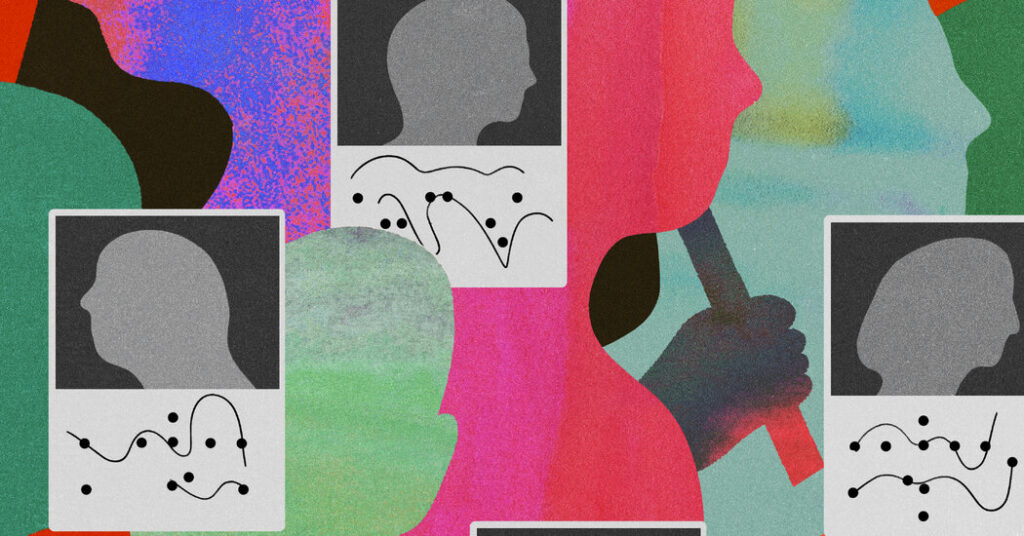
What followed has been anything but logistically impressive. But one feature of President Trump’s crackdown on immigration does seem beamed in from a seamless law-enforcement future: the suddenly ubiquitous use of facial recognition technology to identify not just those whom federal agents suspect are in the country illegally but also those who are protesting, interrupting or simply documenting the nationwide nativist dragnet.
In video after video recorded by protesters and observers in Minneapolis, you can see that the agents are also filming the observers, in a sort of mutual surveillance state, I wrote last month (and one that my colleague Tressie McMillan Cottom covered this week). But in truth, it isn’t really mutual. The Department of Homeland Security has tried to criminalize journalism by characterizing reporting as doxxing and observing as impeding law enforcement, and its agents are now threatening and sometimes assaulting people who record them — an effort to secure, in addition to the state’s monopoly on violence, a monopoly on surveillance. This may be another reason so many immigration officers are masked while on duty: They know better than we do what it means to show one’s face. In Minneapolis and elsewhere, agents now carry tools of surveillance into the field, just as they do their guns.
The most prominent of these phone-based facial recognition apps is Mobile Fortify, which ICE has claimed can deliver a definitive determination of someone’s immigration status but has already bungled IDs. As Joseph Cox of 404 Media reported, it has even identified the same woman as two people, neither of whom was her; the outlet also reported that local law enforcement officers working with the Department of Homeland Security use a different product, Mobile Identify.
There are also reports that officers are using a tool developed by Clearview AI — which the department acknowledged in a contract with the company last fall would be deployed to monitor assaults against law enforcement. Another app used by D.H.S., Webloc, reportedly allows law enforcement officers to identify particular phones and track their movements without a warrant; Tangles apparently monitors social media to make dossiers on people of interest, including location information scraped from their public social media posts.
We don’t know yet quite how all of these tools fit together or what purpose the information gathered about protesters and observers will be put to — a viral video of an ICE agent telling an observer, “We have a nice little database” and “Now you’re considered a domestic terrorist, so have fun with that,” has produced denials from the Department of Homeland Security, with a department spokeswoman telling CNN that there is “no database of domestic terrorists run by D.H.S.”
The contracts for many of these tools are relatively small, by federal expenditure standards, running just in the low millions of dollars. And surveillance technology is one area where the alarmists and the boosters tend to echo one another in describing the power of the new tools. But while it is a familiar warning from civil libertarians that surveillance tools introduced in one narrow context will quickly be deployed in other, more worrying ways, immigration agents appear already to have made that jump, turning their apps on citizens who aren’t doing anything illegal beyond expressing hostility to the vision of state power embraced by MAGA and embodied by its mostly masked immigration enforcement army.
These revelations have arrived against an unnerving backdrop of public pronouncements. In September the president issued two expansive executive orders concerning those he’s called “the enemy within,” designating antifa as a domestic terrorist organization in one and in the other purporting to investigate progressive nongovernmental organizations as anti-American groups engaged in political violence and to unleash federal law enforcement to target them.
A memo from a Department of Homeland Security official reviewed by CNN and sent to agents dispatched to Minneapolis last month asked them to “capture all images, license plates, identifications and general information” on “agitators, protesters, etc. so we can capture it all in one consolidated form.” And the official reportedly provided such a form, called “intel collection.” Last month Tom Homan, the president’s border czar, bragged to Fox News about how he was pushing to “create a database where those people that are arrested for interference, impeding and assault — we’re going to make them famous.”
But Homan, Trump, his adviser Stephen Miller and the homeland security secretary, Kristi Noem, haven’t conjured a new surveillance state out of whole cloth. We are now several decades into the militarization of American law enforcement and the expansion of the homeland security mandate, which have together yielded an unnerving mix of imperial impunity and national-security-style policing that the historian Nikhil Pal Singh has called a new form of “homeland empire.” Last May, researchers at Georgetown Law republished a 2022 report, “American Dragnet,” which found that ICE spent $2.8 billion on expanded surveillance capabilities from 2008 to 2021. The spending had nearly tripled since 2015, and most of the increase was invested in geolocation.
These are not the kinds of investments or tools that go wasted, with new technologies typically spreading from intelligence agencies to battlefields abroad and then to federal law enforcement agencies and eventually down the food chain to local police departments. By 2022, the researchers found, ICE had already scanned the driver’s license photos of one-third of American adults and had access to the information contained on a typical license for many more. It was tracking the movement of drivers in cities home to three-quarters of American adults and could locate three-quarters of American adults through their utility records.
This was before the Department of Homeland Security entered into an agreement with Palantir for tools enabling ICE to track self-deportations with near real-time visibility and another that allows it to map potential deportees. It was before an executive order was issued in March aimed at eliminating “information silos,” integrating data across the federal government and making it more easily available across agencies.
It was before Congress tripled the ICE’s budget, before the State Department acknowledged that Tufts University’s Rumeysa Ozturk had essentially been arrested because she had helped write a student newspaper opinion essay critical of the war in Gaza, before an activist was arrested after wiping his phone before federal agents had a chance to search it, before the F.B.I. began an investigation into Signal groups dedicated to tracking the activity of immigration agents in Minneapolis, before the Department of Homeland Security began bullying its critics with secretive administrative subpoenas. It was before observers of and protesters against Trump’s immigration army began reporting that federal agents were addressing them by name.
“It’s totally unprecedented, what they’re doing,” David Bier of the libertarian Cato Institute told me. “They feel like they can point their phone at anyone who walks by, at any car, at any driver and instantly find out everything they want to know about that person.”
This may not feel like a significant escalation, given how police officers routinely radio in to check the records of those they’ve pulled over, for instance. But giving indiscriminate checkpoint-style power to every agent in the field, Bier said, is “a total reshaping of law enforcement in the United States.” Instead of investigating a crime by identifying a suspect and then pursuing information about him or her, officers instead begin with someone they want to treat as a criminal and then use the technology to find a justification. “This is so far from any type of typical law enforcement activity that I can’t even think of a parallel,” he said. “It’s entirely backward, and it’s all enabled by this technology.”
“We’ve seen cases where agents show up at people’s houses. Sometimes they’re following them home. Sometimes they’re showing up another way,” said Nathan Freed Wessler of the A.C.L.U. “How did they figure out who that person is and where they live?”
“They say, ‘We want to map the insurgency,’” Bier said. But any effort like that “is transforming these people from not a legitimate target of government to people who, if they die, no one in the government is going to shed any tears. We see that with Renee Good. We see that with Alex Pretti.” Bier continued, “I mean, once you transform someone into a domestic terrorist, that’s it.”
“The point is they’re trying to silence dissent by scaring people,” Wessler said. “They’re doing that in large part in violation of the law. And I think that part of their hope may be that if they do it at enough volume, it’ll just overpower the ability of people and the judicial system to resist.” For now, he said, the backlash has been striking — in public opinion, in the courts and in the streets. And in the future? “We’ll just have to see,” he said.
The post ICE’s New Surveillance State Isn’t Tracking Only Immigrants appeared first on New York Times.