Officials in Georgia filed a court challenge Wednesday seeking the return of scores of election records seized by federal agents last week from a warehouse in Fulton County, which has been central to right-wing conspiracy theories about President Donald Trump’s loss in the 2020 presidential election.
Robb Pitts, chairman of the Fulton County board of commissioners, vowed county officials would use “every resource” to secure ballots and other material and cast the court fight as part of a broader effort to ensure the future of independent elections.
The county’s motion, which was filed under seal in federal court in Atlanta also asked the judge to unseal the investigative affidavit that agents submitted to secure their search warrant, Pitts said.
“Our very constitution is at stake in this fight,” he said at a news conference, adding later: “This case is not only about Fulton County. It’s about elections across Georgia and across the nation.”
Trump has long maintained that the 2020 election, which he lost to Joe Biden, was rigged, but U.S. national security officials have said they found no evidence of widespread fraud and numerous courts rejected claims of election irregularities as unfounded.
Despite that, conspiracy theories about the election — especially its administration in Fulton, Georgia’s most populous county — have remained a fixation for the president and his allies six years after his defeat. The county was where, in January 2021, Trump tried to persuade Georgia Secretary of State Brad Raffensperger (R) to “find” enough votes to reverse Biden’s win.
Trump’s focus on the county intensified after a Fulton County grand jury indicted him and 18 associates on racketeering charges in 2023 over their alleged efforts to overturn election results. The case, led by the county District Attorney Fani T. Willis, was dismissed in November after legal stumbles.
Just last month, Trump vowed “people will soon be prosecuted for what they did” as he bemoaned his 2020 loss during a speech at the World Economic Forum in Davos, Switzerland.
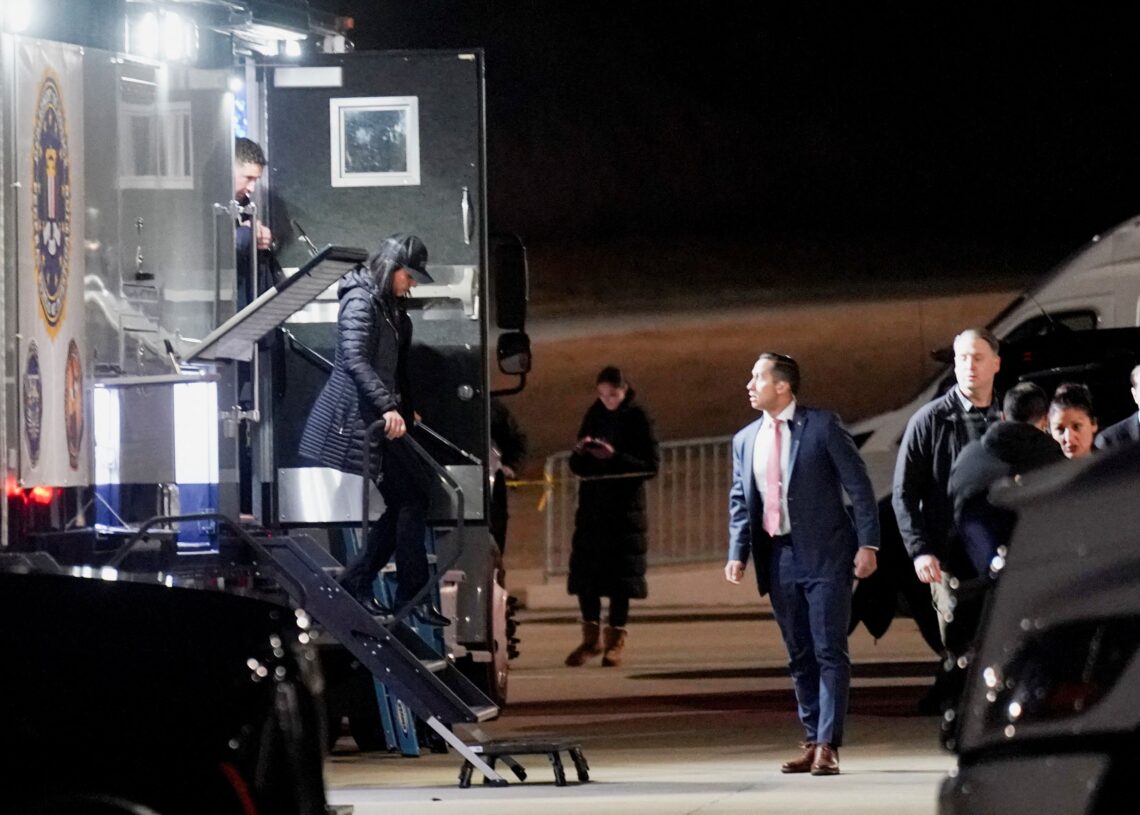
Agents spent several hours last week sifting through documents at the Fulton County warehouse, eventually leaving with what county elections chief Sherri Allen described as 700 boxes of records. The FBI’s deputy director, Andrew Bailey, and Tulsi Gabbard, the director of national intelligence, were present throughout the search.
A copy of the warrant obtained by The Washington Post said the Fulton County search was part of a criminal investigation into possible violations of federal laws — one regarding officials’ retention and preservation of election records, and the other criminalizing efforts to defraud voters from an impartially conducted election.
The warrant authorized agents to seize all physical ballots from the 2020 election, voting machine tabulator tapes, images produced during the ballot count and voter rolls from that year.
It listed Thomas Albus — the recently confirmed U.S. attorney for the Eastern District of Missouri — as the prosecutor overseeing the investigation. Attorney General Pam Bondi recently appointed Albus to a special role within the Justice Department investigating election integrity issues nationwide.
An official from Gabbard’s office said in an email Monday that her trip to Georgia “was requested by the President and executed under her broad statutory authority to coordinate, integrate, and analyze intelligence related to election security.”
The director of national intelligence has no operational authority. Gabbard accompanied Bailey “in an observer role,” said the official with her office, who spoke on the condition of anonymity because they were not authorized to discuss the matter.
After news of Gabbard’s participation in the raid broke last week, the top Democrats on the House and Senate intelligence committees demanded an “immediate” briefing on her actions.
“Your recent actions raise foundational questions about the current mission of your office,” wrote Rep. Jim Himes (D-Connecticut) and Sen. Mark R. Warner (D-Virginia).
In a highly unusual move, Gabbard met with some of the FBI agents who executed the search warrant and called Trump from that meeting, according to a person familiar with the matter, who also spoke on the condition of anonymity because they were not authorized to discuss it.
Trump initially did not answer but called back a short time later and spoke to the FBI agents, thanking them for their work on the case. The FBI declined to comment on the call, which was reported earlier by the New York Times.
In a letter to Himes and Warner released Monday evening, Gabbard defended her presence during the Georgia search, saying it was requested by Trump. Gabbard also said she met with the FBI agents at the bureau’s Atlanta field office and “facilitated a brief phone call for the President to thank the agents personally for their work.”
“He did not ask any questions, nor did he or I issue any directives,” Gabbard wrote.
On Tuesday, Warner portrayed Gabbard’s role as “an effort to try to curry favor with the president” by overstepping her authority as the nation’s senior intelligence official.
“I’m deeply concerned about it spreading to other states,” Warner said, adding that he was not aware of any further planned raids.
“This is not about the 2020 election,” Warner said, instead framing the investigation as an attempt to seize states’ constitutional authority to manage the polls. “If it doesn’t scare the heck out of you, it should.”
Pitts echoed those concerns at his news conference Wednesday. Gabbard’s presence during the search, he said, suggests “there is something sinister going on here” that was bigger than just an FBI investigation.
He said he had been warned two days before FBI agents descended on the county that he and other Georgia elections officials would be arrested within days. Although the threat has not panned out, Pitts said he received another warning call Monday morning.
Pitts declined to specify who sent the warnings, except to say it was a knowledgeable person in Washington.
On Monday, Trump told right-wing podcaster Dan Bongino — who recently stepped down from his role as deputy director of the FBI — that Republican lawmakers “should take over the voting … in at least 15 places.”
Trump continued to falsely claim he had won states he lost during his conversation with Bongino and said “some interesting things” could emerge in Georgia, though he did not detail the findings of the FBI search.
Though the details of their court filing Wednesday remain sealed, county leaders have said they want to retrieve the records taken by the Trump administration and forensically audit the documents.
“To some extent, it’s almost too late at this point because the chain of custody has been broken,” Fulton County Commissioner Marvin Arrington Jr. said Monday. “They could add 11,000 records or lose 11,000 records … and we don’t have any way to counter any false narrative they come up with.”
Arrington said the false perception that Trump won Fulton — a deep-blue county that is home to Atlanta, the state’s capital — has persisted despite multiple recounts, audits and a clean bill of health from Republican state leaders.
“He believes he won the 2020 election,” Arrington said of Trump. “It’s a full-frontal attack on democracy.”
Mariana Alfaro, Ben Brasch, Noah Robertson, Perry Stein and Warren P. Strobel contributed to this report.
The post Fulton County goes to court to demand return of ballots seized by FBI appeared first on Washington Post.