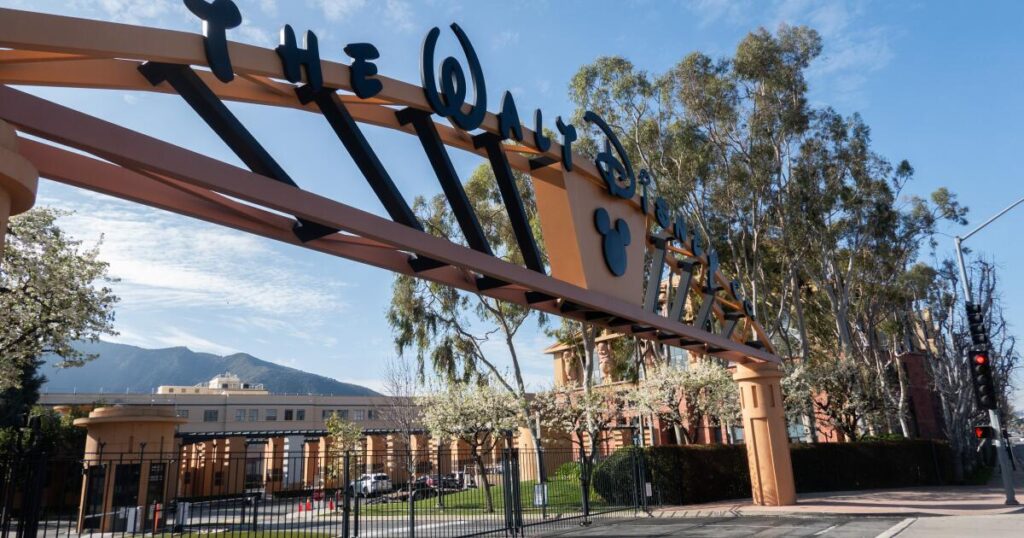
Casual conversation in Hollywood often drifted to a familiar question: “Will Bob extend his contract again?”
Walt Disney Co.’s board had initially set Chief Executive Bob Iger’s target retirement date for 2015. The board instead renewed his contract multiple times, then called him back in 2022 — nearly a year after he had retired — when the last leadership handoff famously unraveled.
Disney’s struggles with succession over the decades have become epic dramas filled with false starts, larger-than-life leaders reticent to go and allegations of hollow searches for a new CEO. Twenty-plus years ago, one candidate for the top job — former Ebay and Hewlett-Packard chief Meg Whitman — withdrew from the running, suggesting the fix was in.
Disney’s board at the time wanted to give Iger, a longtime ABC executive who had toiled years in the shadow of former Chief Executive Michael Eisner, a shot.
With all that history, Disney’s board recognized its imperative of choreographing a meticulous transition. Iger, 74, was ready to go, and the process to find his successor was certain to go under the microscope.
“We had to be open — we couldn’t be questioned on it,” Disney Chairman James Gorman told The Times in an interview to shed light on what, until this week, had been a closely guarded boardroom process. “We didn’t just want to have this as a rigged game.”
This week, Disney’s board unanimously approved the selection of 54-year-old parks chief Josh D’Amaro to succeed Iger on March 18 when the company holds its annual meeting with shareholders. The switch will mark the end of an era, as Iger has been a towering presence in Hollywood for more than 20 years.
Two years of planning led up to D’Amaro’s selection. When Iger’s last successor, Bob Chapek, was ousted in November 2022, Disney’s board announced that Iger would return to serve as CEO for just two years.
But a series of high-level executive departures had thinned Disney’s executive bench. The board later acknowledged it needed additional time to plan succession and Iger’s contract was extended again, this time to December 2026.
Gorman — a former chairman and chief executive of Morgan Stanley — joined Disney’s board in the fall of 2024. He became chairman in January 2025 and succession planning began in earnest. Unlike in early 2020, when Iger was in charge of the board that tapped Chapek, this time the board formed a succession committee comprised of current and former CEOs of different firms.
The committee, led by Gorman, included General Motors Chief Executive Mary Barra, former CEO of Lululemon Athletica Calvin McDonald; and the former head of Britain’s Sky broadcasting, Sir Jeremy Darroch.
The search began with a list of about 100 potential candidates, Gorman said, including names provided by search firm Heidrick & Struggles. The group eventually culled the list to 30, he said, then narrowed it even more. They met with a few outsiders.
“We wanted to see what was out there … but it’s always difficult to go outside for any company,” Gorman said, adding that typically happens during a crisis, such as an abrupt CEO retirement due to illness or some other unforeseen event.
“You don’t take somebody from the industrials world and plop them in a media company,” he said. “That’s just too big a lift.”
Increasing the challenge, the 102-year-old company has a distinct corporate culture — one that still pays homage to founder Walt and instills in its employees (known internally as cast members) the need to serve as guardians of Disney’s treasured characters and brands.
Any outside pick would have been a risky bet.
Four Disney executives were under evaluation. D’Amaro, television and streaming chief Dana Walden, movie chief Alan Bergman and ESPN Chairman Jimmy Pitaro were all viewed as contenders for the job.
The board spent months sizing up strengths and weaknesses of external and internal candidates. Candidates made presentations to the board, laid out their visions for Disney’s future, received mentoring from Iger and spent hours meeting with Gorman and other succession committee members as well as the full board.
Hopefuls were questioned on their visions for the company. They were quizzed about such topics as teamwork and corporate culture.
“We wanted to know that whomever we picked beat all comers,” Gorman said. “And our people stress-tested unbelievably well. Yes, the [Disney executives] were given a huge advantage because they understand the culture, it’s a very unique culture, but it wasn’t just that.
“They were capable and they were ready,” Gorman said.
The board increasingly became comfortable with D’Amaro — who joined the company 28 years ago in Disneyland’s accounting division. For the past six years, D’Amaro has run Disney’s parks and experiences division, which now is the company’s largest business unit amid the decline of traditional television.
The board also carved out a new role as president and chief creative officer for longtime television executive Walden, 61, who becomes the first woman to serve as Disney’s president.
Gorman said Walden, 61, was impressive.
“She’s a strong leader. She’s decisive. She’s got great creative chops,” Gorman said. “She’s worked well with Alan Bergman as co-chair of entertainment. The idea is to ensure we bring creativity to all parts of the company and in all corners of the world.”
“A new CEO is massively, positively enabled by having their team, if they’re capable,” Gorman said. “And we are blessed with [our team] in place.”
The post For Disney’s board, a meticulous CEO handoff — not ‘a rigged game’ — was the imperative appeared first on Los Angeles Times.