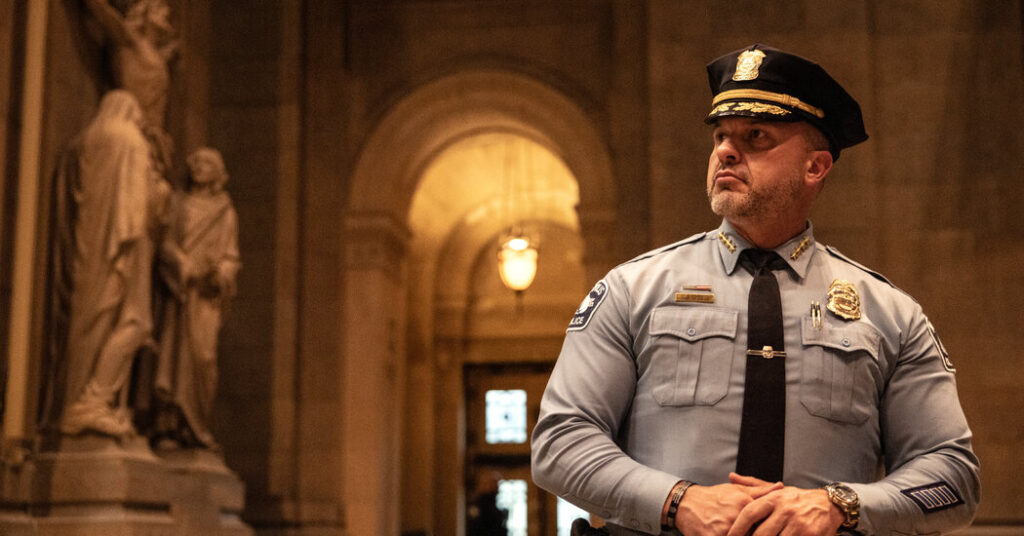
A class of police cadets had gathered inside the Basilica of St. Mary in downtown Minneapolis for their long-awaited swearing in. Standing before them in the majestic church was Chief Brian O’Hara, charged with administering the oath of office and with sending the new officers out into a city once again on edge.
He was hired in 2022 to rebuild a force that was hemorrhaging officers and facing widespread distrust after the murder of George Floyd in 2020 by a veteran of the force.
Taking the reins of the department that had set off a national reckoning over policing and racism was a formidable task. Chief O’Hara plunged in, showing up at precinct roll calls, racing to crime scenes in the middle of the night and becoming a fixture at community meetings large and small.
His efforts to stem the exodus and start replenishing the ranks while regaining the public’s trust were starting to bear fruit.
Then an army of federal immigration agents arrived in Minneapolis late last year, with President Trump declaring a “DAY OF RECKONING & RETRIBUTION.”
In the weeks since, Chief O’Hara, 47, has hardly had a moment’s peace.
The 911 call center has been inundated with calls, some from residents alarmed about aggressive immigration agents and others from the federal agents requesting backup when they have been swarmed by angry protesters.
Agents snatched residents out of cars, sometimes leaving vehicles abandoned in the middle of the street. Protests at times teetered on the edge of anarchy. And what Chief O’Hara feared most — that the growing tension would turn deadly — has come to pass at the hands of federal officers. Twice.
The kind of recklessly confrontational policing that Chief O’Hara had spent the last decade trying to exorcise, first as a police official in Newark, N.J., and more recently as the chief in Minneapolis, was now playing out all over the city.
“Even before Renee Good was killed, there were all these videos online every single day of situations that were just chaotic, with poor tactics that looked like policing from 30 years ago,” he said in an interview before the induction ceremony. “It looked like chaos.”
Chief O’Hara has been in a difficult position, stuck between federal law enforcement officers and the residents of Minneapolis. Many protesters have criticized the Minneapolis police for not doing more to rein in ICE agents. Angry protesters have sometimes screamed at local officers when they show up at tense scenes. But with just over 620 officers, the department has been at a breaking point for weeks, juggling routine calls and those related to the immigration operations
Beyond the daily emergency, Chief O’Hara has a deeper concern: that years of hard-won progress following the murder of Mr. Floyd and the riots that ensued could be undone in a matter of weeks.
“There’s been a real change in this police department,” he said. “It’s totally different than it was five years ago, 10 years ago. It is very, very fragile, though. That’s what I worry about. It’s really easy for the bottom to fall out.”
Chief O’Hara came to Minneapolis from Newark, where he had spent more than 20 years on the police force. Newark was also a city recovering from riots, though those had taken place decades earlier, in 1967. One of the catalysts for that unrest was the routine abuse of Black residents by the police, and those troubles would stalk the department for decades. In 2014, the U.S. Justice Department issued a scathing report documenting racist and unconstitutional police conduct.
The police department and the federal government entered into a consent decree to overhaul the force, and in 2017, Chief O’Hara, then a lieutenant, was charged with implementing it. Though he has the sturdy build and the Irish surname common among earlier generations of big-city cops, he was an apostle of modern policing tactics.
“You had a lot of skeptics who had decades of bad experiences with the Newark police,” said Peter Harvey, a former New Jersey attorney general who served as the court-appointed monitor of the consent decree. “Brian came in and said: ‘There are things we didn’t do right, that the city didn’t do right for a long time. We’re changing that, and we need you to help us.’”
In 2022, officials in Minneapolis were looking for someone to take over a police force that had been under intense federal scrutiny since Mr. Floyd’s death and the video footage of his killing shocked the world. It was perhaps the most daunting police job in the country. Mayor Jacob Frey nominated Mr. O’Hara, who after years of overseeing reform in the police force had become a deputy mayor in Newark.
“Brian had two extraordinarily tall orders before him,” said Andrew M. Luger, who was twice the U.S. attorney for Minnesota: tackling a shocking eruption of violent crime while at the same time repairing the police department’s broken relationship with the city.
Over the next three years, he put the department on a path to expanding the officer ranks. Before Mr. Floyd’s killing, Minneapolis had around 900 officers. That number cratered to a low of 560 in the years that followed, but it now stands at slightly more than 620.
Mr. O’Hara’s recruitment strategy has focused on broadening the ranks of nonwhite officers, including several from the Somali diaspora that has become part of the city’s cultural fabric.
In recent years, Mr. O’Hara led an effort to crack down on violent gangs, seize illegal weapons and combat an epidemic of carjackings.
Violent crime has dropped significantly on his watch — as it has in many large U.S. cities since the end of the pandemic — and the department has faced few controversies over the use of force as it has revamped training to de-escalate tense situations.
“I felt like we had gotten to a point where there was finally light at the end of the tunnel,” Chief O’Hara said.
But the past month has plunged Mr. O’Hara and his department into a dark place. When he got the first report that federal agents had shot Alex Pretti, a Veterans Affairs nurse, the morning of Jan. 24, his heart sank.
“I was, like, physically shaking,” he said.
All the progress that the city had made seemed on the verge of unraveling as tear gas filled the air and enraged protesters took to the streets. And the law enforcement officers in the middle of the mayhem were entirely out of his control.
The contrast is all the more stark given what the department was known for just a few years ago. The federal investigation prompted by the murder of George Floyd found a department with a pattern of violent, racist and unconstitutional policing. Though many criticized the Trump administration’s decision to end the federal consent decree that came out of that investigation, there was broad agreement that the force had improved significantly.
“People are seeing the juxtaposition between the way these federal agents treat community members and the way our Minneapolis Police Department de-escalates situations and treats people with care and compassion,” Mr. Frey said. “Obviously, our Minneapolis Police Department has not always been known for those attributes.”
For Chief O’Hara, perhaps most corrosive of all was the damage that he saw all of this doing to the relationship between the community and law enforcement officers, and the work that will be needed to once again repair that relationship.
“The irony,” he said, “is that’s why I was brought here in the first place.”
An hour later, Chief O’Hara was in the basilica, standing before the cadets.
Among them was Kyle Fowlkes, 28, a former high school football coach. As a child, he had been taught to run from the police, he said. He, too, wanted to be part of a change in Minneapolis, and as a recruit had texted Chief O’Hara out of the blue. “He responded right away,” Mr. Foltz said.
On a brutally cold night, facing pews full of proud friends and relatives, the cadets raised their right hands as Chief O’Hara recited the oath. “That you recognize that you serve as members of the human family worthy of dignity and respect,” he said. “And that your term in office shall be guided by your love of service to our community and the grace of humanity. To affirm this oath, say, ‘I do.’”
Ernesto Londoño is a Times reporter based in Minnesota, covering news in the Midwest and drug use and counternarcotics policy. He welcomes tips and can be reached at elondono.81 on Signal.
The post Federal Crackdown Means Another Repair Job for the Minneapolis Police Chief appeared first on New York Times.