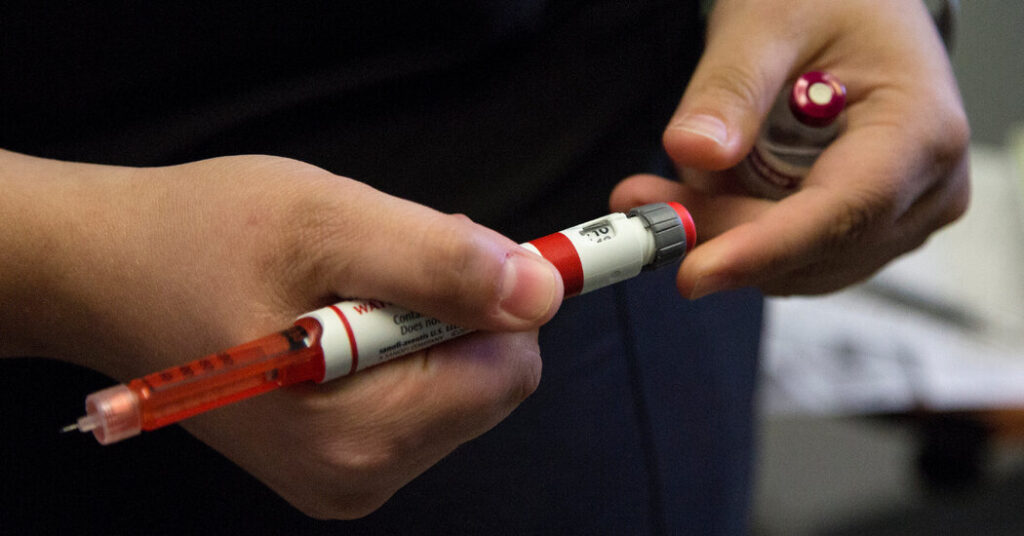
The Federal Trade Commission announced on Wednesday that it had reached a settlement with Cigna’s Express Scripts, one of the nation’s largest pharmacy benefit managers, over its role in driving up insulin prices.
Express Scripts will not pay a fine or face a financial penalty as part of the settlement and did not admit to any wrongdoing. But the company agreed to a range of changes to its business model.
Express Scripts, along with CVS Health’s Caremark and UnitedHealth’s Optum Rx, act as intermediaries in the complex system through which Americans get their prescription drugs. The three collectively control 80 percent of the market.
In 2024, President Joseph R. Biden Jr.’s F.T.C. sued the three pharmacy benefit managers, or P.B.M.s, accusing them of inflating insulin prices and steering patients toward higher-cost insulin products to increase their profits.
Under the settlement with the F.T.C., Express Scripts agreed to a series of changes intended to help patients pay less out of pocket for their medicines and save money for the employers and government programs that shoulder most of the costs of prescription drugs in the United States. Express Scripts had already said it planned to implement some of the changes through a new offering for its clients, which it announced last fall.
Justine Sessions, a spokeswoman for Express Scripts, said in a statement that the settlement allowed the company to “keep moving forward.” Invoking a phrase favored by President Trump, she added, “We appreciate the administration’s reinforcement of our commitment to pharmacy benefits that put Americans first.”
Trump Administration: Live Updates
Updated
- The Trump administration is investigating Nike for discriminating against white workers.
- Talks on reining in immigration agents start in Congress.
- A prosecutor who voiced frustration with her immigration caseload is fired.
The agency’s action against the other two companies is continuing. A Caremark spokesman, David Whitrap, said his company was “engaging in good-faith negotiations” with the agency. Optum Rx did not immediately respond to a request for comment.
High insulin prices generated public outcry for years, though a series of pricing changes in the past few years have sharply reduced patients’ costs, in most cases to no more than $35 a month. But some patients with diabetes still report rationing their insulin. People with diabetes need insulin to stay alive.
The Trump administration has tried to bring the usually independent F.T.C. more directly under the control of the White House. The agency’s chairman, Andrew Ferguson, who was appointed by Mr. Trump, has cast his actions as part of the administration’s broader cultural and political agenda. The president has pushed for lower drug prices, saying on Tuesday that Republicans should run on the issue in the midterm elections this fall.
The settlement adds to mounting pressure on the benefit managers, which are hired by employers and government programs to negotiate with drug companies, pay pharmacies and help decide which drugs patients can get at what price. On Tuesday, Congress passed legislation imposing new restrictions on P.B.M. business practices.
Under the terms of the settlement, Express Scripts also agreed to bring a subsidiary from Switzerland back to the United States to handle price negotiations with drugmakers. Its location had drawn criticism because it allowed the company’s profits to be taxed at much lower rates than if they were generated in the United States. Critics also said the overseas location made the business model more opaque and harder for its clients, employers and insurers to monitor.
The agency claimed there would be substantial savings to consumers because of the changes.
For many years, the major insulin manufacturers — Eli Lilly, Sanofi and Novo Nordisk — increased sticker prices for their products. Critics contend that the P.B.M.s put upward pressure on those prices because they made more money when sticker prices went up.
But that exposed many patients to higher out-of-pocket costs. Without insulin, people with diabetes can die or face serious health consequences, including amputation and kidney failure. The government programs and other payers that cover most of the costs of insulin in the United States also claim they overpaid as a result of these dynamics. Hundreds of states, cities, counties, unions and other payers in the United States have sued Express Scripts, along with insulin makers and the other two big pharmacy benefit managers.
David McCabe contributed reporting.
Rebecca Robbins is a Times reporter covering the pharmaceutical industry. She has been reporting on health and medicine since 2015.
The post F.T.C. Settles With Express Scripts Over High Insulin Prices appeared first on New York Times.