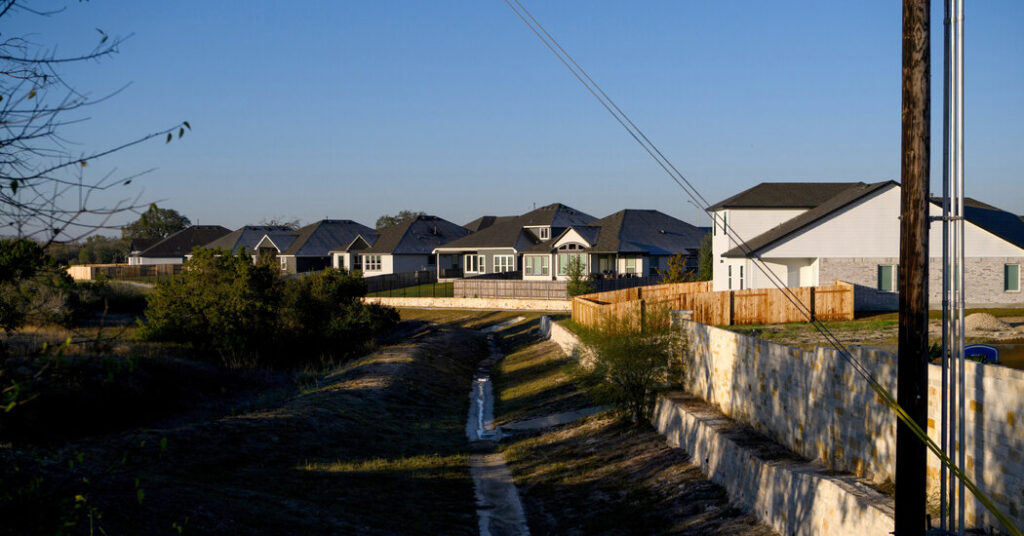
President Trump has struggled to address the housing crisis. But Congress has been moving forward with legislation that, if signed into law, could bring the most significant changes to federal housing laws in a generation, potentially igniting a building boom.
In October, the Senate approved a package of bills to reduce regulations, as well as to give communities incentives to build more homes and renovate existing ones. In December, the House Financial Services Committee passed a similar package that could lay the groundwork for a national building code offering a cohesive alternative to the existing patchwork of codes and guiding communities on ways to build faster. The bills have significant overlap.
The House bill is expected to get a vote on the floor next week, and congressional leaders from both parties say they are optimistic that it will pass. The White House has indicated that it would support congressional housing legislation.
“Congress is going to act on housing this year — it’s a question of when, not if,” said Shaun Donovan, chief executive of Enterprise Community Partners, a nonprofit housing organization, in a telephone interview.
“Housing is the No. 1 economic issue in the country,” added Mr. Donovan, who was secretary of the Department of Housing and Urban Development under President Barack Obama. “It is the single most important affordability challenge that Americans are facing. And, as we’ve all come to recognize in the last few months, affordability is at the center of our politics.”
Mr. Trump’s focus has been on the demand side of the crisis. He and his advisers have said, mostly in social media posts, that he wants to lower borrowing costs and make it easier for buyers to tap their retirement savings. But he has not released a comprehensive plan to address the crisis, and the small moves he has made may not provide lasting relief.
In January, for example, the president directed the mortgage giants Fannie Mae and Freddie Mac to buy back $200 billion in mortgage-backed securities, a move that could drive down interest rates temporarily. Later he signed an executive order directing federal agencies to evaluate the role institutional investors play in the housing market. Many economists think those moves will have a marginal impact, as would other ideas that the Trump administration has proposed, like instituting portable and assumable mortgages, if they are even feasible.
Making it cheaper to buy a house would not address the central reason for the crisis: a housing shortage. It could even worsen things by pumping up demand without boosting supply. For almost 20 years, the country has not been building enough homes, and it is now short by as many as seven million units. That’s a big reason home prices have surged 55 percent since the start of the pandemic, according to the National Association of Home Builders, and why buyers and renters struggle to find places to live.
The congressional bills are designed to make it faster and cheaper to get shovels in the ground.
“Both packages absolutely pull back regulatory barriers that are holding back housing,” said Alex Horowitz, the project director of housing policy for Pew Charitable Trusts, adding, “They will make a dent in the housing shortage.”
Here are some of the major provisions in the bills.
Use carrots and sticks to make communities build
The Senate’s package, a bundle of 40 provisions known as the ROAD to Housing Act, is spearheaded by Senators Tim Scott, Republican of South Carolina, and Elizabeth Warren, Democrat of Massachusetts. The bill would create a pot of money that communities could use toward building housing and improving infrastructure like water and sewer lines.
It also offers other rewards. A community that built housing near transportation, for example, would have an easier time getting federal transit funding. Both the Senate and House bills would ease access to development grants from HUD.
“The Senate got comfortable not just using carrots, but also sticks,” Mr. Donovan said. “If you want federal funding, you need to make housing.”
Consider a national building code
The United States does not have a national building code, a comprehensive set of standards, regulations and guidelines for design, construction, materials and maintenance. The House bill, called the Housing for the 21st Century Act, would direct the federal government to take steps toward creating one. The legislation was introduced by the Financial Services Committee’s Republican chairman, Representative French Hill of Arkansas, and backed by Representatives Mike Flood, Republican of Nebraska, and Maxine Waters, Democrat of California.
With a national building standard, builders could streamline developments, which would reduce costs. Modular housing, which is built in a factory, could be standardized. Plumbing and electrical standards could be uniform.
“This could be a big deal if this happens,” Mr. Horowitz said.
Another provision would direct HUD to loosen regulations that often make it expensive to build smaller multifamily homes. It would also exempt small-scale projects from environmental mandates that often lead to delays.
Ease zoning and permitting rules
Both bills tackle zoning rules, which developers often criticize because they vary from city to city, are often onerous and can lead to long delays. Many communities have outmoded zoning and land-use rules. Both bills would direct HUD to develop guidelines for communities that were looking to modernize. The bills also would provide grants for communities to develop “pattern books” — a collection of approved building designs that builders could choose from, speeding up the permitting process and reducing construction costs.
Encourage manufactured and modular housing
Manufactured and modular housing, which is delivered by truck and assembled on-site, is a cheap and fast way to build homes. The homes are flexible enough to fill a small empty lot in the middle of an existing neighborhood or quickly raise an entirely new neighborhood. While a stick-built house can take 18 months to two years to build, a modular or manufactured home can go up in months. But barriers have long prevented this kind of housing from becoming mainstream.
“We’ve got to have more availability for manufactured housing,” said Kimber White, the president of the National Association of Mortgage Brokers, an industry group.
The bills would amend the definition of “manufactured home” to include modular homes. Both bills would also update rules to make it easier to get a loan to buy a manufactured home.
Make it easier to fix up the homes we already have
America has an aging housing stock, with a median age of 40 years for owner-occupied homes. The Senate bill tries to shore up the existing stock by offering grants and low-interest loans to low- and moderate-income households and small-time landlords who agree to make critical repairs and address health hazards. Another provision would create a pilot program to convert vacant and abandoned property into housing.
Taken together, the bills could tackle the housing crisis from multiple angles simultaneously, a strategy that housing advocates say could have a significant impact.
“The most important accomplishment of passing housing legislation will be the fact that we passed housing legislation for the first time in a generation,” said David M. Dworkin, president of the National Housing Conference, a housing coalition, and a former senior policy adviser at the Treasury Department. “This is a major confidence-building opportunity.”
Ronda Kaysen, a real estate reporter for The Times, writes about the intersection of housing and society.
The post Congress Targets Housing Crisis as Solutions Elude Trump appeared first on New York Times.