“A lady who cannot dance?” To Benedict Bridgerton, the very idea is baffling.
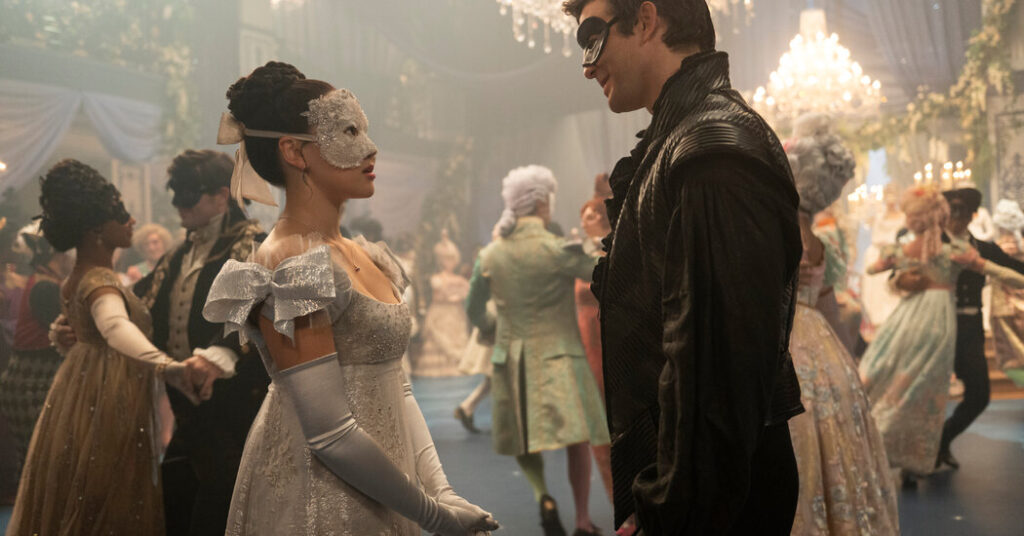
But such is the case with Sophie Baek, the heroine of the new season of “Bridgerton,” Netflix’s popular series based on Julia Quinn’s Regency-era romance novels. At the masquerade ball that sets the stage for this season’s big love story, Sophie manages to hide her face and her name. But she has to admit she doesn’t know how to dance — which is a clue to her social status. (She is not a “lady.”)
In “Bridgerton,” dance reflects rituals and norms, connects characters, heightens emotions, advances plot, creates spectacle, and brings audiences — on the edges of the ballroom and the other side of the screen — into the action.
“It’s kind of the backbone of the show, not only when our main characters are going through their courtship,” said Tom Verica, an executive producer and director of the show. “There’s so much in the pomp and circumstance and the rules of the world that comes through dance,” he said, adding that it illustrates how people communicated and fell in love.
For Daphne Bridgerton and Simon Basset in Season 1, a dance under fireworks announces to society that they are courting. And though the relationship begins as a ruse, this and other dances tease out the true emotions behind their fake courtship and highlight the ease with which they move as a couple. When Anthony Bridgerton and Kate Sharma finally admit their feelings about each other in Season 2, they find their resolve to pursue a life together — despite judgmental whispers — by dancing in public, eyes locked.
“It’s all about powerful nonverbal communication that extends beyond the limits of dialogue,” said Jack Murphy, the show’s choreographer, who trained as an actor. (He was nominated for an Emmy for his work on “Bridgerton.”). Dance in “Bridgerton” isn’t a frill or just for fun. “We only dance in ‘Bridgerton’ when we need to,” Murphy said.
“Bridgerton” isn’t always historically accurate, starting with its racially diverse depiction of British nobility in the Regency era. But the importance of dance reflects a reality of that time, when young people of the upper class often had to dance together in social settings. Cheryl A. Wilson, the author of “Literature and Dance in Nineteenth-Century Britain,” said that there were limited spaces in which eligible, unmarried people could interact with the opposite sex, and even fewer situations in which they could appropriately touch.
In the words of Lady Whistledown, the show’s favorite gossip columnist, “One scandalous move between an unwed couple, a wayward touch, or heaven forbid, a kiss, would banish any young lady from society in a trail of ruin.”
The way a suitor held a debutante’s hand or moved across the dance floor might be her only sanctioned way of gauging their physical compatibility. Because of this, Wilson said, dance played a large role in the marriage market. “This seemingly, in many people’s minds, frivolous pursuit of dance becomes this almost life-or-death economic pursuit for women,” she said, “because of the security that comes with marrying.”
Sophie, the illegitimate daughter of an earl, grew up as his ward but was shut out of dance lessons by his wife and demoted to overworked maid upon his death. When she slips into the masquerade ball, she stares at the waltz unfurling before her.
Some two dozen masked dancers start spinning around before taking hold of their partners. Each has one arm rounded in front of the torso and the other overhead, wrist flexed, palm facing the enormous, glittering chandeliers above, like rogue music box ballerinas.
“She’s spellbound by it,” Murphy said of how Sophie responds to the ball. “I made everything, as much as possible, asymmetric. So it’s very beautiful, but it’s broken, and that’s because, actually, we also know she doesn’t belong.” At the same time, “she’s not frightened,” he added. “She is desperately, desperately drawn to the movement of it, this freedom, this abandonment, this swirling.”
That waltz is one of four dances Murphy created for the masquerade ball. “The fans have told me over the last five years, ‘We can’t wait to see what you do,’” he said. He did his early choreographic brainstorming in his kitchen, he said, and when he felt too much pressure reminded himself, “Just take it one dance at a time.”
One of the most important scenes in the first half of the season (Part 2 comes to Netflix on Feb. 26) comes after Sophie confesses she can’t dance. Benedict leads her to a private terrace and teaches her to waltz. He shows her the proper bow, the frame and a simple box step. He counts gently. One, two, three. One, two, three.
“When have we seen Benedict Bridgeton be so fabulously empathetic?” Murphy said. “He’s teaching, he’s nurturing.” Murphy said that when he saw this scene — “possibly one of my favorite scenes ever in ‘Bridgerton’” — on a big screen at the premiere, he cried. “Because it epitomizes everything I believe in dance drama.”
The waltz, a new dance in England at the time “Bridgerton” takes place, is an apt choice for the episode’s intimations of passion and transgression. “The big scandal” of waltzing, Wilson said, was “the change from what’s called an open-couple dance, where you change partners, to a closed-couple dance, where you just have one partner throughout.”
Unlike a quadrille, for example, which is also featured on “Bridgerton,” the waltz has a closer, sustained hold with, at times, turning steps — a young couple could get swept up, or carried away. This new dance form on the edge of propriety here sets in motion a romance that will likewise upend societal expectations and disrupt class boundaries.
Wilson, a fan of “Bridgerton,” said that dance on the show is “largely accurate,” though she doesn’t watch any period piece with a strict lens. “It’s an interpretation of a historical moment to serve a story.”
That’s by design in “Bridgerton,” Murphy said. “It is hybrid. It understands the world of Regency, but it is very respectful of its audience,” who are of the 21st century. The music often goes even further to connect with the audience, using lush, instrumental renditions of contemporary hits, like, at the masquerade, Usher’s “DJ Got Us Fallin’ in Love.” Music and movement are meant to propel and enhance the drama in a way that is legible to modern viewers.
There’s more dance ahead for Sophie and Benedict. “What will play out, I don’t think this is giving anything away, is the evolution of their partnership,” Verica said. In the resolution dance, “when they are sort of freed from society” — and its judgment — “they are on equal ground.”
“Dance,” he added, “really helps mirror that journey.”
The post ‘Bridgerton’ Is Built on Romance. But Its Backbone Is Dance. appeared first on New York Times.