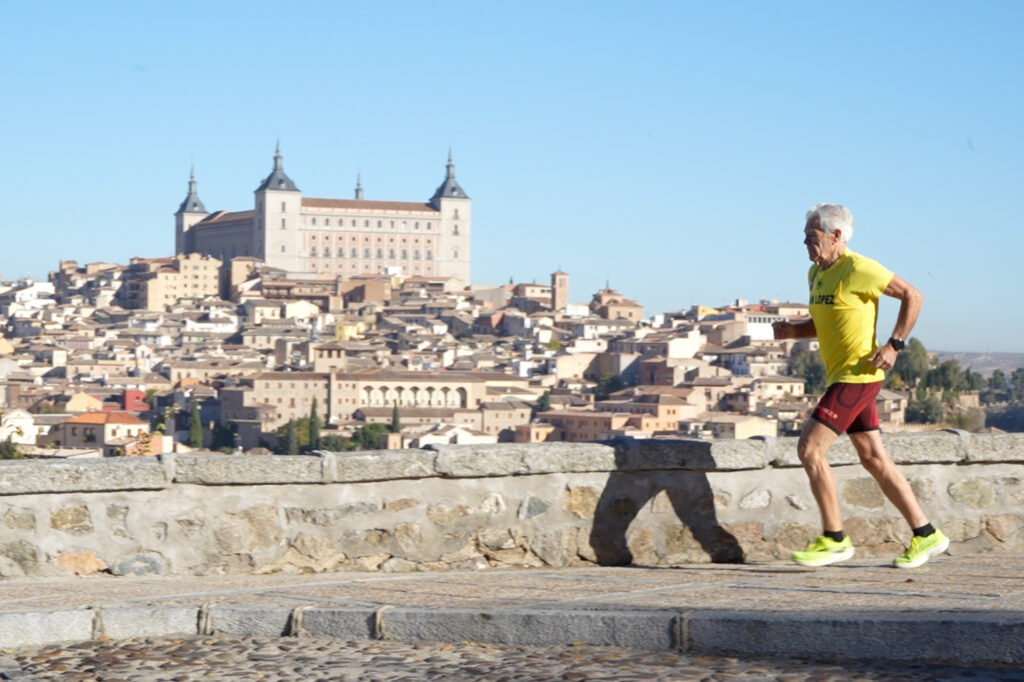
As a model of successful aging, you can’t beat 82-year-old Juan López García.
Really, you can’t beat him.
Sixteen years ago, at age 66, López García first tried running a mile. He’d recently retired after spending his entire working life as a car mechanic in Toledo, Spain. In all those years, he’d never trained as an athlete or exercised much at all.
He couldn’t finish that first mile. He could barely start it.
Now, at age 82, López García is the world record holder in the 80-to-84 age group for the 50-kilometer (31-mile) ultramarathon. In 2024, he also won the world marathon championship for his age group, with a time of 3:39:10, setting a European record in the process.
His outsize success caught the attention of a group of European scientists who study aging. They invited López García to their lab for extensive testing. Their findings, published in January in Frontiers in Physiology, are, at once, revealing and “inspiring,” said Julian Alcazar, an exercise scientist at the University of Castilla-La Mancha in Spain and a co-author of the study.
The researchers found that López García has the highest aerobic fitness recorded in an octogenarian, matching that of healthy 20-to-30-year-old men. His muscles also absorb and use oxygen unusually well. But in other ways, his biology, biomechanics and training seem relatively ordinary.
Taken as a whole, López García’s physiology and performance in his 80s may help upend some common assumptions about what’s possible and normal as we age, the researchers concluded, including whether it’s ever too late for the rest of us to tackle that first mile.
What sets older athletes apart?
“There are still many questions about the trajectory of aging,” said Simone Porcelli, an exercise physiologist at the University of Pavia in Italy and senior author of the study.
To help answer them, he and colleagues in Italy and Spain recently began collaborating on a major research project about whether growing old necessarily involves steep, inevitable declines in muscle, speed, strength and agency.
That interest led them, unsurprisingly, to older, elite athletes, whose trajectory of aging can seem almost otherworldly. Deep into their 70s, 80s and even 90s, these men and women typically preserve or even add to their fitness and strength, and they rarely develop serious illnesses. Most appear younger than their birth years.
What sets them apart, the researchers wondered? Is it training, genetics, luck? How do their bodies differ from those of their peers, and what lessons can we take from their daily routines?
An unusual athlete
Enter López García, a man whose aging has been both ordinary and exceptional. Physically unprepossessing at about 5-foot-2 and 130 pounds, he once spent several weeks walking 500 miles of the Camino de Santiago pilgrimage route in France and Spain. But otherwise, exercise had always been, at best, an afterthought for him. Then, at 66, he tried running and slowly, stubbornly upped his mileage until, at 70, he began to compete, starting with the 800 meters, then longer distances and, eventually, ultras.
The older he got, the longer and faster he ran.
“That’s not,” Alcazar said, pausing for words, “ … usual.”
Intrigued, Alcazar and his Italian colleagues set up López García on a treadmill and a stationary bicycle at their lab and tested his endurance capacity, running economy, fuel usage, power, muscle oxygen uptake and other measures of how his body responds to high-speed exercise. They also asked about his training and nutrition.
The greatest fitness ever measured
Some of the numbers proved eye-popping.
López García’s VO2 max, the standard gauge of aerobic fitness, was the highest the researchers had seen in someone in their 80s. A measure of how much oxygen the body takes in and delivers to muscles, VO2 max usually declines by about 10 percent each decade after middle age. But his almost certainly had been rising after he reached his mid-60s and began to train and is similar to someone a quarter his age.
His muscles also were better able than those of most older — or younger — people to absorb and use that oxygen, allowing López García to run for long periods at a fast, steady pace. He averaged a 9:14 mile during his record-setting ultramarathon. He also produced considerable power during each stride.
But he didn’t have an especially high lactate threshold or running economy, both of which contribute to endurance and speed. His were good, similar to those of competitive athletes in their 60s, but not spectacular, suggesting he still has room to improve as a runner.
How he eats and runs
Even López García was startled by his prowess. His only thought when he started to train, he said, “was to run a little to maintain my health, never to reach the level I have reached today.”
Now, he runs about 40 miles a week when he’s not readying for a competition and almost double that mileage in the buildup to a race. Most of his workouts are long and moderately taxing. But a few times a week, he does intervals of various lengths, sprinting at near or past race pace for a brief spurt, slowing and then sprinting again. (He has a professional coach guiding his workouts.)
He also weight-trains a few times a week, mostly at home, primarily with body weight exercises, and eats a “totally normal” Mediterranean-style diet, he said.
‘It’s never too late’
The big question with López García’s or any older athlete’s successful aging is whether the rest of us can replicate it. Or is he somehow unique, gifted with an ideal mix of genes and background unavailable to most people?
Alcazar suspects it’s both. López García was fortunate to have reached age 66 without serious illnesses or disabilities, Alcazar said, despite being sedentary, which might have been, in large part, because of his genetics, as well as lifestyle.
But Alcazar and his colleagues also believe López García’s successful aging is not just aspirational but achievable by most of us. “Not so long ago, it wasn’t really seen as possible or a positive for older people to do much exercise,” Alcazar said. López García shows otherwise. “It is not only possible. It should be recommended,” Alcazar said.
Begin slowly, if you are older and new to exercise, López García said, as he did. “Start by walking fast and then maybe start running, which is very beneficial,” he said.
“It’s never too late,” Porcelli said. He and the other scientists are continuing to study López García and other aging athletes, as well as more sedentary older people, to understand the molecular and functional differences between them. The researchers expect to publish more studies soon.
In the meantime, López García’s example is already a lodestar for the researchers. “I’m 35,” Alcazar said. “I’m thinking about how to age well. Having seen him, of course I exercise.”
For his part, López García has no plans to slow down. “When I think about the number 80,” he said, “I remember my grandparents. At this age, they were like little old people. Today, I do not feel old.”
Do you have a fitness question? Email [email protected] and we may answer your question in a future column.
The post At 82, he’s as fit as a 20-year-old. His body holds clues to healthy aging. appeared first on Washington Post.