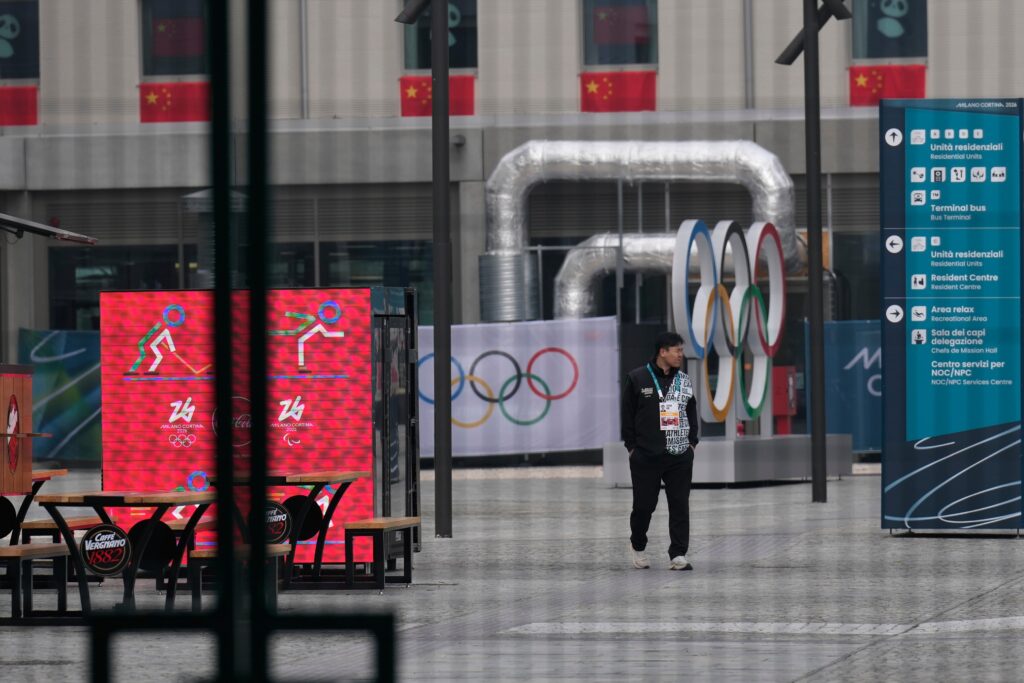
MILAN — Not far from the new Olympic Village — to be repurposed as student housing after this month’s Winter Games — a skyline-altering office tower reminiscent of a futuristic lighthouse is nearing completion.
Milanese fashion house Prada is involved in transforming a railway yard eyesore into an urban park with stores, offices and apartment towers. Milan’s trendy Porta Romana district is peppered with recently built condominiums and blinged-out palazzos with penthouses costing millions.
The Olympics may be intended to bring nations together, but advocates in Milan say the Games risk driving the city apart, as Olympic construction and ancillary projects have accelerated the relentless gentrification in Porta Romana, deepening social divisions and widening income disparities.
“The legacy of the Olympics will be exclusion,” Lorenzo Faggi, an activist and member of the Unsustainable Olympic Committee, a group opposing the Winter Games, said as he surveyed a vast construction site near the Olympic Village.
For host cities, the Olympics can be a magnet of controversy.
Ahead of the 2024 Paris Games, authorities evicted migrant workers and cleared squatters from the downtrodden Seine-Saint-Denis district in what some critics dubbed a “war on the poor.” The Games in Rio de Janeiro, Athens and Montreal left urban landscapes littered with underused athletics venues — huge white elephants. The pandemic-delayed Tokyo Games, pitched as hyper-sustainable, were marred by allegations of greenwashing after construction projects were found to have used “large quantities of tropical plywood linked to rainforest destruction,” according to a report by eight environmental NGOs.
The Milan Cortina Games are no different. They are the most geographically diffuse Olympics in history, with venues spread out over an area three times the size of Delaware. Events will be held in stadiums along urban highways as well as on distant slopes in rural Alpine villages. But Milan, host of Friday’s Opening Ceremonies, is the symbolic center.
Angry demonstrations and statements by civic leaders furious over the deployment of U.S. Immigration and Customs Enforcement agents to Milan to assist with security at the Games have superseded protests about gentrification and environmental damage in recent days.
But for years now, working-class Milanese, as well as politicians on the right and left, have fumed over the city’s radical gentrification, with some also griping about the headache caused by the upcoming Games.
Across Italy, Olympic fever feels decidedly low-grade, with nary a sign of the Olympics beyond the occasional sponsor’s billboard in major cities such as Rome and Naples. That’s partly due to national divisions: Many Italians view the wealthy north, where the Games are taking place, as almost another country.
Ticket sales have reportedly been slow, and, days before the start, organizers are still scrambling to finish facilities including a key hockey arena. The Milanese today seem just as likely to complain about the endless construction and the prospect of congested roads as they are to show excitement.
“When you put on a big event, citizens get punished, as usual,” groused Alessandro Gerli, founder of the Milan-based cultural association Famiglia Meneghina.
Other host countries have turned their Opening Ceremonies into unique displays of national pride. In Milan, however, some are scratching their heads at the organizers’ decision to overshadow a host of Italians — including Tuscan tenor Andrea Bocelli — with a performance by American pop star Mariah Carey.
Even before the Winter Olympics, Milan — Italy’s hub for finance, fashion and design — was having a moment.
As Britain, France and California have moved to target the bursting wallets of the one percent, Italy has become a relative safe haven for the rich, with Milan as the main benefactor. Incentives introduced in 2017 limited taxes on foreign-sourced income to a flat rate of 100,000 euros annually. (This amount was doubled in 2024, but by then the policy had largely served its purpose.)
Millionaires and billionaires now account for 1 in every 12 residents of Milan, with a 24 percent increase between 2014 and 2024, according to a report by investment migration consultancy Henley & Partners.
In particular, several high-flying financiers with business ties to London have flocked to Milan, with recent transplants including Egyptian billionaire Nassef Sawiris, Goldman Sachs vice chairman Richard Gnodde, Brazilian venture capitalist Fersen Lambranho and Frédéric Arnault, the son of Bernard Arnault, chief executive of luxury conglomerate LVMH.
In 2022, the older Arnault bought Leonardo da Vinci’s vineyard and former residence, across the street from the Milanese church that houses “The Last Supper,” for a price that local rumor places at about $130 million.
The jet set have landed in Milan as global events like Expo 2015 and the 2026 Winter Olympics have combined to spark regeneration, beautification and, critics say, soaring housing costs.
According to Tecnocasa, a leading Italian real estate company, house prices in Milan began to diverge from the average of other big Italian cities right after Expo 2015. Over the following decade, Milan’s property prices rose by more than 54 percent — and are now 38 percent higher than the national average for large cities.
“It’s not unlike what happened to San Francisco, a beautiful city with 800,000 inhabitants which then increasingly morphed into an enclave for the elite,” said Riccardo Truppo, a Milan city council member from the right-wing Brothers of Italy party of Prime Minister Giorgia Meloni.
Soaring costs of living are not unique to Milan, and city officials note that several projects — including the massive rail yard redevelopment and the new Olympic Village — will include set-asides for affordable and subsidized housing. Still, they concede that the city’s working class is under pressure.
“We are facing some problems, like most international cities,” Milan Mayor Giuseppe Sala said in an interview with The Washington Post. “In my opinion, the main problem: social inequality. More precise: the cost of living. And in Milan, even more precise: the cost of housing.”
Since Expo 2015, Milan has positioned itself as Italy’s international hub, drawing global firms, Italian professionals returning from abroad and, more recently, Londoners unsettled by Britain’s decision to abolish its long-standing tax regime for wealthy “non-doms” — residents who, for tax purposes, reside outside the country.
“On the one hand, we had a magnet, and on the other, they provided the push,” said Roberto Magaglio, a Milan-based license partner with international real estate firm Engel & Völkers.
New full-time residents say the tax breaks have helped, but that the draw of Milan is broader — and the tightening of tax incentives over the past two years may have a limited effect. The city’s walkability, welcoming Italian culture and rich urban life are just too tempting for foreigners looking to put down international roots.
“I think logically, you’ve got to expect [that raising the tax rate] has an impact,” said Tom Mockridge, a New Zealand-born media executive who, with his Italian wife, lived in Milan part-time for a decade before recently selling their London home to settle in Italy permanently.
The Italian government, Mockridge said, is feeling “political pressure from the people already living in Milan, because the migration has put pressure on housing prices.” But the city’s appeal goes beyond tax incentives, he said. “It’s added to the momentum, but now you’ve got a trend in Milan that is going to continue.”
Pitrelli reported from Rome.
The post Ahead of the Winter Olympics, Milan wins gold in gentrification appeared first on Washington Post.