Sign up to receive WorldView, a free, thrice-weekly email newsletter from the international desk of The Washington Post.
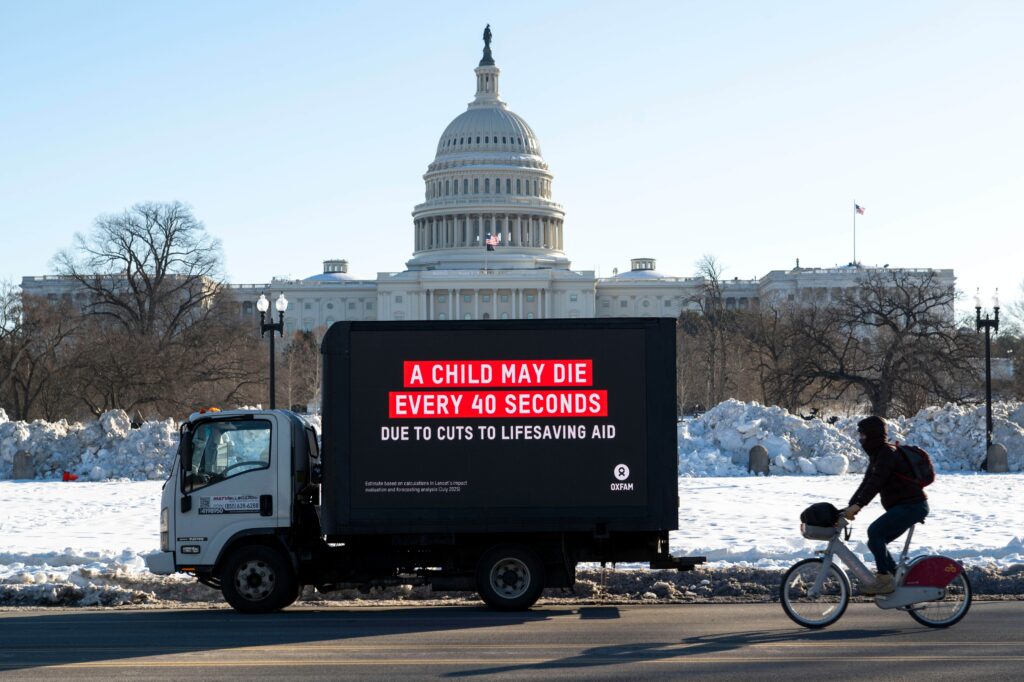
The impact of the ostentatious slashing of foreign aid by President Donald Trump can be measured in human lives. It’s been about a year since the dismantling of USAID, the United States’ key humanitarian agency. The move rocked the international humanitarian system and the supply chains of critical aid to some of the world’s most benighted communities. Food kitchens closed in war-ravaged Sudan; lifesaving medicines failed to reach desperate patients in the Democratic Republic of Congo. Hundreds of people probably died as a result. As the United States cut its humanitarian outlays, other major donor countries scaled back their contributions too.
A study published this week by the British medical journal Lancet projects an extra 9.4 million deaths by 2030 if the current trends persist. “The study amounts to an early picture of how funding reductions from the United States and other Western countries could undo decades of health gains, leading to upsurges in HIV/AIDS, malaria and hunger across the developing world,” explained my colleague Chico Harlan.
The Trump administration is hardly apologetic about its moves. The State Department said in a statement to Harlan that “some recent ‘studies’ are rooted in outdated thinking, insisting that the old and inefficient global development system is the only solution to human suffering. This is simply not true.”
“Rather than helping recipient countries help themselves,” the statement said, “the old system created a global culture of dependency, compounded by significant inefficiency and waste. This has prompted development donors everywhere — not just the United States — to reconsider their approach to foreign aid.”
The gutting of USAID was a prelude to other Trumpist disruption on the world stage. The White House began trade wars on adversaries and allies alike, pulled out of myriad international institutions, and, at various moments, has threatened the underpinnings of the transatlantic alliance.
Trump and his allies cast their actions as a necessary reckoning with a postwar world order no longer operating in American interests. Stephen Miller, a prominent ultranationalist White House official characterized by some as Trump’s “prime minister,” rejected the American need to engage in “international niceties” and proclaimed a return to a world “that is governed by strength, that is governed by force, that is governed by power.” That ethos has trickled down to what’s left of the U.S. government’s humanitarian apparatus.
“Since the elimination of USAID, the U.S. has unveiled a new ‘America First’ global health strategy and reached bilateral health deals with some developing nations,” reported Harlan. “And that kind of work could get a boost if Congress passes a spending bill that would set aside $9.4 billion for international health in fiscal 2026. That sum is more than double what the administration had requested but a step back from budgets of $12.4 billion for both 2024 and 2025.”
But critics see the shift as indicative of a broader retreat from the U.S.’s traditional posture in the world, a position of leadership and cooperation that anchored decades of American primacy and prosperity. That retreat, which includes the wrecking of USAID, leaves a void that no other country can fill. “It is the dismantling of an architecture that took 80 years to build,” Rajiv Shah, the president of the Rockefeller Foundation and the leader of USAID for five years under President Barack Obama, lamented in a statement. “The scale of the cuts and the scale of the reduction far outstrips the scale of philanthropy to step in and solve the problem.”
Developments in recent weeks have underscored the sense of a new reality shaping global affairs. As I reported from Davos, Switzerland, last month, the rest of the world has accepted the “rupture” in the prevailing order and is adjusting accordingly. Canada and the U.S.’s closest allies in Europe are all trying to diversify their interests away from the United States.
Canadian Prime Minister Mark Carney cast Trump’s America as a bullying great power on par with an autocracy such as China. European governments, meanwhile, are preparing to implement bans on social media for minors, moves that have courted the ire of the Silicon Valley tech oligarchs close to the White House such as X’s Elon Musk, as well as prominent Trump officials. Opinion polls have shown tanking public approval of the United States in countries around the world.
In Foreign Affairs, Stephen Walt, an international relations realist at Harvard University, argues that the grand strategy of Trump’s second term can be described as “predatory hegemony,” an approach whose main purpose “is to use Washington’s privileged position to extract concessions, tribute, and displays of deference from both allies and adversaries, pursuing short-term gains in what it sees as a purely zero-sum world.”
While it might allow Trump to tout numerous small victories in the global arena, Walt suggests it obscures what anchored U.S. power: Washington’s “mailed fist” was always cloaked in “a velvet glove.” But taking the gloves off — slashing principled commitments, strong-arming friends, undermining international institutions — won’t help the United States in the long term, especially in a moment when the geopolitical focus falls squarely on the rise of so-called “middle powers” finding their feet on the world stage.
Trump’s predatory hegemony “is ill suited for a world of several competing great powers — especially one in which China is an economic and military peer — because multipolarity gives other states ways to reduce their dependence on the United States,” Walt concluded. “If it continues to define American strategy in the coming years, predatory hegemony will weaken the United States and its allies alike, generate growing global resentment, create tempting opportunities for Washington’s main rivals, and leave Americans less secure, less prosperous, and less influential.”
The post A year after aid cuts, the image of American power shifts under Trump appeared first on Washington Post.