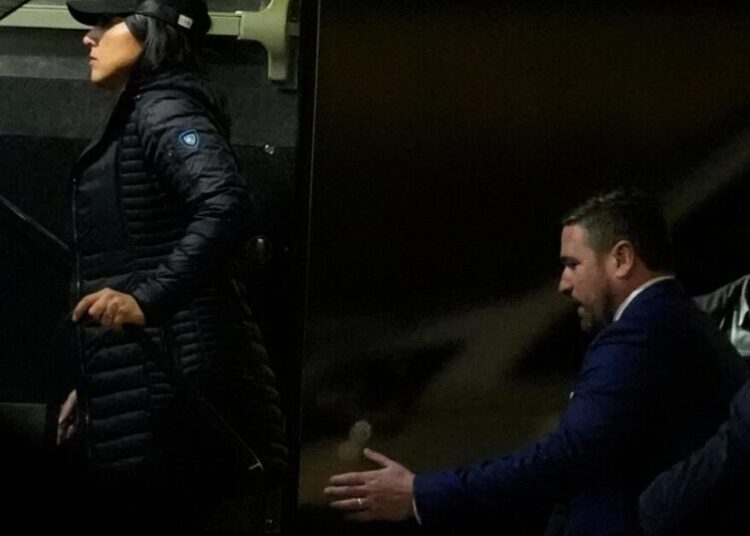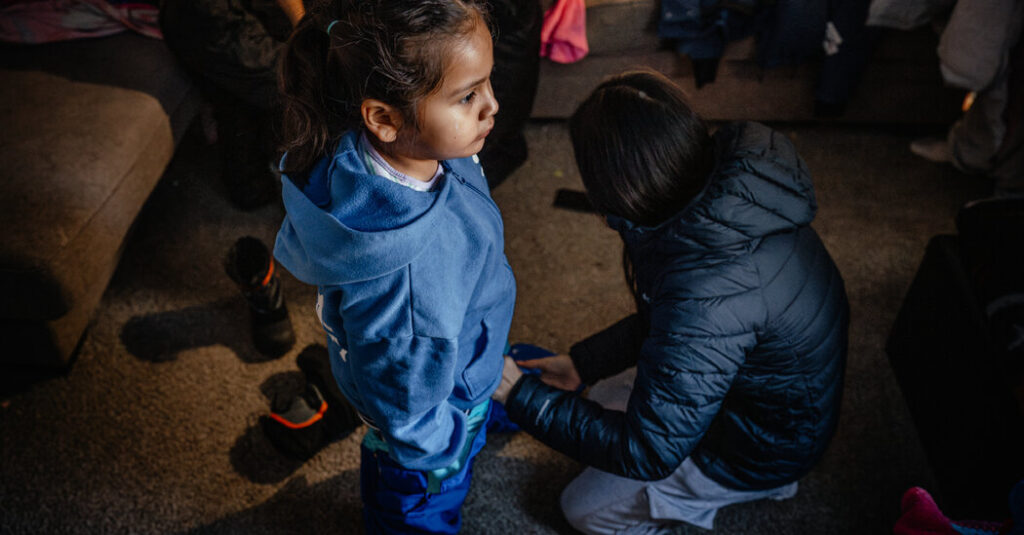
The morning her father called to say that he had been detained on a snowy Minneapolis road, Xochitl Soberanes was seized by an urgent and inescapable feeling. At 16 years old and the eldest of four, she would suddenly have to become the backbone of the family.
Their mother had died of pneumonia less than a year ago, so it was Xochitl who convinced her 4-year-old brother that their father was working late as they packed up belongings to go stay with a nearby aunt. That January night, a cousin found all four siblings curled up asleep in the same queen bed — cradled by Xochitl, who lay on the edge.
“We just wanted to be close together,” she said.
For weeks, the Minneapolis area has been a landscape of intense turmoil as federal immigration agents face off against furious citizens. But there is a quieter upheaval taking place behind closed doors as the city’s youngest residents attempt to grasp the altering of their neighborhoods, their schools, their sense of security.
Regardless of what they might understand about the politics embedded in their surroundings, some things are clear: The adults in their lives are weary and overwhelmed. Neighbors are scared to leave the house. Bomb threats have been called in to schools. Events have been canceled. Friends are missing from classrooms. And parents have been taken.
“I was just thinking, ‘What are we going to do without him?’” Xochitl said about the day her father, Victor, did not come home. She began to insist to her aunt that she could finish her final exams and be available to help with her siblings. Within a week, her friend, a U.S. citizen, was also detained and later released. “It’s like living in fear all the time,” Xochitl said.
It is a sentiment that many children in the area speak of — this fear that now feels innate and will continue to linger in ways they cannot yet comprehend. They live in a world where a barrage of honks and whistles signal that immigration agents are in their midst, and that something bad could happen soon.
It is not unusual for them to see agents dressed in riot gear and carrying rifles stationed on their streets. And those who have found themselves swept up unwillingly into altercations have been left to endure the aftereffects.
Destiny Jackson’s six children cannot forget the day they were driving home and found themselves in the middle of a protest. As her husband attempted to turn the car around, federal agents deployed tear gas and flash-bang grenades. An explosion lifted up their car and set off its airbags while acrid smoke crept inside. The family managed to escape the vehicle, while the littlest one, at 6 months old, required CPR.
“Some of the kids, they’re having night terrors about it,” Ms. Jackson said.
The trauma has affected each child differently. Her 11-year-old constantly checks their home’s security camera and begged his parents to buy an armored car. One of her 4-year-old twins screamed at the sight of someone holding spray-on deodorant, mistaking it for pepper spray. Her 7-year-old son shrinks when classmates refer to him as “the boy from the bombing.” The 2-year-old jumps and cries when he hears a loud noise. The baby requires nasal drops to fight the effects of the chemicals that inflamed his sinuses.
Ms. Jackson said she has tried to avoid letting her children see news reports or images of all that has taken place in their region.
“We’re trying to keep their minds as protected as we can,” she said.
There is a frenzy to the Minneapolis area, however, that cannot be hidden — one that has made those of all ages highly aware of what could go wrong.
At 9 years old, Gael De Leon carries a copy of his passport in his backpack. Although born in the United States, he is of Mexican descent, and his parents fear he is a target for immigration agents.
“I had to tell him, ‘If something happens, I know it’s going to be scary, but don’t worry because I’m going to come for you and I will find you,’” his mother, Amanda, said.
Gael has grown anxious about the possibility of being taken and does not want to ride the bus or attend school. It has not helped that children even younger than him have been whisked away.
If there was an image that put the children of Minneapolis front and center, it was that of 5-year-old Liam Conejo Ramos, with his Spider-Man backpack and his floppy-eared hat, being detained by ICE with his father. The principal of Liam’s school would later report that two more of his students had been detained.
“None of this is normal, none of this is OK, none of this makes Minnesota any safer,” Gov. Tim Walz said Tuesday, adding that Liam’s classmates had taken to making paper bunnies in his honor. “All it does is cause terror and trauma to the children.”
Liam had been sent to a facility in Texas but returned home after a judge ordered his release over the weekend. Still, state leaders said that federal agents remained focused on targeting schools.
Just hours after Renee Good was fatally shot in her car on Jan. 7, armed ICE agents led by the Border Patrol official Gregory Bovino showed up three miles away at Roosevelt High School around dismissal time. Agents quickly appeared to become aggressive, spraying chemical irritants toward students and pushing and tackling staff members.
It was a stunning display of force that made the rounds on social media and earmarked schools as another battleground. Students from across the region saw the footage as a warning of how even teenagers studying on campus were now vulnerable in the era of ICE.
“That was one of the scariest moments of my life, just knowing that they have no boundaries, and really seeing that this is not something in a movie, this is not something away from me that I can ignore,” said Ta’Khya Carlisle, 17, who attends a high school across town from Roosevelt.
Ta’Khya, a junior, lives near where ICE agents shot and wounded a Venezuelan man in the leg in mid-January, and she recalled how helicopters circled overhead that night, while unmarked vehicles roamed the streets.
“I don’t think I will ever get out of the habit of looking outside or looking into people’s cars with tinted windows,” she said. “I don’t think I will ever get over seeing somebody in any kind of authority’s uniform without my heart dropping.”
Although some have turned to therapy or counseling, it will be impossible to quantify the residual effects on children and what they have experienced the last two months.
“Students used to ask me for help navigating friendships,” Tracy Xiong, a social worker at Highland Elementary School, told reporters on Tuesday. “Now they ask me how to cope with ICE breaking apart their families and taking their friends.”
Even the smallest members of families who stick mostly to home are processing what they have witnessed. As eyes were on ChongLy Thao, the Hmong American man handcuffed and forced outside in his underwear in the bitter cold, his 2-year-old grandson was also watching. He has since had trouble sleeping, a family member said.
Last week, Xochitl, the 16-year-old, welcomed her father back home. Up until his detainment, he had appeared regularly at court dates to find a legal path to citizenship and had no criminal record. His lawyers had quickly filed a petition for writ of habeas corpus, which helped lead to his release.
Usually reserved when it comes to affection, Xochitl greeted her father excitedly with a hug. But his arrival offered only a moment of relief, she said. She soon turned to worrying about whether he might be taken away again.
Corina Knoll is a Times correspondent focusing on feature stories.
The post A Winter of Anguish for Minneapolis Children appeared first on New York Times.