A week before the 2024 election, Idaho’s largest electric utility struck a 35-year deal to buy power from a wind farm under development in Wyoming.
The Jackalope Wind project would span an area the size of Chicago, with hundreds of wind turbines generating clean electricity by 2027.
But the wind farm soon became a casualty of President Trump’s efforts to slow — and sometimes revoke — federal approvals for wind and solar projects. A key environmental review of Jackalope by the Interior Department was stalled for months, and the project is now effectively dead.
Similar stories are unfolding nationwide. While Mr. Trump’s attacks on offshore wind have been highly visible, his administration has also been hobbling solar and wind energy projects on land by halting or delaying federal approvals that were once routine.
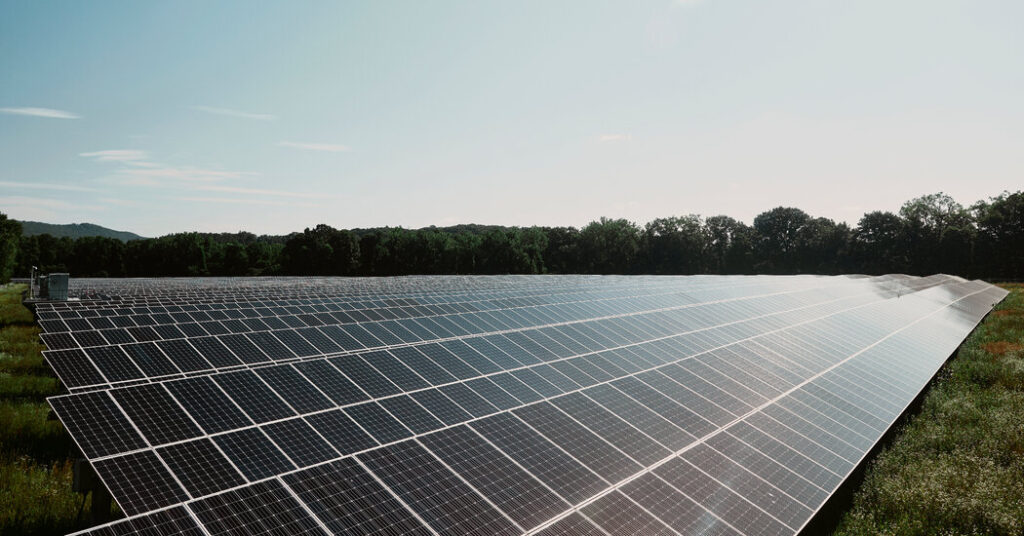
More than 60 large wind and solar farms under development on federal lands, such as Jackalope Wind, are at risk of being stymied by a pause on renewable energy permitting. But the administration is also holding up hundreds of wind and solar projects on private land that require federal consultations. Many projects are facing potentially fatal delays, according to interviews with more than a dozen energy companies, industry groups and analysts.
The extra layer of scrutiny for wind and solar contrasts with actions by the Trump administration to make it easier and cheaper for companies to produce oil, coal, gas and nuclear power. And it sets the United States apart from other countries that are embracing renewable energy.
In September, the Idaho utility finally canceled its contracts with Jackalope Wind, citing “uncertainties related to the federal permitting process.”
Now, Idaho Power is accelerating plans to install nine engines that burn natural gas. And this week, NextEra Energy, the company behind Jackalope, told The New York Times that it was scrapping the wind farm altogether.
The efforts to delay renewable energy on land could prove even more consequential than the administration’s battles against offshore wind. The five wind farms in the Atlantic Ocean that Mr. Trump is trying to stop would collectively produce up to 5,800 megawatts, roughly enough to power 2.5 million homes. But 73,000 megawatts of solar projects on land are currently at risk from political interference, according to the Solar Energy Industries Association, which called Mr. Trump’s policies a “blockade.”
“There’s a real intention to slow these things down,” said David Carroll, chief executive of Engie North America, which develops wind, solar, battery and gas projects.
Mr. Carroll estimated that roughly 40 percent of Engie’s planned renewable projects could be affected by the federal permitting bottleneck, including several wind farms on private land in the Midwest. Wind projects that require federal permits are “nearly impossible” to advance right now, he said.
Most of the wind and solar projects affected by the permitting slowdown were expected to come online in 2027 or later. Without them, companies say, the country could face a shortage of power and ratepayers could see even higher electric bills at a time when affordability has become a national concern.
“Demand from utilities is astronomical,” said Sandhya Ganapathy, chief executive of EDP Renewables North America, a leading wind and solar developer. “But now permitting is becoming much more difficult, which means many projects may never come online or take forever to come online.”
“It’s going to mean higher energy prices,” Ms. Ganapathy said.
A White House spokeswoman, Taylor Rogers, said the administration’s policies were designed to reverse “unfair, preferential treatment of green energy sources like wind and solar” and “cut burdensome red tape to level the playing field for oil and gas companies.” (The United States is the world’s biggest oil and gas producer.)
In January, Mr. Trump was more explicit. “My goal,” he said, “is to not let any windmill be built.”
Permitting paralysis
Mr. Trump has for years dismissed wind turbines and solar panels as ugly and expensive. In July, Republicans in Congress phased out federal tax credits for wind and solar power.
But the Trump administration then went beyond cutting subsidies. Weeks later, the Interior Department issued a memo saying that a wide array of federal decisions and consultations on wind and solar projects that are typically carried out by career employees would be subject to new layers of review by Interior Secretary Doug Burgum’s office. The U.S. Army Corps of Engineers and Transportation Department also issued new restrictions for renewable projects.
The effects have been far-reaching.
While fewer than 5 percent of solar and wind projects are on lands directly overseen by the Interior Department, even developers that build on private land often need federal approvals.
If a solar or wind farm is going to disturb nearby wetlands, which are widespread, the developer may need a water permit from the U.S. Army Corps of Engineers, which in turn often consults with the U.S. Fish & Wildlife Service to gauge the effects on sensitive habitat.
Wind and solar developers also often need to work with the Fish & Wildlife Service to alleviate concerns that projects might harm protected species like bald eagles or desert tortoises. Wind farms need clearances from the Federal Aviation Administration.
Much of that permitting has come to a standstill. Career staffers are often unsure how to move forward with once-routine work such as approving plans for access roads, developers say. Former Interior Department officials say it is unworkable for the secretary to review each of the hundreds of small decisions needed to approve projects.
Trump Administration: Live Updates
Updated
- Homan says D.H.S. is pulling 700 officers out of Minneapolis.
- Ukraine talks resume, despite an intense Russian bombardment of Ukraine’s power grid.
- Trump throws a possible deal with Harvard into chaos.
Kevin Smith, the chief executive of Arevon, a solar and battery developer, said his company has 7,000 megawatts worth of projects in development on private land. About half require federal consultation.
“Historically this was a check-the-box process,” Mr. Smith said. “Now that everything has to go up to the secretary’s desk, it’s essentially a pause on permitting.”
Other obstacles are emerging.
In Indiana, Patoka Solar is a proposed 250-megawatt solar array on private land that could affect local wetlands. To apply for a federal water permit, the developer needs to use a taxpayer-funded database to document the effects on wildlife. Yet the Interior Department has barred wind and solar companies from using that database, making it “impossible” for the project to advance, according to court filings in a lawsuit against the agency by a coalition of clean energy groups.
In Illinois, the Kaskaskia Wind project has been delayed indefinitely while waiting for wildlife and water permits, the filings said. The project has now lost its spot in line to connect to the grid after its developer had already invested $10 million.
Elsewhere, wind farms are stalled because the Defense Department has stopped finalizing agreements designed to address the risk that turbines interfere with radar, companies said.
Not all projects are blocked. Exus Renewables North America recently received clearances from the Federal Aviation Administration to upgrade existing wind farms in Pennsylvania, but only after a “severe delay” of nearly seven months, said Jim Spencer, the company’s president. He attributed the delay to staffing shortages.
Many smaller solar projects that do not require federal approvals are also advancing.
Alyse Sharpe, an Interior Department spokeswoman, said the agency’s reviews were meant to ensure that wind and solar projects “receive appropriate oversight.” The policy, she said, “strengthens accountability, prevents misuse of taxpayer-funded subsidies and upholds our commitment to restoring balance in energy development.”
Eugene Pawlik, a spokesman for the Army Corps of Engineers, said the agency was “implementing the laws as Congress has directed, consistent with the administration’s priorities.”
A race to survive
Wind and solar developers are scrambling to adapt. Some are redesigning projects to avoid the need for federal approvals by, say, relocating power lines. But that has costs.
In Missouri, the Empire Prairie wind and solar project has been unable to obtain federal water permits. So the developer is re-engineering the site to avoid disturbing wetlands, changes that will cost “millions” and make the project less efficient, according to filings in the lawsuit by clean energy groups.
Some developers have grown fearful after the Interior Department signaled it would step up enforcement against wind farms that kill eagles, even as it has become harder to secure permits that allow for unintentional bird deaths.
In response, some companies have spent “several million dollars” to install technology that shuts down wind turbines if eagles are detected nearby, even if the risk of deaths was low, the filings claimed.
Others are asking politicians for help.
Last summer, Gov. Joe Lombardo of Nevada, a Republican who is up for re-election this year, wrote to Mr. Burgum saying the Interior Department’s reviews have “not only stopped solar development on federal lands in Nevada, but also on private land” and asked for a more workable process. Nevada gets one-third of its electricity from solar.
In December, the Interior Department began advancing a large solar-and-battery project in northern Nevada, known as Libra. Governor Lombardo’s office did not reply to an interview request.
Some companies are pivoting to the fossil fuels preferred by the Trump administration. The burning of oil, gas and coal are the main drivers of global warming.
NextEra, the company behind Jackalope in Wyoming, is one of the country’s largest wind and solar developers. Its chief executive, John Ketchum, told investors recently that renewables remain “the lowest-cost and fastest solution to meet our customers’ immediate needs.”
Still, NextEra expects to build less wind and solar over the next two years than it forecast a year ago. And the company is expanding plans for natural gas plants to power data centers.
In Idaho, the utility has not publicly disclosed how much its new gas-burning reciprocating engines will cost compared with buying wind power from Jackalope, according to Halcyon, an energy research platform. Idaho Power said it selected the gas project to balance cost and risk.
But such engines are among the most expensive ways of generating electricity from natural gas. They also create more air pollution. Mark Brownstein of the Environmental Defense Fund likened the technology to “giant truck engines.”
Last fall, Mr. Ketchum downplayed NextEra’s setbacks in Wyoming, describing Jackalope as “one small project in the grand scheme of things.” On Monday, a spokesman said the company was “focusing on alternative generation options for the site, including natural gas.”
‘The electrons are stuck’
The crackdown on renewable power comes as America’s demand for electricity is surging for the first time in decades. That makes adding wind and solar power an important near-term option, proponents say, since there are long waits for natural gas turbines and new nuclear reactors are years away.
“The cheapest electrons we can add to the supply side of that equation are stuck on Secretary Burgum’s desk,” said Senator Martin Heinrich, Democrat of New Mexico.
In Congress, lawmakers are debating bills to speed up permitting for all sorts of energy projects, including gas pipelines, transmission lines, oil wells and solar farms. But Mr. Heinrich and other Democrats say they will oppose the legislation if the Trump administration keeps throttling renewable energy.
Even some oil and gas executives have expressed unease at the breadth of the restrictions, worried that future administrations could use similar tactics to thwart fossil fuels.
“It is time for everyone to put their swords down and work toward comprehensive reform,” said Mike Sommers, chief executive of the American Petroleum Institute.
Some hope that voter frustration over electricity prices might persuade the Trump administration to ease restrictions on wind and solar power.
Still, “at a certain point the uncertainty becomes so corrosive to the financing of projects that things start to fail,” said Jason Grumet, chief executive of the American Clean Power Association, which represents renewable energy companies.
Brad Plumer is a Times reporter who covers technology and policy efforts to address global warming.
The post A Trump ‘Blockade’ Is Stalling Hundreds of Wind and Solar Projects Nationwide appeared first on New York Times.