On the cover of a German magazine from 1934, Adolf Hitler stands in his Nazi uniform while his propaganda minister, Joseph Goebbels, affixes a Karl Marx beard to the dictator’s face from behind. The illustration pokes fun at Hitler’s attempts to woo working-class Germans with socialist policies and suggests that nobody should be fooled by such mimicry.
To modern eyes, the image, created by John Heartfield, is obviously not real, with its cutout figures, mismatched proportions and blatantly stuck-on beard. But for newsstand browsers of the 1930s, it likely elicited a double take.
Heartfield, a German-born artist and antifascist activist, pioneered photomontage for political satire. His mocking magazine cover is probably the most overtly political image in “FAKE!,” a new exhibition at the Rijksmuseum in Amsterdam that opens Friday and runs through May 25. The show delves into early photography, from 1860 to 1940, to show that visual manipulation has a longer history than you might think.
“When we talk about A.I. today, as we’ve talked about Photoshop since 1990, some people are worried while others only see the limitless possibilities,” said Hans Rooseboom, the exhibition’s curator. “We want to show that this is nothing new. It’s always been as part of photography — so deal with it.”
From the birth of photography in 1839, people cut up images and combined them with other pictures, drawings or text. In the 1860s, a popular double-exposure technique created “spirit photography” — surreal, ethereal images that appeared to capture ghosts.
One of the earliest photos in the exhibition is a political postcard made by the Paris portrait photographer Ernest Eugène Appert in 1871. It was part of a series of photos he made to discredit the Paris Commune, a group of rebels who had seized control of the French capital from France’s national government.
Appert’s photomontage, “Murder of Dominican Monks,” depicted actual events during the final “Bloody Week” of the Paris Commune. But while the massacre was real, Appert staged the scenes in his studio and pasted headshots of Commune participants onto the actors.
The images created such a popular uproar that once the French government regained power in the city, it banned the publication of many Commune-related photographs. These photos were deemed dangerous in part because the public could not tell they were fabricated.
“If people knew images back then, it was mainly paintings, drawings and prints,” Rooseboom said. “We see more images every day than they did in their whole lives. People were just not used to seeing, let alone judging and distinguishing fake from real.”
Viewers these days are more savvy, and our ability to distinguish between fact and fiction in photographs is often referred to as media literacy. Mark Fiore, a Pulitzer Prize-winning political cartoonist who has studied the role of visuals in politics and satire, said in an interview that this distinction had been a persistent struggle between the advancement of technology and our critical capacity to discern truth.
“It’s almost like we’re in this arms race between what people perceive and the technology that artists or propagandists use,” Fiore said.
The Rijksmuseum exhibition also shows that, before 1940, most “fake” photography — about three-quarters by Rooseboom’s assessment — was created “merely for entertainment purposes,” he said.
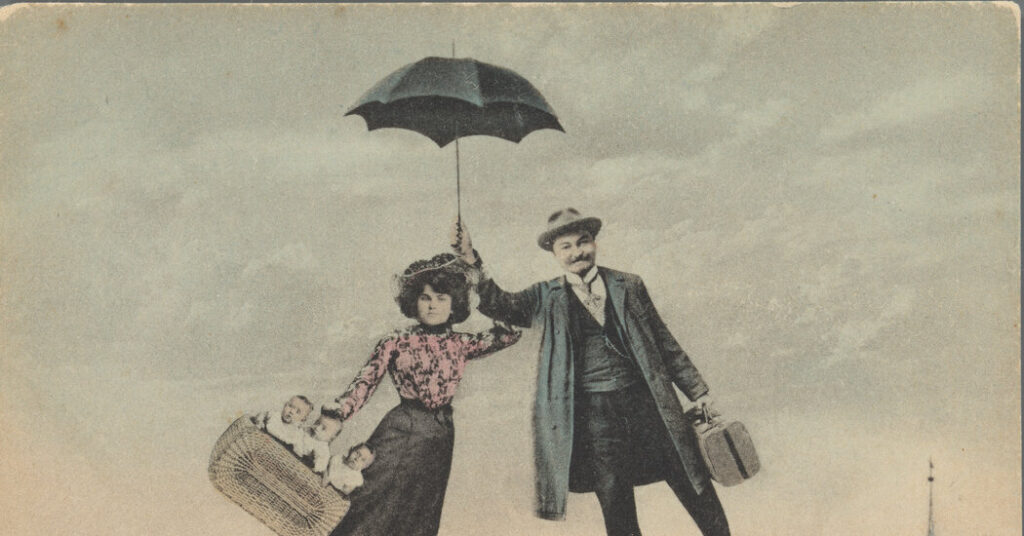
“Trick photography” at the turn of the 20th century included whimsical images of flying cars, carriages filled with suspiciously huge vegetables and a man pushing a wheelbarrow containing his own head.
When magazines and newspapers started incorporating photography around 1920, new codes of conduct and ethical standards for photojournalism led to an expectation of authenticity.
Illustrators like Heartfield made their satirical cut-ups to show the public how easily the media could be manipulated. But at the same time, Hitler’s propagandists used photography to glorify the regime, and in the Soviet Union, Joseph Stalin had photo technicians airbrush his enemies, like Leon Trotsky, out of official photographs to erase them from history.
That was long before the advent of Adobe Photoshop in 1990, Snapchat in 2011 or the generative A.I. breakthrough of 2023. In the course of 150 years, fakes have proliferated and now dominate our media landscape, according to Hany Farid, a professor at the University of California, Berkeley who specializes in the forensic analysis of digital images and gave a popular TED Talk about how to detect A.I. deepfakes.
Today’s A.I.-generated fakes aren’t part of a steady continuum, he said. From 1860 to now, we “went from 0 to 150 miles an hour,” he said. “This is not the same thing or a slight variant of it, right? This is wildly different.”
While it is not fundamentally new that we can create fake photos, Farid said, we can now “do it at a speed and a scale and a level of sophistication” as never before. “We’ve raised the bar in terms of what’s possible and simultaneously lowered the bar in terms of who can do it,” he added.
The danger of fakery today, he said, is that the average person isn’t trained to differentiate between original and manipulated images, or wholly generated images. As the technology to create fully fledged fakes improves exponentially, our ability to tell the difference will be reduced to zero.
“I would say in a year, it’ll be over,” Farid said. “The average person on the internet, doomscrolling on TikTok or Twitter, they’re not going to be able to do it.”
Fiore agreed with Farid, but he thinks most people are already second-guessing every photo on social media these days.
“We’ve reached that end,” he said. “I feel like we’ve entered that phase where everybody might look at a real photo with a news story and think, ‘Oh yeah, nice A.I. image.’ Then you realize, ‘Oh wait, no: That’s real.’ Now we’re in a phase where a photo is false until proven otherwise.”
For Rooseboom, exploring the historical roots of visual manipulation helps remind us to ask ourselves: “Do I believe this?”
“By going back in time and seeing these obvious fakes, it will remind you, ‘Look out, don’t trust your eyes without critical rethinking,’” he said. “We should be on the alert and not take for granted that every image we see is true. That’s something you need to train.”
Fake! Friday through May 25 at the Rijksmuseum in Amsterdam; rijksmuseum.nl.
The post A.I. Loves Fake Images. But They’ve Been a Thing Since Photography Began. appeared first on New York Times.