“It’s really over,” says the TikToker @joebro909. “TikTok’s washed.” In the video — a conversation he’s having with a character also played by himself — @joebro909 and his alter ego can’t find any new memes to send each other. When a new one appears on his screen, he tries to send it, but within seconds declares: “The meme’s dead. It’s not funny anymore.” The life span of a meme’s humor has grown impossibly short, creating what he calls the “TikTok drought.” Then he has an epiphany: There needs to be a total reset, a kind of cleanse, one that will lead to a return of the good old days when memes were actually funny.
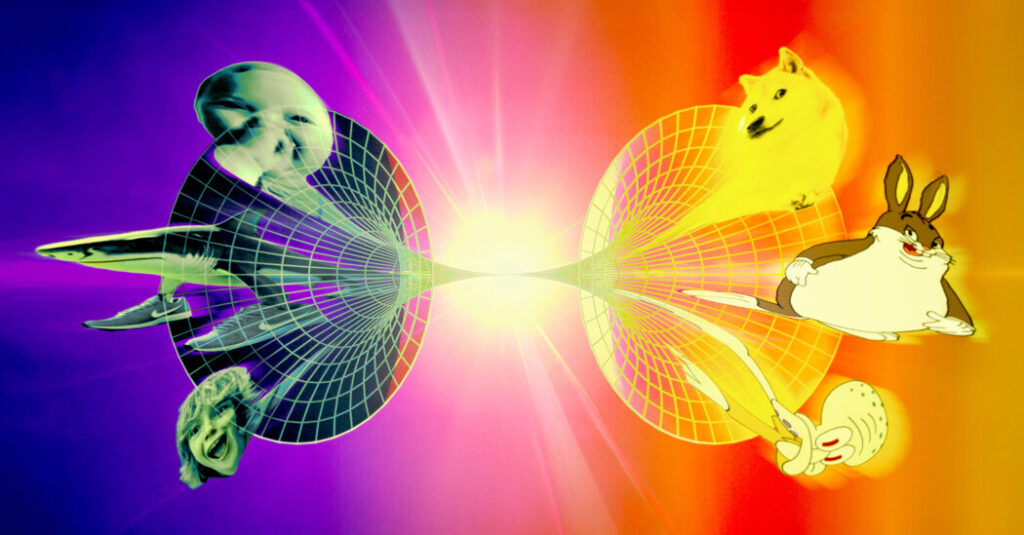
This video was one of many that helped ignite a fantasy on TikTok late last year: the Great Meme Reset. On Jan. 1, 2026, the internet — and especially the corner of the internet that is TikTok — would be purged of its viral inside jokes, images and word-salad formulations. If not all memes, then at least memes that originated after 2016, or maybe 2018, or at least the memes from last year. “No more ‘6-7,’ no more ‘niche baby,’ no more Domer, no more Cassius Thundercock, no more Ballerina Cappuccina and Tralalero Tralala,” one self-appointed meme explainer says in a video for confused adults. As the calendar year flipped, in a Cinderella-like moment, these memes would vanish. TikTokers vowed instead to flood the algorithm with “O.G. memes” — silly images or out-of-context photos you could chuckle at with little prior knowledge, many of which originated in pop culture. The images of an overweight Bugs Bunny known as Big Chungus, for instance, or the Squidward dab, or the classic Shiba Inu before it was co-opted by Elon Musk for his Department of Government Efficiency.
Some calls for the reset were couched in quasi-earnest concern for the degraded state of the internet, and even society. “People of the world! I know things are looking pretty grim, and we’re all worried about A.I. and where the world is going,” a stick-figure animation intones in a high-pitched, synthy voice in one video. “But it doesn’t have to end like this.” Most of it was jokier: a bunny (Big Chungus, of course) standing in front of a montage of war scenes, captioned: “me and da bois in the great meme reset war of 2026.” The word spread: Stop memeing nonsense, and return to the days of yore.
Memes were never the pinnacle of logic, but they have descended almost entirely into the realm of nonsense. Take “6-7,” the 2025 phenomenon of kids making a series of hand gestures and yelling out “six” and “seven.” This was funny to people precisely because it meant nothing. It was trace evidence of the way online content is melding our overstimulated brains, producing in-jokes that can’t really be explained. It’s no wonder their life cycles are so short. How long can you laugh at something you barely understand, just because everyone else is?
These fantasies of return are part of a broader trend toward digital nostalgia. Kids pine for “dumbphones” and play around with pixelated Web 1.0 graphics like the Internet Explorer icon; they wish they had been here for the days of GeoCities instead of short-form video. Now they’ve even managed to become bummed that they missed the “moment” when Pepe the Frog was first funny. But this yearning comes from something deeper than FOMO: It represents a desire for things online to make sense again. These TikTokers want an end to “brain rot” humor, to jokes with no setup and no punchline, to flat characters and plotless content and a climate of incoherence.
All of this isn’t really funny anymore, even for the generation that pioneered this approach to humor, if @joebro909’s video is any indication. The sketch ends with him laughing and nodding approvingly to a clip of Larry David in “Curb Your Enthusiasm” — now that’s funny. At least it makes sense.
The hope, the dream of the Great Meme Reset, was of a kind of self-generated Y2K. If Y2K was envisioned as a digital calamity that would translate into real-world problems (would the banks all fail because we had put too much trust in computers?), then the fantasy of the Great Meme Reset was something like its opposite: a human-driven intervention into a digital realm that seems to be spiraling out of our control. It would be an attempt to wrangle the algorithms back into our own hands and correct what they seem to be doing to our brains, or at least to our jokes.
Of course, it failed. This was all but guaranteed — even its creators seemed only half-serious. A sudden, coordinated purge of content is neither how digital interactions really work nor how algorithms operate. The new memes were going to be hard to outpace and replace; TikTok spoon-feeds users videos based on what they’ve already liked and shared. If that was “niche baby” and “6-7,” more of that content will surface and resurface. Individuals don’t have as much control as they like to think, and brain rot remains firmly lodged in the annals of the internet. In fact, incoherence might be, paradoxically, what gives this brand of humor its staying power. A clip of Larry David is vintage funny, and vintage funny is almost certainly funnier. But it belongs to a different time and a different medium. “Curb Your Enthusiasm” was on television, with its situational dramas — at least loosely scripted — and unfolding plotlines. But we’ve lost the plot, and so, therefore, have our jokes. You can’t eradicate Ballerina Cappuccina any more easily than you can shake the smartphone-induced feeling that nothing makes sense. All that’s left to do is laugh into this vacuum of logic.
Because what is brain-rot humor, really, but a response to the brain-rotting conditions under which we live? It reflects and refracts the sense many of us have that living online is making us stupider, that we’re overstimulating ourselves to the point of dullness — and that we can’t stop. In one sense, this isn’t true: We can stop. There are plenty of things we can do to get ourselves off-line and break these attentional patterns. But even if we remove ourselves from social media, its effects remain socially endemic — just look around on the subway and see how many adults are playing games on their phones. Meme formulas creep offscreen and into speech patterns. (Last year, fully grown adults were saying, “It’s giving main character energy.”) Brain-rot memes respond to all of this formally. They provide a mirror for our distorted attentions. They may seem to rot our brains, but they are showing us something about them, too.
The failure of the Great Meme Reset did provide an opportunity for a whole new genre of TikTok content — videos about how the Great Meme Reset failed. “Everyone lied to you,” someone said. “People posted dramatic goodbyes to 6-7 and Italian brain rot and swore this was the last time. Then 2026 hit and nothing changed.” Some declared a kind of victory; they had never thought it would work and hadn’t wanted it to. “Like some of all y’all really thought we were going to be sitting here laughing at Big Chungus in 2026?” another TikTok user asked. Some people seemed just sad, veering into acceptance that there would be no blank slate after all. The truth is not just that we can’t gain control of TikTok’s mysterious algorithm; we also don’t have control over how we’re influenced by it or how our brand of humor is warping over time. “It’s so disappointing that we couldn’t even come together for a single day to appreciate the memes that got us to where we are now,” @NoahGlennCarter opined emotionally. “Everyone just decided that they love the brain-rot memes, and they’re clearly here to stay.”
Sophie Haigney is a writer. She is working on a book about our obsession with collecting — why and how we accumulate objects, from priceless fossils to plastic Power Rangers. Source for illustration above: Screenshots from Know Your Meme.
The post A Group of TikTokers Tried to Detox Their Timelines. The Memes Were Too Strong. appeared first on New York Times.