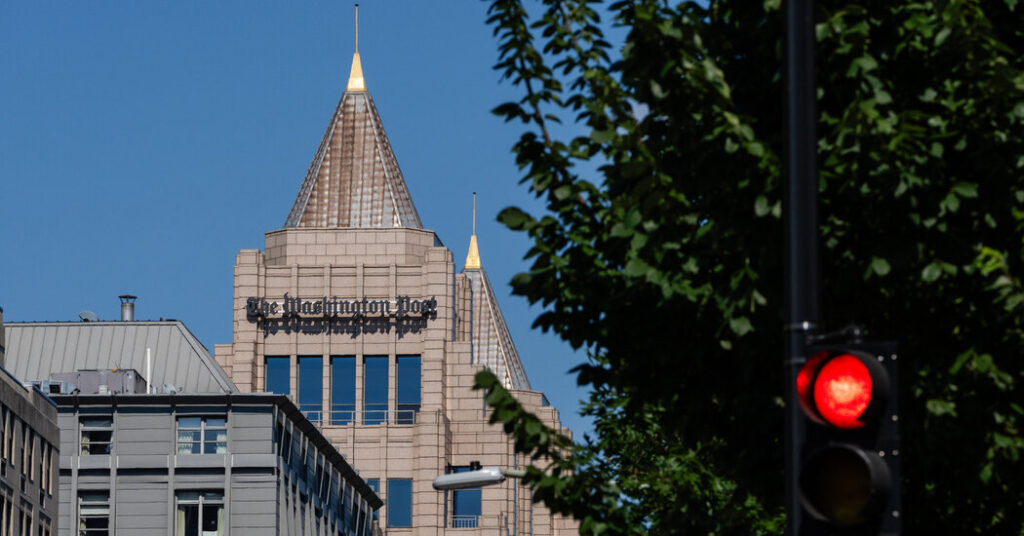
The Justice Department failed to tell a magistrate judge about a 1980 law protecting journalists in its application materials for a warrant to search a Washington Post reporter’s home last month as part of a leak investigation, an unsealed court filing shows.
Gabe Rottman, the vice president for policy at the Reporters Committee for Freedom of the Press, which had asked the judge to unseal the materials, called that omission significant.
“By not alerting the judge to the existence of a federal law that is supposed to limit searches for reporting materials, it may have greased the skids for the judge agreeing to the warrant when otherwise the judge might have scrutinized it more carefully,” Mr. Rottman said.
The 1980 law, the Privacy Protection Act, says “it shall be unlawful” for investigators to search for or seize journalistic work product and documentary materials unless the reporters themselves are suspected of committing certain crimes related to those materials.
The crime by the reporter that can trigger that exception, the statute also says, cannot be mere possession of the materials unless they are child sexual abuse imagery or national security secrets covered by the Espionage Act.
The search last month was part of an inquiry into whether a Pentagon contractor had violated the Espionage Act by leaking classified information.
But it would be a major escalation for the Justice Department to declare that the Constitution permits considering the reporter, too, to have committed that crime. Prosecutors have never charged traditional reporters under the Espionage Act in the face of untested concerns that applying it to ordinary news-gathering activities could violate the First Amendment.
It is so anomalous for the Justice Department to seek a search warrant for reporting material in the first place that there is no established standard for what such applications should address. But in one rare precedent — a 2010 application for a warrant to read the emails of a Fox News reporter — the submission flagged the Privacy Protection Act for the judge’s consideration and made an argument for why the request complied with its limits.
When the 2010 application came to light in 2013, it elicited bipartisan outrage. That request, however, was merely for certain emails — a far less intrusive step than searching the home and seizing the devices of the Post reporter, Hannah Natanson. First Amendment scholars say such a search of a reporter’s home appears to be unprecedented.
The search raised the question of how the Trump administration handled the 1980 law, including whether law enforcement officials had taken the position in court that it was constitutional to criminalize a journalist’s receipt of classified information during ordinary news gathering.
Asked about the matter on the day of the search, Jan. 14, the Justice Department said only that “the search was consistent with the law.” It has not responded to questions about the unsealed filings. Lawyers for Ms. Natanson and The Post also did not respond to requests for comment.
It remains unclear whether the department skipped the analysis entirely, or considered the Privacy Protection Act for itself but chose not to tell the magistrate judge who approved the warrant, William B. Porter of the Federal District Court for the Eastern District of Virginia, about the legal obstacle and its argument for surmounting it.
The disclosure that the department’s submission, at a minimum, failed to flag the existence of the 1980 law’s limitation for the judge comes as the administration has put pressure on journalism on multiple fronts.
Last week, it obtained an indictment of the former CNN anchor Don Lemon and the journalist Georgia Fort after they entered a Minnesota church to film a protest, though a magistrate judge had declined to approve arrest warrants for them. The charges have alarmed press freedom advocates.
The warrant application for Ms. Natanson included an affidavit signed by an F.B.I. agent discussing the case against the government contractor, Aurelio Perez-Lugones, whom prosecutors say violated the Espionage Act by leaking information to Ms. Natanson.
The affidavit said that after Mr. Perez-Lugones’s arrest, his phone showed he had sent information to Ms. Natanson. It listed Post articles with her byline that prosecutors believe relied on documents from him.
But the affidavit does not mention the Privacy Protection Act and its standard that there had to be probable cause that Ms. Natanson herself “has committed or is committing the criminal offense to which the materials relate.”
The Justice Department in recent years has already taken steps toward treating investigative journalistic activities in the national security arena as a crime. During Mr. Trump’s first term, it charged Julian Assange, the WikiLeaks founder, under the Espionage Act for soliciting, receiving and publishing classified documents.
Though Mr. Assange is not a traditional journalist, his charged actions mirrored standard reporting practices. He eventually struck a plea deal with the Biden Justice Department, so the constitutionality of applying that charge to his actions was never tested.
In 1980, Congress passed the Privacy Protection Act after the Supreme Court upheld a police search of a university student newspaper’s newsroom for unpublished photos of a protest.
The remedy for violations of the 1980 law is monetary damages, not suppression of evidence. But a separate federal rule of criminal procedure allows those aggrieved by “unlawful” searches to seek the return of their property. The Post has cited that rule in asking that Ms. Natanson regain possession of her data unrelated to the Perez-Lugones investigation.
The closest precedent for the search warrant appears to be the 2010 warrant for the Gmail account of a Fox News reporter at the time, James Rosen, after he reported on North Korea’s plans for a nuclear test.
Criminal charges over unauthorized disclosures had been vanishingly rare until the Bush administration, when the Justice Department began to charge people accused of leaking more frequently. The surge continued into the Obama administration. As part of that crackdown, the Justice Department prosecuted Mr. Rosen’s source, a contractor for the State Department, Stephen Jin-Woo Kim.
Against that backdrop, when the search warrant application materials for Mr. Rosen’s email account were unsealed in 2013, they drew bipartisan outrage: The affidavit extensively discussed the Privacy Protection Act, but said it did not bar a search warrant because it called Mr. Rosen “an aider and abettor and/or co-conspirator” in his source’s crime of leaking classified information.
That raised the possibility that the Justice Department had considered escalating its crackdown on leaks by prosecuting Mr. Rosen. It also raised questions about testimony by Attorney General Eric H. Holder Jr., who had told Congress he opposed charging reporters for doing their jobs and was not aware of any discussion of that possibility.
Defending itself, the department said it had simply called Mr. Rosen a criminal to get around the Privacy Protection Act and had no intention of charging him.
Critics said this amounted to gaming the law in bad faith, including by relying on a claim that the Espionage Act could be used to criminalize investigative reporting in a way that might not withstand constitutional scrutiny. (Mr. Rosen, who is now the chief Washington correspondent for Newsmax, did not pursue damages, so the move was never tested.)
Mr. Holder then banned officials from calling reporters criminals in search warrant applications to circumvent the 1980 law unless prosecutors really intended to charge them. Last year, however, Attorney General Pam Bondi rolled back that limit as part of a broader move to reduce protections for press freedoms in leak investigations.
Charlie Savage writes about national security and legal policy for The Times.
The post U.S. Failed to Alert Judge to Press Law in Application to Search Reporter’s Home appeared first on New York Times.