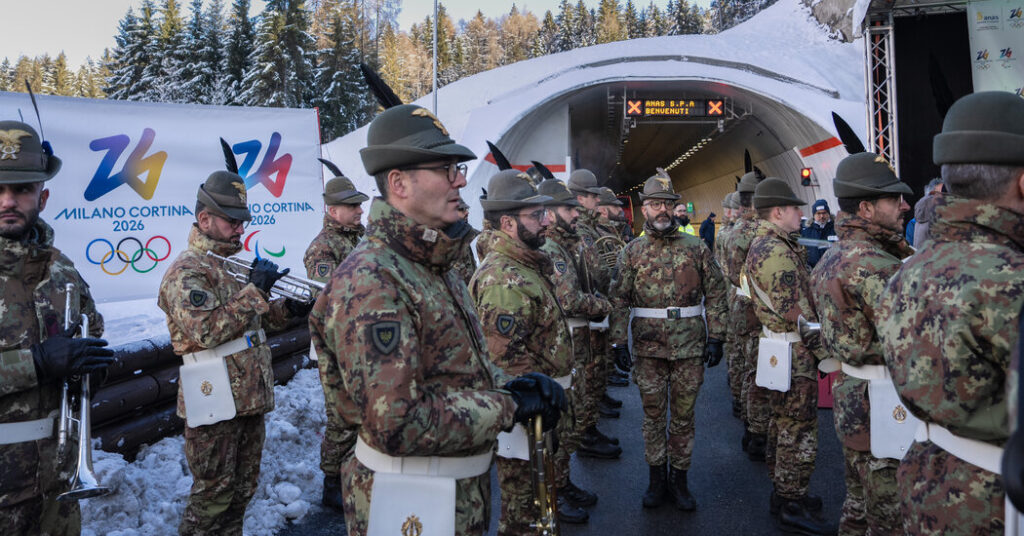
On the day the Olympic flame arrived to Cortina d’Ampezzo, one of the principal hubs of this month’s Winter Games, a potentially more critical ceremony for the event’s success took place 20 miles south beside a curving mountain road.
Claudio Andrea Gemme, the head of Italy’s highway authority, stood on a red carpet that rolled toward the mouth of a tunnel that he and other officials were inaugurating after years of works. “Our goal was to complete this project for the Olympics,” Mr. Gemme said, before an Alpine marching band began playing and drowned him out. He drifted off to greet top Italian government officials and the local bishop, who came to bless the new construction with splashes of holy water and a prayer for the Games.
The 25th edition of the Winter Games, which start this week, will have eight separate locations spread across about 8,500 square miles of northern Italy, a logistical nightmare that has led officials to welcome each new tunnel, increased train service or extended bus route as a thrill of victory in the face of the agony of defeat.
Venues are hundreds of miles apart, and even the seemingly closer ones are separated by winding, icy mountain roads and vast valleys. The men’s downhill competition will be in Bormio, north of Milan. Nordic skiing will be in the Val di Fiemme, the biathlon in Anterselva, near the border with Austria. Officials have cast the choice as innovative and sustainable, avoiding major new construction while improving local infrastructure like the road network around the tunnel blessed by the bishop. They have also pitched the diffuse strategy as a gift to spectators, giving them more of Italy to explore.
“I can watch curling here and then travel to Predazzo to see the ski jump for two days then in Milan I can see hockey,” said Gianluca Lorenzi, the mayor of Cortina. He spoke enthusiastically about the possibility of taking a bus to Mestre, near Venice, catching a train to Milan and then somehow getting up to “what’s it called, Livigno, to watch something. I understand it’s more complicated, but it’s also more beautiful, because one can see all of the valley.”
That rosy vision of a cross-country Olympics has been the talking point of the Milan-Cortina Organizing Committee from the get-go. “In an event that embraces different territories, movement becomes the beating heart of the organization,” Andrea Varnier, the committee’s chief executive, told Fleet Magazine, a Milan-based publication dedicated to traffic.
Out of necessity, Italy blew up the old town-and-country model of the Winter Olympics, where stadium and ice sports were often held in a single host city, while skiers competed nearby in the surrounding mountains. After the Beijing 2008 summer games cost more than $40 billion, Thomas Bach, then president of the International Olympic Committee, sought to bring down costs and emphasize sustainability by imploring candidate countries to propose using existing venues and adapting to local needs. Italy did just that, but it also needed to make sure that its trains, planes and automobiles ran on time.
It added zero-emission buses, more trains and a fleet of Fiat Pandas and Alfa Romeos to shuttle around officials and other V.I.P.s. All those vehicles are expected to make 400,000 trips and transport 1.5 million people. In the race to finish the upgrades before the Olympics began, roads were a slalom of traffic cones, as workers painted crossing stripes, poured cement and unwrapped new signs.
To help travelers get around, the Games’ organizers have introduced an official transport app that explains how to move between events. It is thorough.
According to the app, the “best route” from the curling and bobsled events in Cortina, in the Dolomite mountains of northeastern Italy, to the snowboard competitions in Livigno, on the border between northwestern Italy and Switzerland, is to walk eight minutes, take the TC-CO-AS transport shuttle for 3 hours and 3 minutes to Venice; walk another four minutes to catch the 9748 high speed train for 2 hours and 15 minutes to Milan’s central station, where, after a walk of five minutes, one can take the 9074 regional train for 2 hours and 39 minutes to Tirano; then walk another two minutes to the bus station, catch the TC-VA-01 bus for 50 minutes; then change to the TC-VA-02 bus for nine more stops and another 1 hour and 12 minutes and walk nine minutes to the competition site.
The estimated travel time is 18 hours and 6 minutes.
Already in the days before the opening ceremony on Feb. 6, the Games have been the source of bumper-to-bumper gridlock.
“Temporary road closures related to the passage of the Olympic torch,” the app informed users on Jan. 30. And sure enough, all around the country, the Olympic flame was stopping traffic cold.
In one of those backups, on a narrow mountain road alongside fog-shrouded peaks in the Italian alps outside Cortina, passengers abandoned their cars to stretch their legs or walk a leashed cat. After nearly an hour, they watched a caravan of police cars with blue sirens, red and yellow trucks equipped with D.J. booths, shuttle buses and a van — apparently with the flame inside — drive by.
Some officials fear a wintry mix will also snow on the logistical parade. Heavy snowfall is anticipated in Cortina during the first week of February, leading one top Italian Olympic official, who spoke on condition of anonymity to avoid stating the off-message obvious, to urge spectators in one location to watch events in another on television.
In recent days, Cortina was already hammered by a snowstorm that turned the town into an enchanting winter wonderland and traffic nightmare. “Due to the weather conditions in the mountains,” read an alert on the Olympics travel app, “we have experienced some delays in the TC and TG services today.”
Some locals spoke bitterly about the special passes they have had to procure to go about their usual commutes. Others were more optimistic. “Let’s say you travel, you also see the landscape,” said Alessandra Pompanin, 57, from Cortina. “Maybe it won’t even go badly.”
She spoke next to a bobsled track where she and some friends had just helped a group of southern Italians whose car had spun out into a snow bank. That morning, much of Cortina seemed littered with ill-equipped rental cars. “Careful, it’s soap!” a woman walking her dog under an umbrella shouted to a car sliding by a stadium that will host the curling events.
When one reporter (OK, this one) got stuck on a back road, an Olympic gold medal-winning curler had to rescue him in her four-wheel drive.
Some wealthier Olympic enthusiasts have decided to avoid the roads all together.
Davide Rinaldi, a luxury experience concierge, talked about a client who had paid more than 110,000 euros (roughly $130,000) for a 10-day Olympic package that will transport them around northern Italy by helicopter. “They are paying a lot of money for the Games,” Mr. Rinaldi said at the VIP Club in Cortina.
Most visitors, though, are still counting on ground transportation. For them, improvements like the new tunnel, in the small town of Tai di Cadore south of Cortina, were a breakthrough.
“Thanks to these Olympics,” the government had been able to invest more in public infrastructure projects, said Matteo Salvini, Italy’s minister of transportation, at the ceremony. The Olympic spirit seem to carry away the hard-right anti-immigrant populist — Mr. Salvini even thanked foreign workers who had helped build the tunnel. But only to a point, as he noted that the immigrant laborers “shouldn’t be confused with the fools who infest our train stations.”
The local Gazzetino newspaper echoed Mr. Salvini’s enthusiasm, heralding the opening with an “Olympics out of the Tunnel” headline. Yet its other Olympics-related transportation news was a reminder that the overall picture was more complicated.
One story blamed the Games for a hike in bus ticket costs. “Eleven-year-old kicked off bus,” the story read. “The little guy didn’t have 10 euros for a ticket and had to walk six kilometers in the snow.”
Through it all, the app has kept visitors updated. “A strike has been announced,” a daily service alert read on Feb. 1, advising visitors how to get around the work stoppage on Trenord train service connecting Milan to the venues in the Alps. “To reach the Valtellina Cluster: connect by bus to MXP and take the direct lines to Bormio.”
Jason Horowitz is the Madrid bureau chief for The Times, covering Spain, Portugal and the way people live throughout Europe.
The post Trekking Among Italy’s Winter Olympic Venues? You’d Better Not Be in a Hurry. appeared first on New York Times.