Hours after Alex Pretti was shot and killed by federal agents in Minneapolis, Apple’s chief executive, Tim Cook, joined President Trump; his wife, Melania; and other luminaries in the White House to attend a screening of a documentary devoted to the first lady.
Apple employees voiced anger in internal Slack channels, while other Silicon Valley tech workers publicly denounced the Trump administration’s deployment of federal officers across America. Workers at Palantir erupted in internal complaints over the software company’s work with immigration enforcement. At Meta, some longtime employees are considering leaving the company, saying it is now led by a MAGA-skewing chief they no longer recognize.
But by and large, tech employees reacted to how their leaders addressed (or failed to address) what’s happening in Minneapolis with exhausted apathy. At a time when companies are shedding workers by the thousands, dumping them into an increasingly shaky job market, tech employees feel mostly powerless to influence an industry whose leaders had once convinced them they could change the world.
There are many theories about Silicon Valley’s swift, and very conspicuous, rightward turn. Tech leaders course-corrected from an overly permissive era. The Trump administration demands fealty in exchange for critical regulatory favors. Mr. Trump’s re-election reshaped the national climate and reoriented the values of tech leadership.
Each of these explanations is convenient, but none are correct. I’ve worked in tech for 20 years, across both Big Tech and venture-backed start-ups, and I can tell you the truth is much more mundane. Silicon Valley’s chief executives have always been driven by economics, not ideology. As Michael Corleone put it: It’s not personal — it’s strictly business.
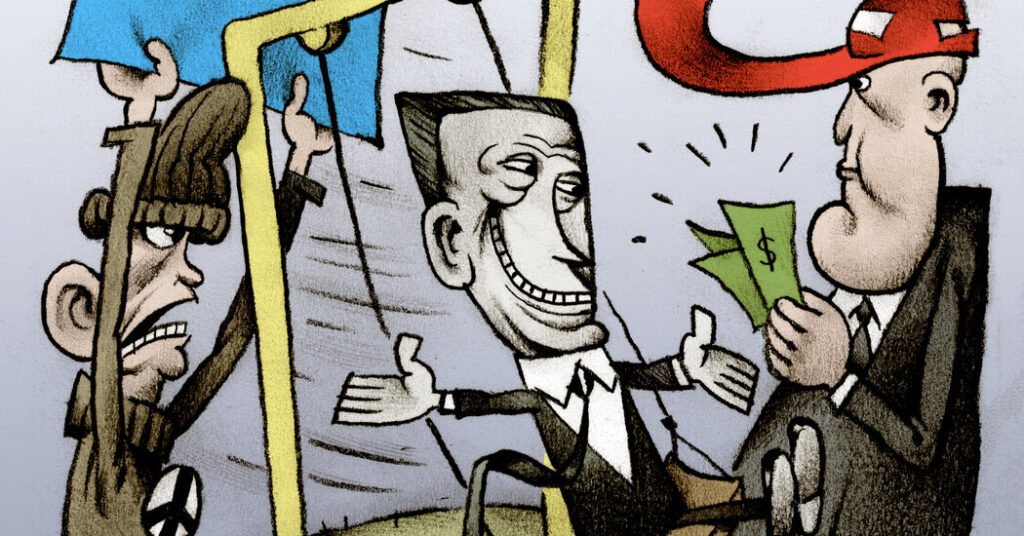
What has happened in tech is a market correction, not a cultural one — a transfer of power from labor back to management. To attribute this change to a “vibe shift” among tech leaders may flatter political actors, but it’s beside the point. The real danger is mistaking a change in leverage for something permanent, or confusing business incentives with values. The idea of “woke corporations” was always flawed — conflating business strategy with political belief distorts not just how we understand the tech industry, but also how we interpret corporate power in American life more broadly.
Here’s how Silicon Valley actually works. Big tech companies and growing start-ups are in constant, vicious competition with one another to hire and retain the best employees, especially in product and engineering roles. When these companies are in hypergrowth mode, and particularly when the job market is tight, hiring top talent can be nothing short of a matter of survival. And they are fishing in a largely progressive pond: Political donation data shows tech employees are predominantly Democratic-leaning.
The late 2010s and early 2020s were a particularly intense period in the industry’s war for talent. Hiring exploded. Meta nearly doubled to 86,000 employees in 2022 from approximately 45,000 three years earlier. Amazon added over 400,000 employees in 2020 alone. As Silicon Valley recruiting teams relentlessly poached one another’s people, tech labor had infinite choices and all the leverage.
So what did companies do when a generous compensation package was no longer enough to win over candidates? They instead sold a sense of belonging. Amid fierce competition, many companies realized that encouraging workers to bring their perspectives and passions to the office could increase their loyalty and their willingness to work hard. That, in turn, served the real financial objective: higher job acceptance rates, lower employee attrition and faster growth.
When the pandemic further supercharged hiring, tech companies started a corporate-values arms race to differentiate on employee experience. LinkedIn gave workers a paid full week off to combat burnout. Pinterest increased monetary assistance for adoption and expanded fertility benefits. Even Tesla made Juneteenth a company holiday (and no one would accuse Elon Musk of being “woke”). Companies said, “Bring your whole self to work.”
Tech didn’t embrace these policies out of moral enlightenment. It did it because replacing a top engineer could cost hundreds of thousands of dollars in lost productivity, institutional knowledge, recruiter time and onboarding. When attrition costs are existential, empathy becomes a strategy. Whether it’s flexible work-from-home policies or mental health stipends, you give your people what they want or they’ll go somewhere else to get it. “Whole self” culture wasn’t part of a political movement. It was a labor-market artifact where talent war conditions made employee empowerment economically rational.
A new economic reality following the height of the pandemic — evident in Silicon Valley Bank’s failure, a “crypto winter” of plummeting currency prices and a significant slowdown in the tech sector’s growth — ultimately pushed companies from Amazon to Microsoft to rein in spending on hiring, and the incentive structure flipped. Because they no longer needed to compete for labor at any cost, executives exhausted by their formerly empowered employees were happy to take back the control that they’d ceded. The slowdown didn’t just change how companies behaved; it exposed what had been driving their behavior all along.
It’s worth asking whether many tech companies’ professed values were ever real. We’ve seen leaders who built their reputations on defying authority become foot soldiers for the administration. The same elasticity informs their rollback of the culture they once championed.
Four years ago, Marc Benioff, the Salesforce boss, said, “Office mandates are never going to work.” He now works from home in Hawaii much of the time while most of his employees are required to be in-office three to five days a week. In 2020, Mark Zuckerberg announced that Facebook would donate $10 million to groups working on racial justice. Last year he rolled back Meta’s D.E.I. programs. Did his values change? Or did the power dynamics?
Of course, work is not the best place for cubicle fights about the war in Gaza. Nor is it a place where lavish perks are entitlements. These companies are businesses, not nonprofits. But when companies said “be your authentic self,” and then silenced employees who raised societal concerns related to their work, they essentially blamed workers for a culture war they didn’t start and disciplined them for holding leaders to the values they had promoted.
This about-face will prove counterproductive over the long term. In my conversations with tech employees, the result hasn’t been anger at hypocrisy so much as detachment — a loss of tribal loyalty (fewer T-shirts emblazoned with tech company logos), and a clearer understanding of the limits of corporate idealism.
The recent reassertion of managerial prerogative was only possible in an economic environment where top executives could flex their muscles like a boss. It won’t last forever. When labor is scarce again, many of these companies will rediscover the values they abandoned. The question is whether employees will forget just as quickly.
Aaron Zamost is a tech communications consultant and former head of communications, policy and people at Square.
The Times is committed to publishing a diversity of letters to the editor. We’d like to hear what you think about this or any of our articles. Here are some tips. And here’s our email: [email protected].
Follow the New York Times Opinion section on Facebook, Instagram, TikTok, Bluesky, WhatsApp and Threads.
The post The Real Reason Silicon Valley Won’t Stand Up to Trump appeared first on New York Times.