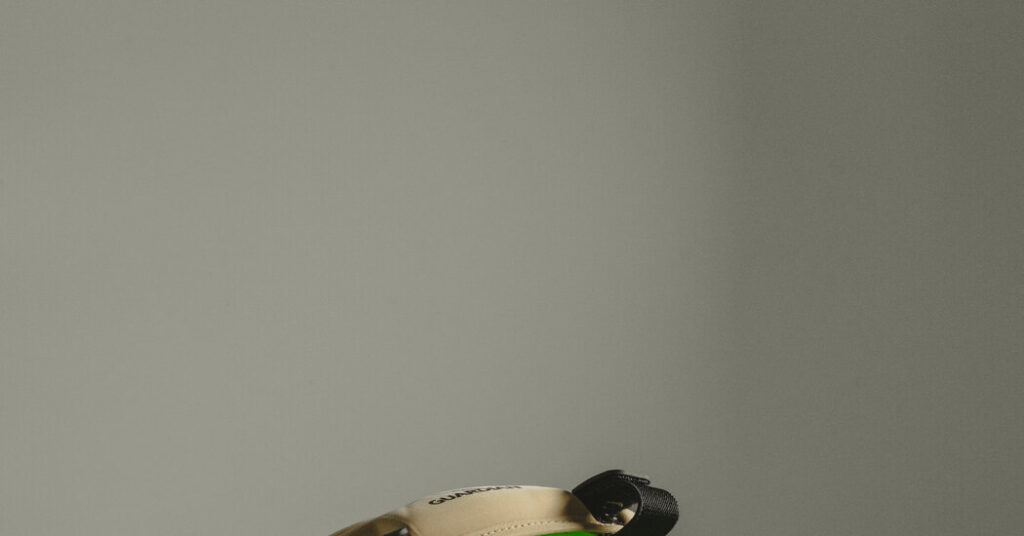
The first time Jared Wilson, a New England Patriots offensive lineman, is seen on the Super Bowl broadcast on Sunday, some viewers may wonder why he has such a big helmet.
It’s called a Guardian Cap, and Mr. Wilson is among about two dozen National Football League players who have worn the helmet covering in games this year. Not for comfort or style. Even the company that makes the cap acknowledges that it’s bulky and ugly. Rather, Wilson and others have worn it for its purported safety benefits.
The N.F.L. claims the cartoonish caps reduce the risk of getting a concussion, convincing some players that they are worth wearing. The company that designed and manufactures Guardian Caps, though, makes no such claim.
“No helmet, headgear or chin strap can prevent or eliminate the risk of concussions or other serious head injuries while playing sports or otherwise,” the product’s disclaimer warns. Instead, the company says its caps blunt the impact of smaller hits to the head that are linked to long-term brain damage.
“It has nothing to do with concussions,” Erin Hanson, a co-founder of Guardian Sports, the Atlanta-area company that makes the cap. “We call concussions ‘the C word.’ This is about reducing the impact of all those hits every time. That’s all that was.”
The disconnect between the N.F.L.’s claims about the Guardian Caps and what the company promises is emblematic of the messy line between promotion and protection, and the power of the N.F.L. to sway football coaches and players trying to insulate themselves from the dangers of the sport.
An endorsement by the N.F.L., the country’s most visible and powerful sports league, can generate millions of dollars in sales for equipment makers, including Guardian Sports. The N.F.L.’s embrace of the caps, beginning in 2022, has led to a surge in orders from youth leagues to pro teams. About half a million players at all levels now wear them, Guardian Sports said.
“Anything I can do to save my brain, save my head,” said Kevin Dotson, an offensive lineman on the Los Angeles Rams who has worn the cap in games since last season.
The league claimed that the Guardian Cap had helped reduce concussions by more than 50 percent, which has put the company in the awkward position of embracing the spirit of the endorsement while distancing itself from the facts of it. Further complicating the situation: The model worn by pro and college players, the NXT, is not the same as the company’s mass-market product, the XT, which retails for $75. That model has less padding than the NXT, and may be less effective at limiting the impact of hits to the head, studies have shown.
Ms. Hanson said the company had struggled with whether to promote the N.F.L.’s claims about concussions. It decided to do so because the N.F.L.’s boasts might persuade young players to use the product, even if the benefits are not comparable.
Guardian Sports’ website includes testimonials from the N.F.L.’s commissioner, Roger Goodell; the league’s head spokesman, Jeff Miller; a current N.F.L. player; and two former players, including Deion Sanders, who as a college coach had his players use the caps.
Young athletes “don’t want to do anything that their heroes aren’t doing,” Ms. Hanson said. “So once the N.F.L. took note and they are seeing it, now suddenly it’s OK. So that filters down. Now I’m in the position of, if I report what the N.F.L. is seeing, the chances are I’m going to help some 11-year-old in the middle of Kansas.”
Guardian Caps are the latest in a wave of products that have emerged since researchers linked the sport to the progressive brain disease known as chronic traumatic encephalopathy, or C.T.E. Scores of companies have introduced equipment that purports to prevent head injuries, from a silicone collar worn around a player’s neck, known as the Q-Collar, which is promoted as a way to give the brain an extra layer of cushioning, to G8RSkin Shiesty, a head covering that is worn under helmets and promises to significantly reduce concussion risk.
Independent neurologists are generally skeptical, if not outright dismissive, of the benefits of any product claiming to reduce concussions because few rigorous studies have been done to demonstrate their effectiveness.
Few products have received as much publicity as the Guardian Cap, though. Sales of the caps, which were introduced in 2012, took off after the company won the N.F.L.’s HeadHealthTECH Challenge in 2017 — two years after the league settled a lawsuit brought by more than 5,000 former players who accused the N.F.L. of hiding from them the dangers of concussions.
Guardian Sports received $20,000 from the league for additional testing, but the N.F.L.’s endorsement was priceless.
Orders for the caps from colleges, high schools and youth teams poured in. Nearly every college team in the top ranks practices with the caps. In 2021, researchers, including some affiliated with the N.F.L. and its players’ union, published a paper that said Guardian Caps reduced “head impact severity” by 9 percent.
That year, Guardian Sports introduced its NXT model, with an extra layer of padding for bigger, stronger players. The N.F.L. required linemen, tight ends and linebackers to wear them in training camp. In 2023, the mandate expanded to all contact practices, and running backs and fullbacks were added. Starting in 2024, wide receivers and defensive backs had to wear them in practices, and players could wear them in games.
After the caps were required in practices, the league said, concussion rates began to decline. Last year, researchers, including some affiliated with the N.F.L. and its players’ union, published a peer-reviewed paper in The American Journal of Sports Medicine that looked at the rate of concussions in preseason practices from 2018 to 2023.
While the rate declined between 54 and 62 percent, the authors said there was no way to conclude the reduction was solely attributed to the Guardian Caps. They also noted that when looking only at concussions caused by hits to the helmet shell — one of the most common causes of concussions — there was “no longer a significant relationship” between the use of the Guardian Cap and the incidence of concussions.
After questioning by a reporter about this research, Guardian Sports added language to its website to clarify that the league had found that the reduction in concussions was also caused by “additional protective measures.”
“The bottom line for us is that we saw what the number of concussions looked like for the players who are wearing the Guardian Cap,” said Mr. Miller, the league’s chief spokesman. “There’s no question that every injury or injury reduction strategy is multifactorial.”
While Americans suffer millions of concussions each year, their causes are not fully understood. Whiplash and collisions are often cited, but doctors cannot explain why, for instance, one athlete might be concussed while another player under the same circumstances might not. Many concussions also occur when a football player’s head hits the ground, or when he is kicked while on the ground.
In one study, published in The British Journal of Sports Medicine, researchers tracked 2,610 high school football players in Wisconsin and found that the Guardian Cap’s use was not associated with a lower risk of concussions.
The National Athletic Trainers’ Association said in a position paper that “helmet add-on products may overstate injury prevention benefits.”
Researchers at Virginia Tech, which runs a well-regarded helmet-testing laboratory, found that players who wore the NXT version of the Guardian Cap experienced a 14 percent decline in rotational accelerations — basically, the turning of the head — and that their concussion risk was 34 percent lower than for players who wore only helmets.
The benefits were significantly lower for players who wore the XT, the model worn in youth leagues and high schools. Rotational acceleration was only 5 percent lower, and the concussion risk was reduced by 15 percent.
Stefan Duma, who leads the lab, said the smaller reductions, combined with better helmets and fewer full contact practices, suggested that the benefits of wearing the XT were negligible.
“We tested it thoroughly, and the benefits are just not there,” Dr. Duma said. “It’s all noise, no statistical difference in youth.”
Most parents and coaches, though, do not read research reports from testing labs, and there is little information on the Guardian Sports website that explains the difference in performance between the XT and NXT models. But looking at the testimonials on the website from Mr. Goodell and other N.F.L. luminaries, parents and coaches might believe they were buying the cap worn by the pros.
Ms. Hanson said the company was not trying to deceive anyone. While the NXT is shown on the website, she noted, it is described as being for college and pro players 250 pounds or more, and is available only through a company representative.
“We have to figure out if it’s sending the wrong message, and if it is, we need to take it down,” she said. She added that her goal was to get younger players to wear the caps, and that if the N.F.L.’s use of Guardian Caps helped persuade them to buy their own, so much the better.
“Your heart wants the little guys to get protection,” she said.
Ken Belson is a Times reporter covering sports, power and money at the N.F.L. and other professional sports leagues.
The post The Questionable Science Behind the Odd-Looking Football Helmets appeared first on New York Times.