The general bewilderment that bedevils the economic mandarins these days was captured by a recent World Bank note: “Global Growth Defies Expectations.”
Forecasts that turn out to be wrong — or defy expectations — are as routine as a heartbeat.
But now something is up. Familiar guideposts to how businesses, consumers, investors and workers have historically responded to economic slings and arrows have turned out to be less reliable.
This has made interpreting the cascade of data trickier than ever. It’s as if cars, instead of slowing down at a flashing yellow light as expected, started speeding up.
Consider people’s spending habits. Normally when consumers are gloomy about the economy, they tend to spend less, wary of what lies ahead.
And in the United States, consumers’ outlook has been depressed. In every category, from rising prices to the job market, a survey showed that consumer sentiment has dropped to a 12-year low. Yet Americans have not stopped shopping. Consumer spending has risen steadily.
The stock market, too, has generally been on a tear despite pell-mell disturbances, including a worldwide trade war, whiplash-inducing policy changes, threats to central bank independence, military conflicts and rising geopolitical tensions, titanic debt, and a possible financial bubble related to artificial intelligence.
“It’s just been remarkable that we haven’t seen more big swings going on,” Kenneth Rogoff, author of “Our Dollar, Your Problem,” said of the market’s calm.
Many businesses have also shrugged off uncertainty.
“Textbooks would say uncertainty is bad for economic growth, but there’s not much evidence that it’s had a significant impact on the U.S. economy so far,” said Neil Shearing, group chief economist at Capital Economics. “Business investment is the first place you would expect it to show up, but that’s been strong.”
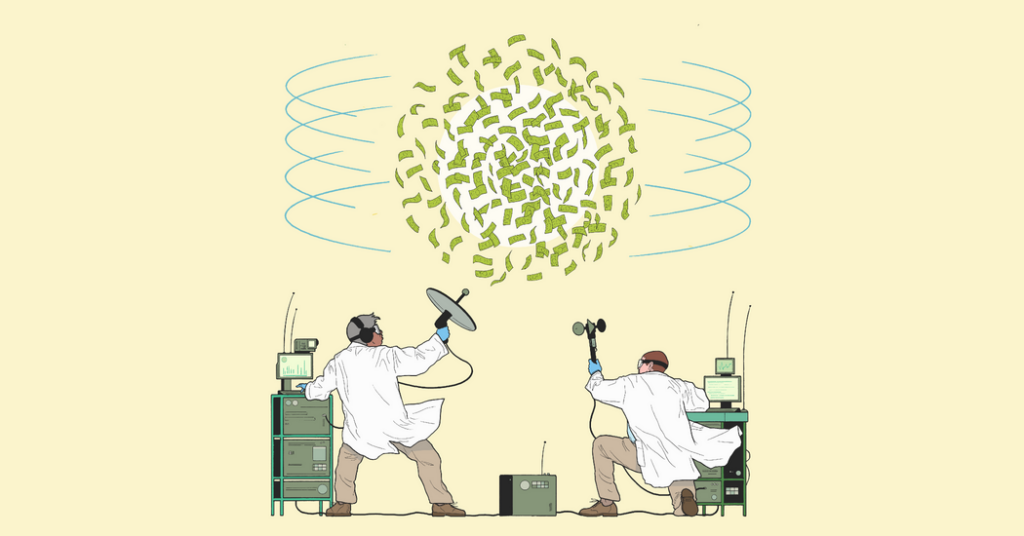
In some ways, scrambled expectations should not be that surprising. Even in quotidian times, economists tend to exaggerate the scientific precision of their field, acting as if economies are ruled by inexorable forces instead of the uncoordinated activities of mercurial human beings with varied goals and drives.
The Covid-19 pandemic delivered a major shock to the global economic system. And now the unpredictable volatility has been further supercharged with the transformation of the world’s economy and geopolitical order that President Trump has pushed forward.
The cooperative system of trade based on rules is giving way to great power aggression and mercantilism. With so much change happening so fast, historical patterns are cracking.
Usually reliable indicators that signal a recession is starting have also gone kerflooey. A sudden and marked rise in unemployment, for instance, has historically been remarkably successful in predicting recessions.
Yet this linkage has broken. A measure called the Sahm Rule, after Claudia Sahm, a former Federal Reserve economist, predicted a recession in 2024 that never materialized.
Another recession signal — the difference between returns on long-term and short-term bonds, known as the yield curve — has been a washout. Normally, long-term government bonds offer higher rates than short-term bonds because investors don’t want to tie up their money for a long time when the economy is good.
So when the normal yield curve turns upside down, or becomes inverted, and rates on short-term bonds are higher than on long-term ones, it has traditionally been a sign that the economy is about to stumble into recession.
But this indicator, too, was off base, most notably in 2022 and 2023.
The traditional connection between the American economy’s performance and the value of the dollar has also been snapped. Uncertainty tends to increase the dollar’s value compared with other currencies as investors seek a safe haven in risky times. But the dollar has sunk to its lowest level in years.
These are weird times. Still, putting aside instances of “irrational exuberance” like the possible overinvestment surrounding artificial intelligence, there are reasonable explanations for most false signals.
Analysts backed down on their predictions that Mr. Trump’s tariff blitz last spring would cause higher prices, rising unemployment and a possible recession. Tariff levels continued to flip-flop unpredictably, and many businesses stockpiled goods in advance while others temporarily absorbed higher costs.
As for vigorous consumer spending, it is actually dominated by a thin sliver of high-income households. Moody’s Analytics estimated that the top 10 percent of households accounted for nearly half of all consumer spending.
People who are worried about their financial prospects are shopping but at discount stores.
And what they are spending money on has shifted. Recent credit card data from Bank of America showed that people were shopping more at grocery stores at lunchtime and less at restaurants and eateries, suggesting that rising prices are a concern.
The unusually weak dollar can be explained by Mr. Trump’s heavy tariffs combined with fears that he may interfere with the Federal Reserve’s independence and fuel inflation.
Barry Eichengreen, a professor of economics and political science at the University of California, Berkeley, said economists had always tended to rely too much on conventions.
“The economy is an incredibly complicated beast, and we’re in a period of structural change,” Mr. Eichengreen said, “so it’s not surprising that simple rules of thumb increasingly fail.”
Patricia Cohen writes about global economics for The Times and is based in London.
The post The Global Economy’s Warning Signals Are Broken appeared first on New York Times.