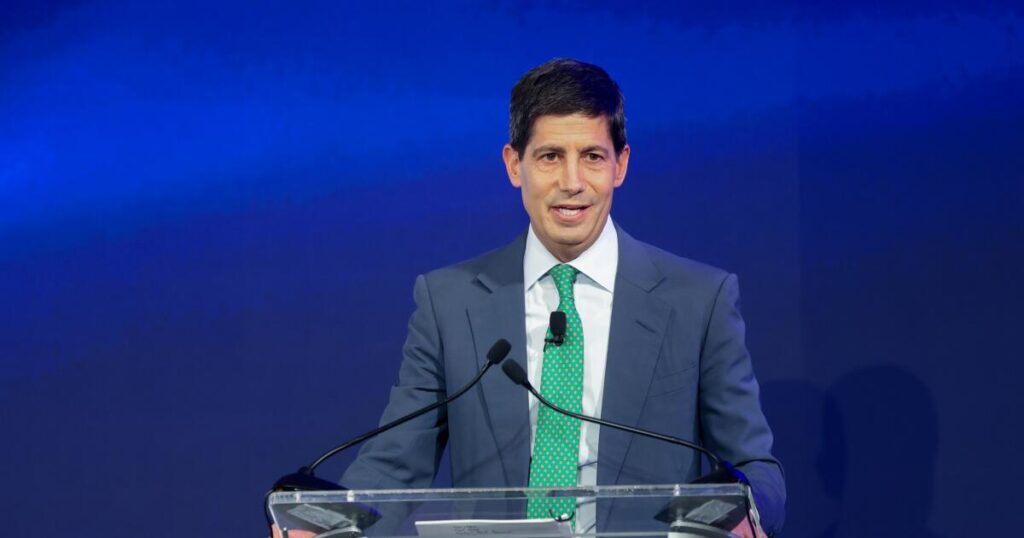
The one thing that was clear about President Trump’s nomination of Kevin M. Warsh as chairman of the Federal Reserve Board, announced Friday, is that the investment community didn’t really know what to make of it.
The dollar rallied, even though Warsh has been agitating for more rate cuts, which tend to undermine the dollar’s value. Gold and silver spot prices plummeted, with the latter experiencing its worst day in 45 years, as fears about Trump’s attacks on the Fed’s independence eased — despite Warsh’s alignment with Trump’s disenchantment with the Fed’s management.
The stock market wavered, then recovered through the day Friday, so who knows what those investors think?
Economists and economic analysts were all over the place. They debated whether to define Warsh as an inflation “hawk” — that is, pressing for higher interest rates to keep inflation in check — or a “dove” — advocating lower rates to spur economic growth.
Liberal Nobel economic laureate Paul Krugman argued that defining Warsh as either a hawk or a dove is a “category error,” since he has tailored his approach to rates to which party is in the White House, calling for higher rates in Democratic administrations and lower rates for Republicans.
To the extent that investors and economists breathed sighs of relief with Trump’s announcement, one main argument was that at least Warsh isn’t the other Kevin.
That would be Trump’s top economic aide, Kevin Hassett, whose has shown himself such a sedulous sycophant of Trump’s that he lost all credibility as a potentially independent Fed nominee, especially as Trump stepped up his attacks on current Chairman Jerome Powell. (You may have recognized Hassett in his frequent appearances on cable news shows for his smug grin with which he delivers the White House mantra that Trump’s economic policies are working great, though you may have to wait a year or so for the benefits to show up.)
If confirmed by the Senate, Warsh would take office as chairman in May; Powell could stay on as a Fed governor through January 2028.
As for the critical question of whether a Chairman Warsh would stand up for the Fed’s independence from political pressure, such as the squeeze Trump has applied to Powell, the received wisdom is that he’ll protect the central bank from overt pressure, but might do so by advocating the policies Trump wants anyway.
Whether Warsh’s appointment will move Fed policy in the direction Trump desires is doubtful. The Fed chair gets one vote out of 12 on the Fed’s rate-setting Open Market Committee. The chair’s influence depends on his or her credibility among the other 11, and whether Warsh can summon the necessary intellectual authority is unknown.
In recent committee meetings, eight members have sided with Powell on rate decisions; the three Trump appointees to the Fed board, including Warsh, will be in a tiny minority if he tries to goad the committee into making rate decisions they consider unwise.
On paper, Warsh’s credentials as Fed chair look decent enough. He served on the Fed’s Board of Governors from 2006 to 2011, as an economic assistant in the George W. Bush White House from 2002 to 2006 and before that as an investment banker at Morgan Stanley.
Currently, Warsh is a partner at the Duquesne Family Office, the personal investment vehicle of hedge fund billionaire Stanley Druckenmiller (with whom he has co-authored the occasional op-ed). Warsh also serves as a visiting fellow at the conservative Hoover Institution. He isn’t an academically trained economist, but that’s not necessarily a disqualification. Neither is Powell — he and Warsh are lawyers.
I asked Warsh via the Hoover Institution to comment on the criticisms he’s received and got a cordial demurral from a Hoover representative.
There isn’t much mystery about why Trump found Warsh so appealing. One factor is his partisan provenance; he’s the son-in-law of Ronald Lauder, heir to the Estée Lauder fortune and a heavy contributor to GOP candidates, including Trump. Another is Trump’s perception that Warsh looks the part of a Fed chair: “On top of everything else,” Trump said, “he is ‘central casting.’”
But the most important factors may be that Warsh seems willing to match his economic policies to partisan blueprints, and that he has been almost as hostile as Trump to the current Fed leadership.
So let’s look at Warsh’s record on those last two factors. The major rap on him as an economic policy sage originated during the Great Recession, when he continued to counsel higher interest rates to combat inflation while the inflation rate was in the 2% to 3% range. At a meeting of the Open Market Committee on Sept. 16, 2008, he stated he was “still not ready to relinquish my concerns on the inflation front.”
That was the day after Lehman Bros. filed for bankruptcy, launching the crisis era of the crash. Inflation expectations had been falling for months, as Romesh Ponnuru, editor of the conservative National Review, observed in 2017. Ponnuru contended that Warsh’s resistance to cutting rates contributed to the Fed’s reluctance to do so — exacerbating the crisis — though it’s not clear that his position had that much influence on the other 11 committee members.
Warsh continued plumping for tight money (that is, higher rates) until 2018, during Trump’s first term, when he and Druckenmiller called for lower rates. In 2023, during former President Biden’s term, Warsh again called for higher rates, placing the Fed’s low-rate policy “among the most significant economic policy errors in nearly half a century.”
In September 2024 (still under Biden), he flayed the Fed for slashing rates by one-half of a percentage point. After Trump took office, Warsh reversed course and launched a direct attack on the Fed board. “Their hesitancy to cut rates, I think, is actually … quite a mark against them,” he said on CNBC. He repeated a call for “regime change” at the Fed that he first voiced in 2023.
It’s not unusual for policymakers to change course on interest rates as conditions warrant. For Warsh’s critics, the issue is that his rationales have been incoherent, with no discernible pattern except for advocating higher rates under Democrats and lower rates under Republicans.
By November last year, Warsh showed himself to be fully on board with Trump’s economic policies. “The deregulatory agenda, the most significant since President Ronald Reagan’s, has begun to liberate households and businesses from the dictates of Washington’s bureaucracy,” he wrote in a Wall Street Journal op-ed.
That latter claim warrants examination. The expansion of capital investing is concentrated among artificial intelligence companies, which may be investing in a bubble. Manufacturing employment, the growth of which is ostensibly a Trump goal, hasn’t responded to his constant tariff threats; it’s fallen by 63,000 jobs, or about 0.5%, since he took office.
The sources of some of his assertions about general economic conditions are unclear, or at least not cited in his published work. For instance, here’s what he wrote about Social Security, in a Hoover Institution essay co-authored with Druckenmiller calling in effect for benefit cuts:
“Young people now entering the workforce will actually lose 4.2% of their total lifetime wages because of their participation in Social Security. A typical third-grader will get back [in present value terms] only 75 cents for every dollar he contributes to Social Security over his lifetime. Meanwhile, many seniors with greater means nearing retirement age will pocket a handsome profit.”
This assertion is contradicted by studies linking lifetime Social Security taxes with lifetime benefits. The latest such study, published in December by C. Eugene Steuerle of the Urban Institute, shows that Social Security produces the greatest lifetime gains for lower- and middle-income households.
A single male retiring in 2065 after a lifetime of average earnings at the bottom echelon, say $35,000 annually, would pay $291,000 in lifetime payroll taxes but collect $441,000 in lifetime benefits, calculated as the present value of taxes and benefits in 2025 dollars.
That hypothetical person with maximum covered earnings of $176,100, however, would pay $1.586 million in taxes but receive benefits of only $1.172 million. So the distribution of taxes and benefits is exactly the reverse of Warsh’s claim — the wealthy receive only a portion of their lifetime outlay, but the middle and lower classes pocket what Warsh might define as “a handsome profit.”
Who is this “typical third-grader,” anyway? Warsh and Druckenmiller don’t tell us his or her income or lifespan, essential factors in calculating one’s Social Security return.
That’s just one policy prescription pointing to the question of whose economy Warsh would serve as Fed chair. Another muddle concerns his expectations of economic gains from artificial intelligence. Warsh is confident that AI will be an unalloyed boon for the U.S. economy.
“AI will be a significant disinflationary force, increasing productivity and bolstering American competitiveness,” he predicted in November. “Productivity improvements should drive significant increases in real take-home wages. A 1-percentage-point increase in annual productivity growth would double standards of living within a single generation.”
A couple of things about that. One is that the concept of “productivity improvements” carries more weight in this statement than it can bear. What we’ve seen thus far from the rollout of AI applications is that corporations aren’t shy about ascribing their job cuts to efficiency gains from AI, but the gains haven’t yet appeared and may never materialize at all.
Moreover, while it’s perhaps conceivable that a one-percentage-point improvement in productivity growth theoretically could double standards of living within a single generation, that’s a wild generalization and doesn’t bow to how hard it would be to achieve anything like that improvement: Annual productivity growth has averaged 1.5% since 2004 and peaked at about 2.9% in the 1990s.
So Warsh is talking about increasing productivity growth by one-third or even two-thirds, keeping it there through an entire generation and distributing the gains economy-wide, notwithstanding AI-driven unemployment. To use his own phraseology: “Would it were so.”
The post The best being said for Trump’s pick for Fed chair is that it could have been worse appeared first on Los Angeles Times.