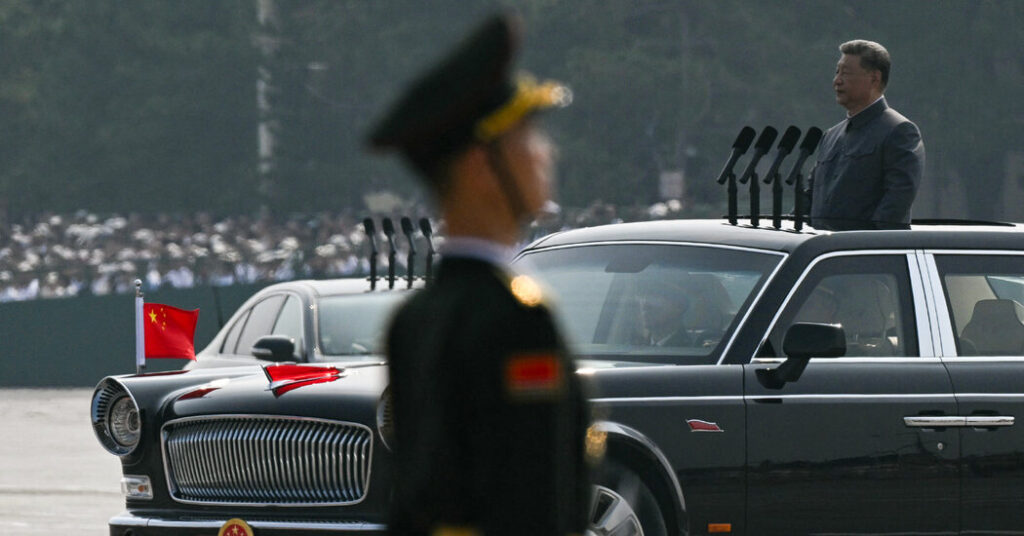
Since taking the reins of the world’s most populous superpower nearly 14 years ago, Xi Jinping has ravaged the ranks of the Chinese Communist Party.
He has taken down ruling officials, security chiefs and children of the party’s “red aristocracy.” But even by those standards, his latest purge was remarkable.
The Chinese defense ministry’s announcement on Jan. 24 that the country’s top military leader, Gen. Zhang Youxia, and an associate, Gen. Liu Zhenli, were under investigation for “grave violations” startled officials and analysts in Washington. General Zhang is a venerated war veteran long believed to be loyal to Mr. Xi.
U.S. officials have been trying to sift through the murky waters of elite politics in Beijing to figure out why China’s leader took such a dramatic step. They say it is critical for the U.S. government to get a handle on Mr. Xi’s state of mind because his policies, like those of President Trump, affect everything from the global economy to the operations of one of the world’s most powerful militaries.
But current and former U.S. officials say that no obvious reason has emerged behind Mr. Xi’s latest actions. The Chinese leader could be acting out of paranoia, defending himself against a real political challenge, or genuinely attempting to address high-level corruption in the People’s Liberation Army, they say.
U.S. intelligence analysts have concluded in assessments in recent years that Mr. Xi has an extreme level of paranoia, the officials say.
Since the start of his rule in 2012, Mr. Xi, now 72, has consolidated authority through purges, and by deploying so-called anti-corruption campaigns, becoming the most powerful Chinese leader in decades.
He has now removed all but one of the six generals he appointed to the Central Military Commission in 2022. Mr. Xi is the chairman of the commission, which controls the People’s Liberation Army. The purges have left a leadership vacuum at the top of the world’s largest military.
And of the 30 generals and admirals who ran theater commands or specialized operations at the start of 2023, almost all have been expelled or have disappeared, according to a New York Times analysis.
Marcel Dirsus, a German political scientist who wrote a book about the erosion of dictatorships, said that autocrats view people in their inner circles — rather than protesters or dissidents — as the greatest threats to their power.
“As an autocrat, you have to be paranoid. You’re constantly at risk,” he said. “Everyone around you is lying all the time. You never know who is authentically loyal and who is lying to you.”
Purges of military commanders are common in such systems. “Being a general in an autocracy is a thankless job,” Mr. Dirsus said. “If you are seen as effective and your subordinates like you, you develop an alternative power center, and the autocrat feels threatened by you. But if you perform poorly, the autocrat also doesn’t like you.”
General Zhang is the former: a veteran of the 1979 China-Vietnam war who, while known for his loyalty to Mr. Xi, also commanded great respect from officers and troops beneath him.
The U.S. assessments about Mr. Xi’s paranoia raise questions about whether he is being rational in his purges.
“Paranoia is more of a feature of his leadership than a bug,” said John Culver, a former C.I.A. analyst on China who retired in 2020, before the most recent assessments. “He would not have lasted this long or this strong given the powerful elders and institutions he has politically eviscerated.”
The C.I.A. compiles profiles of foreign leaders that include psychological portraits. Analysts have tried for many years to better understand Mr. Xi, a party “princeling” who was pegged in a 2007 party conclave as a likely leader of China. Within weeks of taking power in 2012, he began an anti-corruption campaign that shook up the entire party.
The Wall Street Journal reported last week that some Chinese military officers were told that General Zhang was a spy for the U.S. government and had passed it nuclear secrets. Such an act would be considered among the most treasonous crimes by a Chinese official.
Current and former U.S. officials, however, said that they were unaware of General Zhang having been a U.S. intelligence asset or having handed over nuclear information. They also said they had not detected an internal campaign in Beijing to spread the word among officials that General Zhang was a spy for the United States.
In recent years, Mr. Xi and China’s main intelligence agency, the Ministry of State Security, have carried out a campaign to warn the public of national security threats from spies for foreign powers. At the same time, the C.I.A. is on a drive to recruit agents and assets in China, and says the effort is showing signs of success.
On Saturday, the Liberation Army Daily, the official newspaper of the military, hailed the punishment of General Zhang and General Liu as a “major achievement” in the anti-corruption struggle, and said that all officers and soldiers had to support the decision of the party’s Central Committee, with “Comrade Xi Jinping at its core in thought, politics and action.”
Liu Pengyu, a Chinese embassy spokesman in Washington, said in a statement that the Central Committee had opened investigations into the two generals “on suspicion of serious violations of discipline and law,” which reflected a “zero-tolerance approach to combating corruption.”
Analysts say Mr. Xi’s long-running anti-corruption campaign is aimed at forcing the party’s 100 million members to become more disciplined — corruption has indeed been rampant throughout the ranks for decades — and at destroying political rivals and factions.
A recent report by the Asia Society Policy Institute noted that less than 84 percent of the 376 members and alternates of the party’s Central Committee had attended a political conference last October, a record low — and a sign of the sweep of Mr. Xi’s purges.
Mr. Xi’s targeting of top military commanders has drawn the most attention in recent years and has raised questions about the extent of corruption. The purges have also ignited debate among analysts about whether there are differences among Mr. Xi and his top generals over their approaches to the democratic island of Taiwan, which the Chinese leader has said must come under party rule, by force if necessary.
In any case, the expulsions could have a deep impact on military planning.
“It’s possible that distrust between the party and its army could produce hesitation toward any significant operations, at least in the near term,” said Rush Doshi, a scholar at Georgetown University and the Council on Foreign Relations.
China’s military operations, especially around Taiwan, could be a topic of discussion at a Beijing summit between Mr. Trump and Mr. Xi planned for April.
China’s rapidly growing military and intelligence budgets have allowed ample room for corruption. Like in the United States, the People’s Liberation Army gives out lucrative contracts to Chinese firms across a range of industries. Corrupt officers can get paid to steer contracts to specific firms, easily doubling their salaries, U.S. officials said.
Because General Zhang was considered Mr. Xi’s most trusted commander by far, his purge has been likened by some scholars of China to Mao’s split in 1971 with Lin Biao, a top commander and party vice chairman. Mr. Lin died in a mysterious plane crash in Mongolia that year while fleeing to the Soviet Union.
Yun Sun, a China analyst at the Stimson Center in Washington, said the urgency of Mr. Xi’s actions could mean that he was trying to head off any potential challenge to his power ahead of the next party congress, in 2027.
At the last party congress, in 2022, Mr. Xi took the remarkable step of extending his power for a third five-year term. That fueled anxiety among Chinese citizens, including some party officials, who thought he could become a Mao-like tyrant.
Mr. Xi might have decided to go for a fourth term rather than anoint a successor at next year’s congress, Ms. Sun said, and General Zhang’s removal could be an attempt to head off a potentially influential critic.
If the general disagreed with Mr. Xi “on this most important political question,” she said, “that makes Zhang incredibly dangerous.”
Edward Wong reports on global affairs, U.S. foreign policy and the State Department for The Times.
The post Ruptures in China’s Leadership Could Be Due to Paranoia and Power Plays appeared first on New York Times.