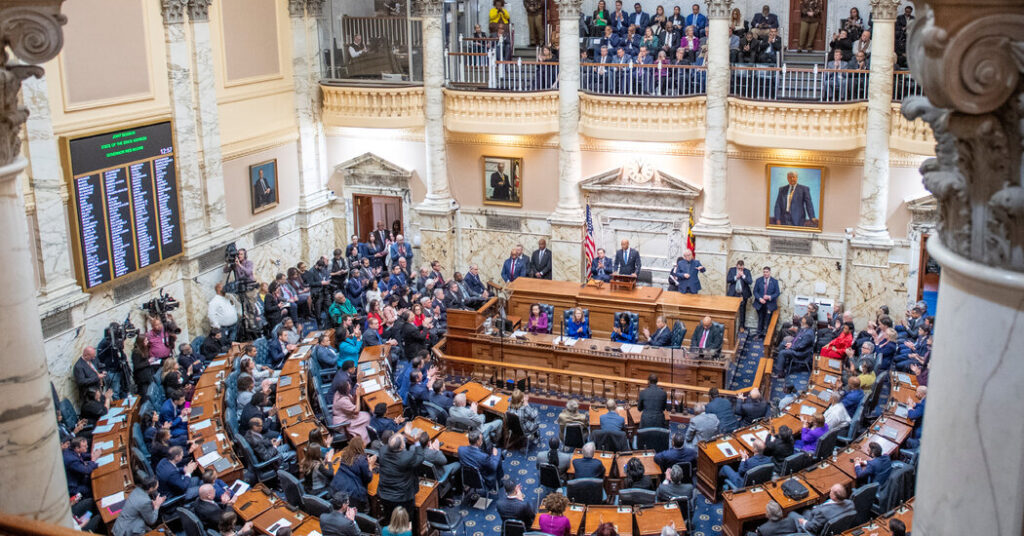
The Maryland House of Delegates on Monday approved a newly gerrymandered congressional map that would most likely eliminate the state’s only Republican-leaning U.S. House district, setting up a potential intraparty showdown with skeptical Democrats in the State Senate.
In passing the new map, House Democrats went along with a push led by Gov. Wes Moore, a Democrat who created a committee in November to explore redistricting in the deep-blue state. He had pointed to efforts in other states — beginning with Republican-controlled Texas — to redraw their maps for a partisan advantage ahead of the 2026 midterm elections.
“We didn’t pick this fight,” C.T. Wilson, a Democratic state delegate who sponsored the legislation in the House, said on the chamber floor last week. “But I’ll be damned if I just turn the other cheek.”
Yet the effort’s fate in the Maryland Senate is far from certain, with some pro-redistricting Democrats fearing that Bill Ferguson, the Democratic president of the chamber and an outspoken gerrymandering opponent, will not allow a full floor vote on the new map.
Last month, Democrats still appeared short of the votes they needed in the State Senate, and Mr. Ferguson has seemed to grow increasingly entrenched in his resistance. In private meetings, prominent Democrats like Mr. Moore; Representative Hakeem Jeffries, the U.S. House minority leader; and former U.S. Attorney General Eric H. Holder Jr. have so far been unable to change Mr. Ferguson’s mind.
Nationally, Democrats have been trying to keep pace with Republicans in the redistricting arms race that Republicans started last summer in Texas. There, Republican legislators heeded President Trump’s demands and took the unusual step of redrawing the state’s House map in the middle of the decade, with the explicit aim of helping Republicans in the midterm elections.
While some Republican-led states, including North Carolina and Missouri, quickly followed and gerrymandered their own maps, others like Indiana and Kansas resisted, drawing criticism and threats from the president.
Up until now, most Democratic-controlled states that have pushed for redistricting have not run into serious resistance from within the party. Maryland could be the first state where Democrats engage in a public standoff over redistricting, with some lawmakers trying to claim a moral high ground or demonstrate a no-one-tells-us-what-to-do ethos.
The battle over Maryland’s remaining Republican seat has gripped the state’s politics. More than 200 people signed up to testify at a House committee meeting on the measure last week, and the debate in the chamber on Monday lasted nearly four hours, even though the outcome was never in doubt.
Republicans were effusive in their criticism.
“These maps, they’re not about fairness, they’re not about protecting democracy,” Brian Chisholm, a Republican state delegate, said during the floor debate on Monday. “This is about disenfranchising one million Republicans.”
But the battle comes down to the state’s top Democrats, and a public spat between Mr. Moore and Mr. Ferguson.
On Tuesday, at the committee meeting, Mr. Moore appeared as a witness, voicing his support for the maps and sharing some not-very-subtle criticism of Mr. Ferguson, though he did not mention him by name.
“For all those who are looking for all the reasons why we should not respond, instead of using your energy to find ways to respond,” Mr. Moore said, nodding to Democratic responses to Republican redistricting efforts, “history will remember you worse.”
His comments were a slight escalation from remarks he made after a private meeting with Mr. Jeffries last week. Meeting with reporters afterward, Mr. Moore said he did not think Mr. Ferguson would single-handedly block the Democratic redistricting plan and predicted that the Democratic State Senate leader would bring it up for a floor vote.
“My job is not to get around one person — that’s not how democracy works,” the governor said. “Democracy works when you allow for a vote and everyone’s voice is heard.”
“I believe the Senate president believes in democracy, and I believe he’s going to show us that within this vote,” Mr. Moore added.
But in a briefing for reporters the next morning, Mr. Ferguson did not commit to a floor vote, acknowledging that he and the governor continued to have a difference of opinion about redistricting.
“We have a disagreement,” he said. He quickly added that they did see eye to eye on the damage they think the Trump administration is doing to Maryland. The question was what to do about it.
“We all agree that what is happening at the federal level is unconscionable,” Mr. Ferguson said. “What we have to do, from our perspective, is focus on the things that will make a true difference for Marylanders, and that will have an actual impact.”
In Mr. Ferguson’s telling, that means focusing on affordability and economic growth.
Maryland is one of only two remaining Democratic-controlled states with a viable path to draw new congressional maps before the midterms. The party’s effort in the other state, Virginia, is currently tied up in court.
Nick Corasaniti is a Times reporter covering national politics, with a focus on voting and elections.
The post Maryland Moves to Give Democrats Extra House Seat, but Big Hurdles Remain appeared first on New York Times.