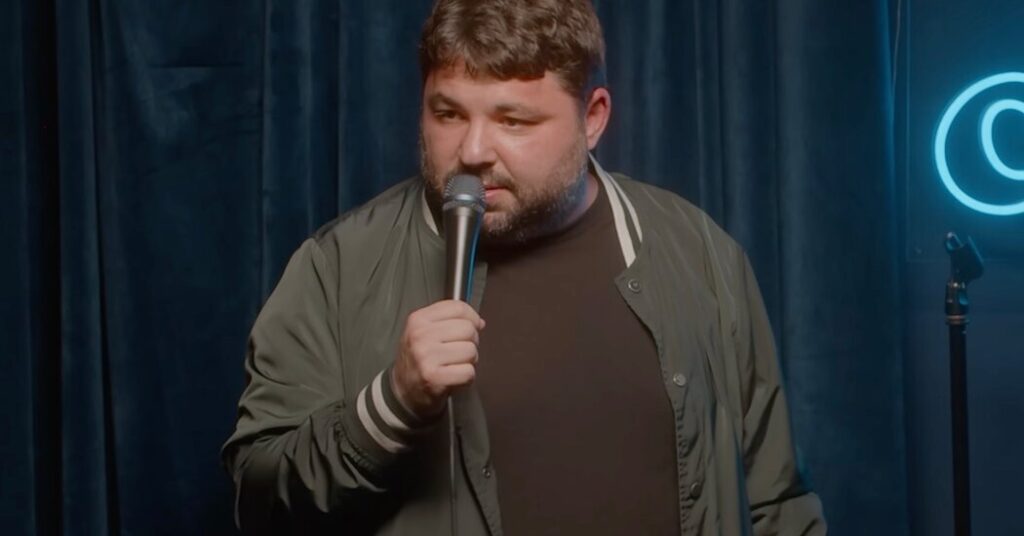
In his new YouTube special, “Morbidly Jewish,” Raanan Hershberg explains that Germany has changed so much since World War II, you can now be imprisoned there for drawing a swastika. “Even though they are no longer Nazis,” he said, taking a beat, “they are kind of being Nazis about it.”
Nazi jokes have a long tradition in Jewish comedy, flexible enough to include self-sabotaging Broadway musicals and stern soup salesmen. But what makes this one unusual — and gleefully perverse — is that it’s a Nazi joke about overreacting to antisemitism. That’s a twist.
Hershberg has become one of the most reliably funny stand-ups working today, thanks to hard punchlines without sentiment or didacticism. With Hershberg an often unreliable narrator of his own perspective, his most ambitious, often raunchy jokes lean on subtext and metaphor rather than thesis statements. His latest release captures a strain of anguish among Jews right now. You get a hint of what he’s after when right before bringing up Israel, he says bluntly, “It’s a weird time to be a liberal Jew.” No joke.
In the past year or so, I have seen Marc Maron and Alex Edelman make essentially the same joke. It begins with them noting it’s a bad time for Jews, before conceding it always has been. Then each pauses to consider exceptions. “Maybe ‘Seinfeld’ Season 4,” Maron quipped at the Brooklyn Academy of Music.
Edelman’s version of the punchline, at Carnegie Hall: “Those five years in the ’90s when ‘Seinfeld’ was popular.”
This parallel thinking speaks to a nostalgia for a less antisemitic and politicized era. But I sense something else, a reflection of pessimism about the trajectory of Jewish culture. You see it expressed in titles from the last couple of years like the book “Tablets Shattered: The End of an American Jewish Century and the Future of Jewish Life” by Joshua Leifer. Or the even more blunt headline of an Atlantic cover story by Franklin Foer: “The Golden Age of American Jews Is Ending.”
Such gloomy declarations are understandable. The biggest podcasts in the country are relitigating World War II. Antisemitic hate crimes are in the news frequently. And the Hamas-led attacks of Oct. 7 and the subsequent response from Israel, killing tens of thousands, have fractured Jewish communities in this country. So has the way that the current administration has used the threat of antisemitism to crack down on free speech and universities. It’s a charged, rancorous moment, but who says that artists flourish in comfortable times?
Between “Marty Supreme,” the animated series “Long Story Short” and countless standup comics, there is no shortage of new ambitious art on Jewish themes. The eulogies for Jewish artistic success assume culture directly follows politics. The Atlantic article connects Jewish cultural triumphs, like the novels of Saul Bellow and Philip Roth and the comedy of Lenny Bruce and Gilda Radner, to declines in antisemitism.
The more common narrative is that Jews’ success in comedy or the arts is related to their outsider status, their marginalization, even suffering. Which is it? Do Jews tell Nazi jokes to cope with antisemitism or is it freedom from antisemitism that allows us to joke about Nazis? Probably both.
What’s undoubtedly true is that the history of Jewish art, whether in comedy, theater or literature, has involved smuggling a niche sensibility into the mainstream. It’s about working around constraints. No less an authority than Mel Brooks, speaking in the new two-part documentary about his career, explained the Jewish facility for comedy this way: “It has to do with fear,” he said. “There’s a great energy coming from it.”
It’s popular these days to be nostalgic for a pre-online era. But there were downsides to the offline era, including more barriers to entry. It’s worth recalling that “Seinfeld” was originally considered “too Jewish” by an NBC executive.
But clearly, since Oct. 7, comedy, along with so much else, has changed. Famous stand-ups have become far more outspoken about the Middle East. Dave Chappelle ended his last special with a joke about not standing with Israel, and Bill Burr mocked Israel’s argument that it killed children in Gaza because Hamas was using them as human shields. “It’s like, you got to work around that,” he said with characteristic exasperation. The comics Azhar Usman and Ramy Youssef have produced trenchant political comedy about faith and the politics of the Middle East. In his latest special, Mo Amer gets boos when he brings up Jerry Seinfeld, who has himself become a political football for, among other things, comments unfavorably likening the Free Palestine movement to the Ku Klux Klan. “Festivus for the rest of us,” Amer says. “I used to watch that show in much simpler times.”
Yet Modi Rosenfeld, who ends some performances by singing the Israeli national anthem, and Yohay Sponder, an Israeli whose tour “Self-Loving Jew” fiercely defends his country, have become much more prominent. More overtly political comedy is more likely to get traction these days — and earn blowback, which also gets traction.
But what you see from Raanan Hershberg is something different. It’s not righteous political comedy. His perspective is serious but confused, aggressively ambivalent, rattled by the actions of Hamas, but horrified by deaths in Gaza. He’s worried by antisemitism, but also uneasy about how fearmongering over it is being used to justify government crackdowns.
Hershberg is attempting the kind of broad, mainstream neurotic Jewish humor that is one of the main traditions of American comedy but adjusted for the politics of right now. It’s not easy. He dramatizes his anxious, conflicted, fearful attempt to find his way on Israel. His neurotic style locates humor in his own exaggerated, unreasonable reactions. He’s a comedian whose jokes say one thing but mean another.
In “Morbidly Jewish,” a title that refers to yet another joke about how antisemitism hasn’t held him back as much as prejudice against fat people has, he describes his own education in the history and politics of the Middle East. He notes the challenge of finding unbiased history, flailing, before moving on to make a similar point in more traditional club-comedy terrain: Porn.
When he discovers that a porn star posted on social media about Israeli apartheid on Oct. 7, he gets quiet and reflective. This is hard, he says, getting emotional as he describes his dilemma. “I know you’re supposed to separate the artist from the hard-core pornography,” he adds. “How am I supposed to watch this and feel good about myself?” He takes a moment to build suspense and finish his thought: “The answer is: reluctantly.”
So, then he tries to watch an Israeli porn star, who, he says, is into B.D.S.M. not B.D.S. Trying to find a porn star with a nuanced position on Israel, it turns out, is not easy. “That’s not a category on Pornhub,” he notes, in a hilarious bit, that captures and satirizes the plight of the reasonable middle ground.
There’s no one theory that can explain the success of Jack Benny and Lenny Bruce, Joan Rivers and Adam Sandler, Jackie Mason and Sarah Sherman. But mainstream American Jewish sensibility has long been marked by a relentless self-questioning rooted in the kind of Talmudic thinking that could quickly turn into its own dark ironic absurdity. This has produced an anxious Jewish style as well as a silly one.
Groucho Marx’s quip about refusing to join any club that would accept him as a member is a distinct product. So is Hershberg’s conflicted attitude toward antisemitism. He questions people who criticize the Harry Potter books for perpetuating Jewish stereotypes because they include a fictional big-nosed goblin with no specified religion who runs the banks. He pauses to consider the assumption that this character is Jewish. “Isn’t it antisemitic to think that’s antisemitic?”
If we are seeing the end of the era of Jewish comedy, it was a good run. But at the risk of getting in the way of a kvetch — what’s less Jewish than that? — I am skeptical. I suspect we’ll see more comedy navigating the thorniest subjects, including Israel. Many Jews are now feeling as if they are in a bind: adrift, confused, unsure what to say. I can’t imagine a better time to make a joke.
Jason Zinoman is a critic at large for the Culture section of The Times and writes a column about comedy.
The post Is the Golden Era of Jewish Comedy Coming to an End? appeared first on New York Times.