On Feb.1, 1979, Ayatollah Ruhollah Khomeini arrived in Tehran after 15 years of exile in Turkey, Iraq, and a little village outside Paris. Millions of Iranians saw him as a spiritual man who would usher in democracy and deliver a better economic life. They welcomed him. Khomeini and his supporters delivered neither. Instead, they gradually transformed the Shah’s authoritarian, secular monarchy into a totalitarian theocracy.
[time-brightcove not-tgx=”true”]
From the earliest days of the Islamic Republic of Iran, Iranians found themselves confronted with a political theology that defined the ideological contours of the power struggle in their society. The people’s sovereignty and capacity for collective action were eclipsed by an uncompromising, monolithic order embodied in Ayatollah Khomeini’s leadership and institutionalized through his doctrine of Velayat-e Faqih (the guardianship of the Islamic jurist), which concentrated authority in the hands of a supreme religious jurist.
The doctrine of Velayat-e Faqih allowed Khomeini to supersede the political views of other government officials and the popular will itself. The constitution was thus wrested from the Iranian people and appropriated by a ruling cadre that imposed its own interpretation of Islamic law upon them. Blind obedience to the Supreme Leader’s will transformed violence against victims into patriotism and a righteous struggle against “corruptors on earth.”
Subsequently, the loss of rights suffered by a wide range of Iranians—Baha’is, gays, feminists, dissenting intellectuals, and young people with non-ideological dreams—became a widespread loss of identity. But as the population swelled from around 38.5 million in 1980 to over 92 million today, post-revolutionary Iran grew younger and more rebellious than revolutionary.
Over the past 30 years, a new type of Iranian, who is defined by the absence of ideology, has emerged. These Iranians embrace individualism and global culture through the internet, and simply want to exist and act as citizens within their society. A new vision of society has taken hold in Iran—nourished by these new Iranians, particularly young women—and it has chipped away at the legitimacy of the regime.
For more than four decades, Iranian women have been trying to reclaim parts of their personal lives upended by the revolution in 1979. One of the defining images of the revolution in 1979 was an Iranian woman in a traditional black Shiite chador holding a G-3 rifle. Today, the iconic image of the protests in Iran is different: a young woman setting her headscarf on fire and chanting against Iran’s clerical rulers.
Violence has been the primary language of the Islamic Republic since 1979. The regime has repeatedly met economic, social and political demands of Iranian citizens with prison cells and graves. The 1979 revolution did not leave any space for persuasion, plurality, and mutual recognition. Political authority does not rest with citizens acting together; it is controlled by the Supreme Leader and the Revolutionary Guards. For 47 years, violence has forced compliance, but it has not generated legitimacy for the Iranian regime.
Every turn to state violence in Iran has served as evidence of erosion of its authority, a self-defeating strategy to maintain the status quo: violence substitutes consent with massacre and undermines the popular legitimacy on which any government ultimately rests. And yet, after 47 years of civil resistance and nonviolent confrontation, Iranians have converted the loss of their sons and daughters, and their private sufferings into public claims. They have built new, lasting repertoires of protest and forms of dissent that survive individual campaigns of repression.
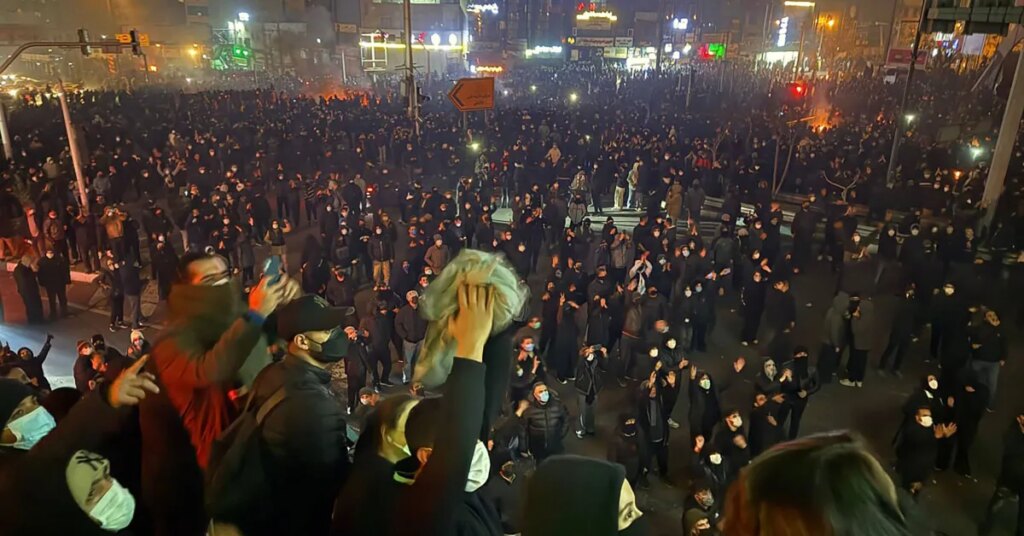
Today Iranians are mourning thousands of their fellow citizens who were massacred during savage crackdowns on recent protests in Iran. What endures after all the killings is storytelling. If Iran is to have a democratic future, the differences within the Iranian society have to be confronted and argued through, not buried. That work carries a warning: ending an illegitimate government is to refuse to support a new dictatorial and corrupted regime.
To be an Iranian today is to live within the memory and continuity of Persian civilization, to sustain an ethics of beauty and embody an act of resistance against an ugly and tyrannical Iran. If Iran remains beautiful, then the idea of Persia is more than mere ornament adorning the corpse of an ancient civilization. It is the revolt of beauty and freedom against the ugliness of tyranny and the wilful forgetting of horror.
- When I Think of Iran I Think of Light
- The Islamic Republic’s Founding Myth
- My Very Specific Dreams for Iran
- Iran Is Beautiful
- Iranian Progress Cannot Be Stopped
The post Iran Is Beautiful appeared first on TIME.