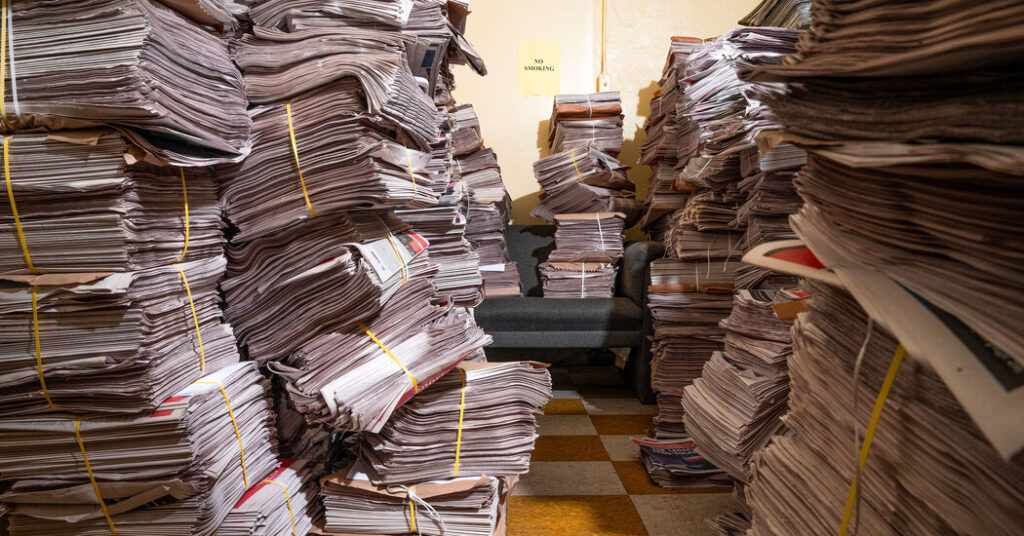
When something newsworthy happens in your community, like an election, the arrival of a storm, the opening of a business, a change to a law or the final score of an important game, how do you usually find out about it? You could read about it in the newspaper or on a website, see it on TV or on social media, or hear about it from a podcast or people you know.
In general, how much do you keep up with what’s going on locally? How important is it to you?
In the guest essay “Local Newspapers Are Closing. Local News Is Surviving,” Sarabeth Berman, the chief executive of the American Journalism Project, writes about changes to how and where people get their local news:
The Pittsburgh Post-Gazette, one of America’s oldest newspapers, announced this month that it would cease publication. The family-owned company that operates the paper made the announcement after a court ruled against it in a dispute with unionized workers. Pittsburgh is hardly alone. Since 2005, more than 3,500 newspapers have shuttered. On average, two close every week.
The consequences of the collapse of the local newspaper business have been severe. When communities lose their local news outlets, civic engagement drops, corruption rises, government waste increases and political polarization worsens. Communities no longer know themselves. No number of headlines about goings-on in Washington can change that.
But the death of The Pittsburgh Post-Gazette does not mean that Pittsburghers must go without local news. While the market failure of the newspaper business has been well documented, what is less known is how communities all over the country have responded to this crisis.
Hundreds of nonprofit local news organizations have sprung up, from Lafayette, La., to New Bedford, Mass., to Chicago. Rather than relying primarily on advertising revenue, nonprofit newsrooms are sustained by coalitions of philanthropic institutions, local businesses, individual donors and readers. Under this model, local journalism is treated as a public good, essential to civic life, akin to a museum or a food bank.
Many of these nonprofits started within the past decade. They operate where audiences can be most easily found today: online and in email inboxes. There’s less focus on print and newsstands. This new generation of local nonprofit outlets — some of which are supported by the American Journalism Project, where I work — has already distinguished itself with journalism of the highest quality. In the past three years, the Pulitzer Prize for local reporting has been awarded entirely or jointly to a nonprofit newsroom that did not exist even a decade prior.
The excellent reporting by nonprofits includes the Pulitzer-winning work of Mississippi Today, founded in 2016, which exposed tens of millions of dollars in misused Mississippi state welfare money. The Indiana-based Mirror Indy uncovered systemic abuse at a mental health facility in Lawrence, Ind. In the run-up to the 2025 election, the Boyle Heights Beat in East Los Angeles reported a shortage of in-person polling centers; officials solved the problem as a result. The City, a nonprofit based in New York City, revealed allegedly corrupt practices within then-Mayor Eric Adams’s administration after a senior adviser attempted to give cash, memorably concealed in a bag of chips, to a reporter.
The success of these newsrooms suggests the problem facing local news is not a lack of public appetite but an outdated business model.
Students, read the entire essay and then tell us:
-
How much do you keep up with the news of your town, city or region? How do you usually find out about what’s going on? How important is it to you to know what’s happening in your community?
-
Do you think many people your age follow the news? For those that do, are they more interested in local, national or world news? Why? What do you think could make teenagers more curious about what’s happening in their own towns and cities?
-
When it comes to where you get your news, do you see differences in the sources you follow in terms of credibility, accuracy, independence and degree of detail? How do you know what sources you can trust for the truth?
-
Respond to this statement from the article: “When communities lose their local news outlets, civic engagement drops, corruption rises, government waste increases and political polarization worsens. Communities no longer know themselves.” What do you think explains this? How important do you think access to local news is for a community? To what extent do you think journalism can create change?
-
What is an issue in your community that you care about? Do you think it gets enough attention? How could you find out more about it? How might you spread the word yourself?
Students 13 and older in the United States and Britain, and 16 and older elsewhere, are invited to comment. All comments are moderated by the Learning Network staff, but please keep in mind that once your comment is accepted, it will be made public and may appear in print.
Find more Student Opinion questions here. Teachers, check out this guide to learn how you can incorporate these prompts into your classroom.
The post How Do You Find Out What’s Happening in Your Community? appeared first on New York Times.