“Hello, I’ve never met you before, so it really is a pleasure. I hope the feeling is mutual.” So begins my grandmother’s diary from 1939. She was 18, living at home with her parents in Brooklyn. “As you will find out henceforth, I am a ‘different’ person.”
I’ve never consistently kept a diary. On the rare occasions I’ve tried, the voice that emerges is that of a “different” person — a clunky, wooden avatar, by turns stifled and overly performative. My grandmother, who as far as I know never expressed literary ambitions, didn’t have this problem. Her diary crackles with vivid turns of phrase and snapshots of her life: riding to a dance near Eastern Parkway on a bus “packed to the margin”; watching her friends make out at a party (“They necked all evening, and I mean necked … I saw some champion mauling”); eerily prescient rumblings of the atrocities playing out overseas as Hitler advanced farther into Europe (on Sept. 9, 1939, “John Gunther reported that 1,000,000 cats + dogs have been killed by Britishes for fear they would be unable to defend themselves in case of an air raid”).
My own rare diary entries from the summer of 2008, when I was 23, make me sound like an overwhelmed executive assistant to my own memory. “S. and G. had their first child yesterday, the first of my friends to do such a thing,” I wrote in one. “Well. Now seems the time to put that to the side. There will be plenty of time for considering it later.” Elsewhere I favored embarrassing hyperbole, as when I claimed that same week that the rapper Nas “saved my life.”
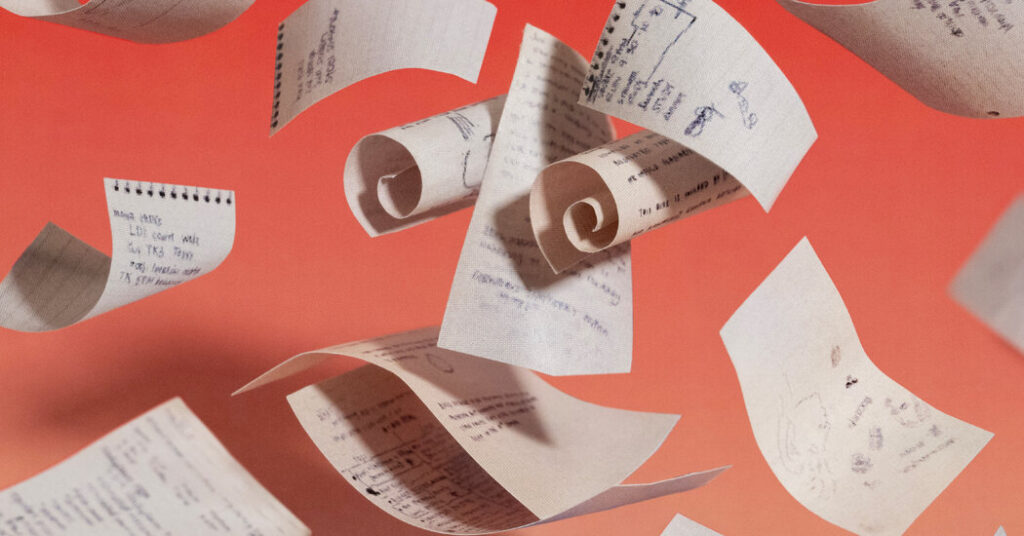
Over time, a shift in approach loosened me up: Rather than keeping a diary, I started keeping notebooks. Where a diary constructs narrative, character and voice, a notebook is inherently fragmented, allowing for unexpected glimmers of serendipitous juxtaposition and lyric voltage. It is at once a less restricted form and one that renders perception more precisely. It has always been more generative for my writing, more comfortable, more surprising. Joan Didion made a similar distinction in her 1968 essay “On Keeping a Notebook.” For her, the point “has never been, nor is it now, to have an accurate factual record of what I have been doing or thinking. That would be a different impulse entirely, an instinct for reality which I sometimes envy but do not possess.”
One of my notebook entries from 2018 reads, “What a random emperor you are!” The following month, “Pants: a tool like any other.” Accuracy or basic coherence is less the point than recording the music hidden behind the white noise of routine. In 2016, preparing for an impending job interview, I wrote, “Will there be opportunity for my career to develop here?” On the following page, “A poem refuses death.” (I did not get the job.) A friend’s turn of phrase, an overheard conversation on the subway, a weirdly resonant ad — all of it has a place in a notebook. “Dog afraid of noises? THUNDER SHIRT,” I wrote in 2011, recording the text of a billboard, followed by, “I offer you here a break from my voice.”
That’s what a notebook is: a break from your own voice. If diaries are where we willfully perform ourselves, notebooks project a slanted light onto our days, revealing a shadowed grain and texture that we otherwise might not notice. It is a place where we can drop the act that we put on — even in the privacy of our own thoughts, we are often playing a part. “Our notebooks give us away,” Didion writes, “for however dutifully we record what we see around us, the common denominator of all we see is always, transparently, shamelessly, the implacable ‘I.’”
On this score, I only partially agree. Our notebooks do give us away, but they also reveal something about where we stand in relation to our time and place. Take Sei Shonagon’s “The Pillow Book,” written just before the year 1,000 — the notebook that she kept while serving as a lady-in-waiting in the cloistered luxury of Japan’s imperial court. “The Pillow Book” is perhaps best known for its detailed, gossipy, beautiful lists: “Things now useless that recall a glorious past,” “Things that quicken the heart,” “People who feel smug,” “Spectacles” and “Wind instruments,” to name just a few. It does not reflect the widespread poverty of its time, nor the fact that Shonagon was eventually forced to leave the court and most likely lived in poverty herself — but we can’t know for sure, because there is no definitive historical record. “The Pillow Book,” like all autobiographical writing, is limited in its view.
The same is true of my own notebooks. In 2020, I wrote, “Come for the death-knell, stay for the preserves.” I don’t remember writing this, and while it might sound like nonsense, the joke about death and preservation reflects a feeling that I do remember having early in the pandemic about the very real possibility of societal collapse. In these abstract fragments, real life comes into focus.
It is an impulse that many of us share: to put something of our experience into language before time and mortality render us mute. By the end of the summer of 1939, my grandmother’s diary entries became sparse, containing almost no detail about her days. An entire entry from the end of the summer reads, “Today England declared war on Germany /// Germany invaded Poland, therefore the above.”
Can the sundry details, cherry-picked quotations, dream logic and yawning gaps in our diaries and notebooks speak to the violence of our own moment in history? To answer, we have to record not only who we are but also what we observe, and read between the lines.
Daniel Poppick is a poet and the author of the novel “The Copywriter.”
The post Don’t Keep a Diary. Embrace the Fragments of Real Life Instead. appeared first on New York Times.