You may have read recently how minions of the Trump administration removed an exhibit about slavery from the President’s House in Philadelphia (where George Washington lived, with slaves) as part of its ongoing sop to MAGA sensitivities and campaign to erase history in favor of a fairy tale in which the worst thing Washington ever did was chop down a cherry tree.
The study of history is by nature messy, replete with conflicting interpretations and incomplete puzzles, but it’s what you need to know in order not to repeat it. PBS, lately defunded by conservatives but not disassembled, is among the institutions working to bring it to the people — indeed, the only television outlet seriously devoted to it. (History Channel is just a name.) Premiering Tuesday and continuing weekly is the four-part series “Black and Jewish America: An Interwoven History,” presented by Henry Louis Gates Jr., at the start of what happens to be Black History Month.
Gates, who also hosts the PBS genealogy series “Finding Your Roots,” has presented such documentaries as “Africa’s Great Civilizations” and “Great Migrations: A People on the Move,” has made cameo appearances in HBO’s “Watchmen” series and “The Simpsons.” He teaches at Harvard and is a well-known public figure — a history communicator, scholar and storyteller and a minor TV star the world also knows as “Skip.” Even-tempered and even-handed, he’s a good guide through the minefields of racial history — he keeps you from blowing up. You might find yourself angry at the material, but not with Gates.
“Under the floorboards of Western culture run two streams, continuously,” he says. “One is antisemitism, one is anti-Black racism,” whose purpose here is to explore “the areas of overlap.” They aren’t the only victims of bigotry in American history and modern America; Italians and Irish immigrants had their turn, too. White supremacy, which is very much alive in the land — turn on the news — disdains every people of color. But as people who shared the experience of being “mocked and feared, blamed and banished, envied and imitated,” often allied, sometimes antagonists, theirs is a special case.
Gates has assembled a stimulating, illuminating, maddening, saddening, but often inspiring, story of their relations with the world and one another. (Here and there he reaches a little outside his theme.) At 75, he’s lived through a good slice of the history illuminated here, including “our brief golden age” of the 1960s Civil Rights Movement, and though he structures his series as a pendulum swinging between worse and better news, he scrupulously bookends it in a hopeful mood, with a Seder to start and a discussion with students to end. His insistence that no one is safe until everyone is safe, can seem to portend a future in which no one will ever be safe, though as a teacher I assume he’s more sanguine. His manner, at least, is encouraging.
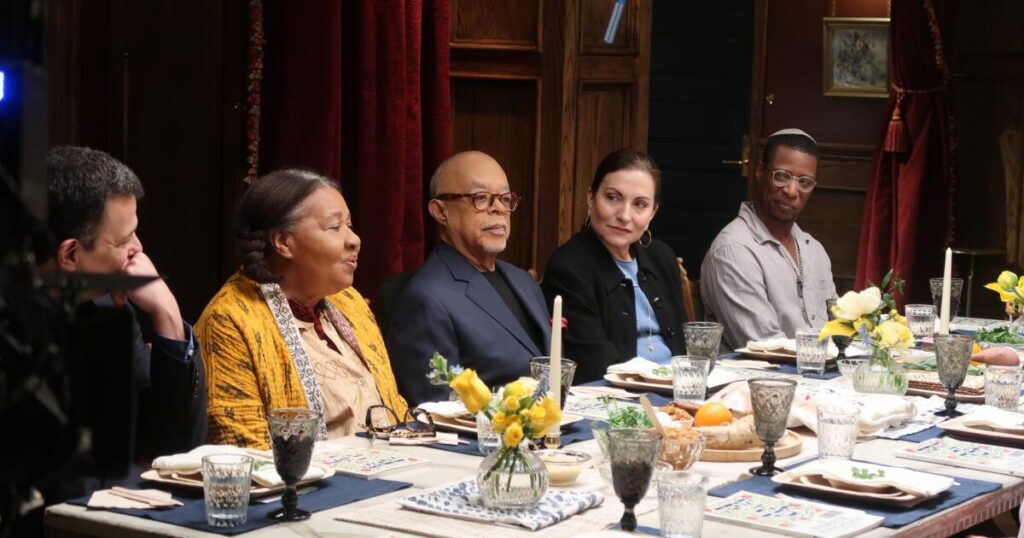
The Seder, which begins with a singing of “Go Down Moses (Let My People Go),” gathers a tableful of Black, white and biracial Jews — each distinguished enough to have their own Wikipedia pages — in a roundtable discussion. Participants include New Yorker editor David Remnick, author Jamaica Kincaid, journalist Esther Fein, rabbi Shais Rishon, Angela Buchdahl (the first East Asian American to be ordained as a rabbi); and culinary historian Michael Twitty, who provides the doubly meal — kosher salt collard greens, West African brisket and potato kugel with sweet and white potatoes and Creole spice.
Though both Jews and Blacks faced (and face) discrimination, their American journeys were launched, says Gates, “on different trajectories,” one group chased from nominally Christian countries, the subject of durable medieval superstitions, the other dragged from their homes. Though the mass of Jewish migration, escaping Russian pogroms and Nazi Germany in succeeding waves, occurred in the late 19th and early 20th centuries, some arrived before the revolution; but the Constitution, which enshrined religious freedom, granted them legal rights. (This presumably did not help the Jews of African descent Gates says were present here early on.) Black people, kidnapped and enslaved, had none, and as freedom was gained, new laws were written to hold them in place.
Gates posits a sympathy between immigrant and first- and second-generation Jewish Americans in the 20th century and disadvantaged Blacks, based on a common experience of oppression; Jewish newspapers used the word “pogrom” to describe violence against Blacks in the South. And Jews, many raised with a sense of social justice, were disproportionately represented among white activists in the Civil Rights Movement. This would change: Where Martin Luther King declared “I’m more convinced than ever before that our destiny is tied up with the destiny of our Jewish brothers and vice versa, and we must work together,” later Black activists, like Stokely Carmichael preferred to go it alone, promoting self-determination and even separation.
Still, many of the stories here are based on Black and Jewish friendships. We learn of W. E. B. Du Bois and Joel Spingarn, who sat together on the board of the NAACP and to whom Du Bois dedicated his 1940 autobiography “Dusk of Dawn.” Of Tuskegee Institute founder Booker T. Washington and philanthropist Julius Rosenwald, a president of Sears, Roebuck and Co., who built schools — more than 5,000 nationally, eventually — for systemically disadvantaged Black students. (Graduates included Maya Angelou and John Lewis.) Of Chicago rabbi Abraham Heschel, bringing 15 other white rabbis down to Selma, Ala., in 1964 at the request of King, where their arrest made headlines — which translated to political pressure.
In music, we meet Louis Armstrong, who as a boy worked and stayed with a Jewish family, and wore a Star of David, and his manager Joe Glaser. We’re told the story of Billie Holiday‘s lynching ballad “Strange Fruit,” written by Abel Meeropol (under his pseudonym Lewis Allan), recorded by Milt Gabler for his Commodore label and performed regularly by Holiday at Barney Josephson’s Cafe Society, New York’s first truly integrated nightclub. And we hear Paul Robeson, daring to sing in Yiddish in a concert in Moscow, in support of Itzik Feffer, a Jewish poet imprisoned (and later murdered) by the Soviets.
As a social and political history covering two intersecting storylines for more than the length of the nation, it’s packed with incident and facts — the Klan resurgent after World War I (six million members, it says here); the 1936 Berlin Olympics, where Jesse Owens triumphed and the U.S. committee pulled two Jewish sprinters from competition; racist Nazi policies, borrowed from American Jim Crow, and the Holocaust. Also the domestic destabilizing effects of wars in the Middle East. Jews and Blacks will find themselves on the opposite sides of some questions.
Even at four hours, it’s a survey course, streamlined but not simplistic, and as such it will fly through some points and elide others; there are whole volumes dedicated elsewhere to what constitutes a single sentence here, and libraries dedicated to some of these figures. (Why not read some?) The view is not singular, and as such, there’ll be something for everyone to question, especially as Jews and Blacks are often described as a community, when neither is heterogeneous. (Jews don’t even agree on what makes a Jew.)
But whatever goes back and forth between then, the world has its own ideas. “People who hate Jews,” says Gates, “uncannily hate Black people too. Because when the stuff hits the fan, they’re coming after both of us.”
The post ‘Black and Jewish America’ compiles an illuminating history of intersection appeared first on Los Angeles Times.