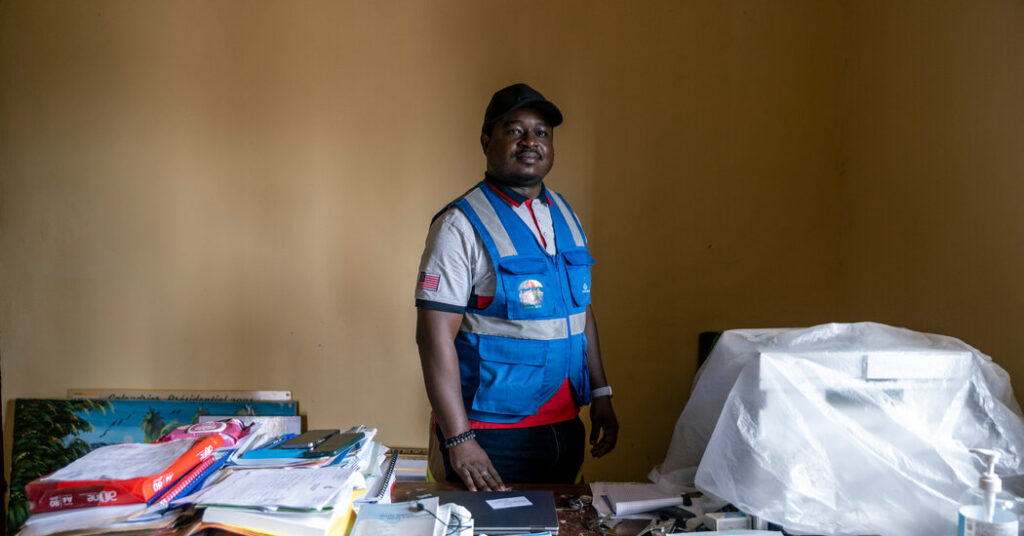
Dr. Vivien Sil Mabouang, the head of health services in a lush, green district in the center of Cameroon, drives the mud village roads with newfound worry about the health threat from the rivers and streams that thread through the land.
Black flies breed in the fast-flowing water, and when they bite people, they can pass on larval worms that mature beneath the skin. The adult worms can live for 15 years, producing millions of immature worms that move through the human tissue. If the immature worms die in the skin, they cause intense itching, and if they die in the eye, they can cause blindness — so the infection, formally called onchocerciasis, is better known as river blindness.
Onchocerciasis is painful and debilitating, but with crucial funding from the United States, Dr. Sil Mabouang and his colleagues had been close to reaching their goal of wiping it out in their region and having the district officially declared free of the disease.
Then, the Trump administration drastically scaled back foreign aid, and funding for the program to eliminate onchocerciasis was cut off.
Onchocerciasis is one of 21 afflictions, most of them treatable and preventable, that the World Health Organization classifies as neglected tropical diseases. Together, they affect more than a billion people, but because many are among the poorest people in the least developed places, these diseases have historically received little funding, research or attention.
While they are rarely fatal, these diseases exact a huge toll in human suffering, including pain, disfigurement and disabilities such as blindness. They are sometimes called “biblical” because they have plagued humans for so long that they are mentioned in ancient texts.
The United States was a major funder of a 20-year effort to finally wipe them out. That money vanished a year ago when the Trump administration dismantled much of U.S. foreign assistance.
In central Cameroon, every year since 1994, community health workers had gone door to door to treat every person with a dose of the antiparasitic drug ivermectin — enough to kill all the worms and all the larvae. The drug distribution relied on about $115 million a year from the United States Agency for International Development, which the Trump administration has shut down.
So there was no ivermectin in 2025. “We’ve had so many complaints, people saying, ‘We’re not getting, you didn’t come,’” Dr. Sil Mabouang said. “We explain to them there has been a cut at the national level, there’s been lots of problems.”
Unlike many of the other health problems that plague people in this Central African country, onchocerciasis isn’t complicated to eliminate. But it requires a tenacious adherence to the plan until the end: If drug distribution stops before the parasite is truly gone, it can come roaring back in a single year.
“We will have to restart at zero if we get new resources,” Dr. Sil Mabouang said, as he guided a visitor through villages in December. “In the meantime, people will lose their sight.”
In Essong, a sleepy crossroads town in the district, François Ewolo knows he is vulnerable to onchocerciasis infection. He makes a living farming, working construction and occasionally driving trucks that he sleeps in on long journeys. “I’m always bitten,” he said.
He also knows the devastating effects of the disease: It cost his mother her sight, and she spent the last 16 years of her life relying on her grandchildren to lead her around by the hand. “There was nothing to help her — we don’t want to go back to that time,” he said.
The list of neglected tropical diseases includes sleeping sickness, leprosy and Chagas disease. The big public health programs have focused on eliminating five that are the most common and easily treated (onchocerciasis; lymphatic filariasis, or elephantiasis; trachoma, a leading cause of blindness; schistosomiasis, a snail-borne parasite; and intestinal worms.)
The only N.T.D. control that happened in Cameroon in 2025 was a drug distribution in just one district that used leftover supplies.
The government was struggling to sustain critical malaria and H.I.V. programs that had also lost U.S. funding, and did not turn its attention to onchocerciasis or the other old scourges.
“These are the neglected diseases,” said Dr. Emilienne Epée, who heads the N.T.D. department in Cameroon’s Ministry of Health. “The government priority is to keep children from dying of malaria, and I understand that.”
Trump Administration: Live Updates
Updated
- Former farm leaders warn there could be a ‘widespread collapse’ of U.S. agriculture.
- Democrats call on ICE watchdog to speed up use of force inquiry.
- Trump will meet with Colombia’s president at the White House.
Most neglected disease programs use drugs that are donated by pharmaceutical companies — nearly a billion dollars’ worth each year. Those manufacturers have been willing to keep sending the treatments. But U.S. funding paid for many of the key steps that got the drugs from ports to people, including trucking and stipends for the health workers who delivered them. Some of those were costs countries could absorb.
However the United States also paid for the critical process of surveillance: testing people to make sure disease levels were dropping or, finally, had hit zero, so that drug distribution could stop. Those surveys are costly. “Government resources do not permit national surveys,” Dr. Epée said.
A spending bill now being considered by Congress contains new funding for neglected tropical diseases, roughly the same amount the program had under U.S.A.I.D. That program was created with bipartisan support under President George W. Bush. There is also funding earmarked for neglected tropical diseases from the 2024 and 2025 financial years that remains unspent. Still, the future of the program is not clear.
It may be possible for countries to restart their neglected disease programs with funding negotiated as part of new aid deals with the United States. Cameroon signed one in December in which the United States agreed to give the country $400 million over five years, if its own government committed an additional $450 million to health spending in the same period. That would represent a cut of about a third in U.S. aid from 2024 levels.
However, all of the U.S.A.I.D. partners in Africa that supported ministries of health with work on neglected tropical diseases have fired their staff and closed their offices. The Trump administration’s new global health strategy does not mention these diseases.
Yet these programs meet many of the criteria highlighted in that strategy, which emphasizes public-private partnerships (such as the drug donations), more financial contribution and leadership by countries receiving aid, and time-limited assistance.
Unlike initiatives such as H.I.V. treatment programs that involve medication for life, neglected disease programs aim for elimination — each year, a handful of countries around the world have been able to declare one more disease wiped out. Most of these programs were slowly being taken over by governments, reducing their reliance on aid, but that process was thrown into chaos by the abrupt cut in funding.
In response to questions about the future of the program, the State Department sent an emailed statement saying, “The Department of State is currently reviewing NTD resources to align with the Trump Administration’s goal of making America safer, stronger and more prosperous.”
Cameroon also had an advanced trachoma program, and was waiting to have three remaining districts mop up the last cases before declaring the disease eliminated. But the neglected disease program does not have the resources for the surveys that would say whether it was gone.
Dr. Sil Mabouang thought they were close in his district on onchocerciasis. They might have been finished a few years earlier, he said, but because two different conflicts in Cameroon have displaced hundreds of thousands of people, there is a lot of movement in and out of the district. His team continued with the mass drug administration as an insurance policy against reintroduction. Drug transport, training and stipends for health workers were supported with the U.S. funds through a contract with the organization Helen Keller Intl.
When programs froze a year ago, the W.H.O. led an effort to make sure that drugs that were already in countries did not expire. Since then, the focus has been on helping countries figure out how they can accelerate a process that was already underway to integrate neglected disease programs into existing health services.
In Madagascar, for example, mass drug administration for lymphatic filariasis has piggybacked on polio vaccination efforts that are funded for door-to-door campaigns. Together, the two programs reached 100 percent coverage of the country for the first time.
In other countries, drugs for trachoma or worms are being given with door-to-door malaria drug prevention campaigns, or in schools.
Those steps might seem so obvious that a person wonders why more weren’t happening already, said Patrick Lammie, who leads the neglected tropical disease work at the Task Force for Global Health. Each disease was addressed through a discrete program for legacy reasons — because individual drug companies started them, and because the donated medications came into the country in a separate channel from the regular health system procurement. And it can be tricky to address multiple diseases at once: One treatment campaign might target children 5 to 15, for example, with a weight-specific dose of drugs, while another aims to give a tablet to every adult.
A big part of the work U.S.A.I.D. was doing before it was shut down had been focused on sustainability and this kind of integration, Dr. Lammie added. Brazil and Indonesia have already shifted into this model; Ethiopia and Nigeria are working on it.
But a big challenge is human resources. Community health workers in places such as Cameroon are minimally paid or not paid by the state at all, and the stipends of $20 or $30 they received from the United States or other donors for the individual campaigns were a key part of their livelihood. As a consequence, they are resistant to the idea of integrating the disease treatments. And the staff members at rural clinics are often already struggling to deliver a range of services to a large population, and are reluctant to take on additional responsibilities.
A few diseases are close to global elimination — one, achingly close. There were just 10 cases of Guinea worm in humans in the world last year.
If programs can be restarted this year, it may be possible to preserve many of the gains. Dr. Lammie made the comparison to the first year of the Covid-19 pandemic, when drug distribution was badly disrupted. Subsequent surveys found that the diseases had not resurged as much as feared, probably because transmission rates had already been pushed down. Countries where elimination had been close might be able to get back on track quickly, he said. The least developed countries, such as Somalia and Sudan, where infection rates are still high and resources are scarce, were likely to do less well.
In Obala, Dr. Sil Mabouang hopes he can soon begin preparing community health workers for a door-to-door campaign this year. After news reports about the shutdown, an anonymous donor gave Helen Keller Intl funding for a year of the campaigns that U.S.A.I.D. used to do, in Cameroon and five other West African countries. That funding should cover most of the costs but would not be enough to fund surveillance.
Cameroon’s Ministry of Health is trying to muster resources to take over in 2027. There will likely be far less money available, but if the onchocerciasis program could be combined with mass treatment of worms and other diseases, it might be much more affordable, said Dr. Bouba Bassirou, the organization’s program director in Cameroon.
“Giving up is not an option,” he said. “So we’re finding a way.”
Stephanie Nolen is a global health reporter for The Times.
The post ‘Biblical Diseases’ Could Resurge in Africa, Health Officials Fear appeared first on New York Times.