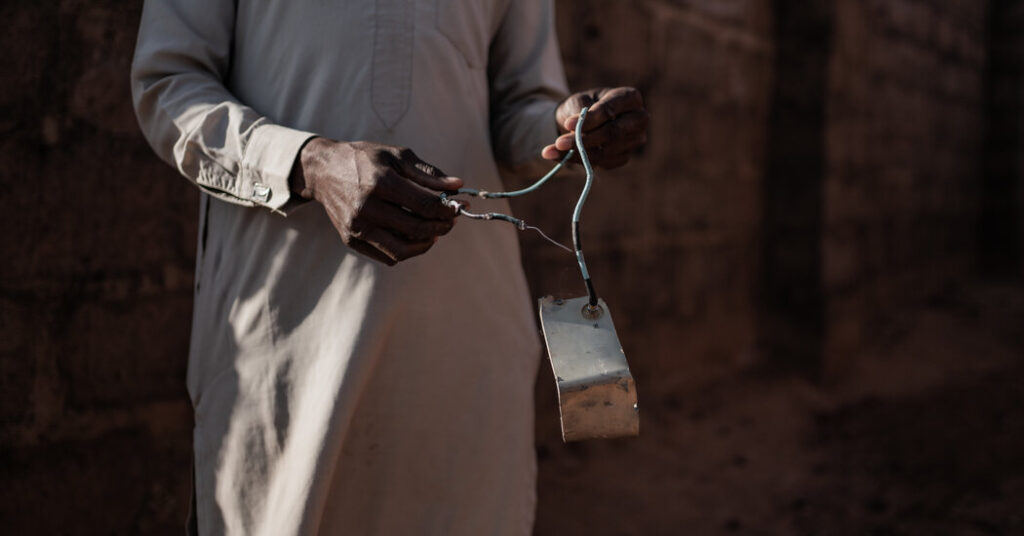
How and why certain places capture President Trump’s imagination and prompt him to take aggressive action can sometimes seem mysterious. (See: his fixation on Greenland.) His surprise decision to bomb Nigeria on Christmas Day in the name of stopping what he called a “Christian genocide” certainly fit that pattern.
But several of my colleagues have spent the past several weeks digging into what led up to those strikes. They found a concerted campaign to shape the administration’s view of Nigeria that continues to have repercussions.
Who pushed Trump to strike Nigeria?
No one disputes that Nigeria has a security crisis.
Thousands of people are killed every year, in battles over land, in kidnappings, and as a result of sectarian violence or terrorism from groups like Boko Haram and the Islamic State. Among those killed are both Christians and Muslims.
But for years, Christian activists lobbying for U.S. intervention in Nigeria have been trying to persuade Washington to view a complex situation through a single lens: the persecution of Christians. And in the Trump administration, these activists saw an opening.
My colleagues have done some fascinating new reporting on how these activists joined forces with Republican lawmakers and even with American celebrities to persuade Trump to do something about what they called a “Christian genocide.” You can read the full story here.
The push eventually culminated in a Christmas Day airstrike on what Trump called the “terrorist scum” who he said were responsible for killing Nigerian Christians.
The narrative of a Christian genocide is continuing to shape U.S. policy toward Nigeria. It’s affecting the criteria for U.S. aid to the country, for instance. Nigeria also faces potential sanctions. There could even be more bombings.
Nigerian officials as recently as last fall were pushing back on the Trump administration’s story of Christian persecution. But for the moment, with all this hanging over them, they’ve given up arguing about it.
‘Christian genocide’
My colleagues Dionne Searcey, Zolan Kanno-Youngs, Ruth Maclean and Eric Schmitt have been reporting on this story from Washington, D.C., and Abuja, the Nigerian capital. Dionne also went to Sokoto State, the predominantly Muslim region struck by the U.S. last December, and Ruth went to Nigeria’s Middle Belt, where the mostly Muslim north meets the mostly Christian south.
It was in the Middle Belt, in the state of Benue, where gunmen last June overran the largely Christian community of Yelwata, hacking, shooting and burning residents in a horrific, bloody massacre. In all, about 200 civilians were killed. It was one of Nigeria’s worst outbreaks of violence in years.
Religious groups on Capitol Hill circulated articles about the Yelwata attack to get lawmakers’ attention. A prominent bishop from Benue was invited to testify before Congress. It worked. In July, a Republican congressman from West Virginia introduced a House resolution condemning the persecution of Christians in Muslim-majority countries, citing the attacks. By the fall, Senator Ted Cruz, a Republican from Texas, was calling for sanctions against Nigeria.
The Yelwata attack was a breakthrough moment for those pushing to have violence against Christians in Nigeria taken seriously. Concern soon spread beyond Capitol Hill: The rapper Nicki Minaj posted about it on social media. Current and retired N.F.L. players signed an open letter calling on Trump to do something about “religious persecution in Nigeria.”
But similarly brutal attacks are also perpetrated against Muslims, Matthew Page, a former diplomat and a Nigeria expert, told my colleagues. The victims are often herders, who are nomadic. The difference is that these groups don’t have political representation. “The extent to which they are victims is just never revealed,” he said.
Not everyone in the Trump administration saw the Yelwata massacre as proof of genocide. After a meeting with Nigeria’s president, Trump’s Africa adviser, Massad Boulos, said Islamist groups were killing more Muslims than Christians. The Trump administration, he said, understood the complexity of the violence plaguing Africa’s most populous country.
Trump, for his part, told The New York Times last month that “Muslims are being killed also in Nigeria, but it’s mostly Christians.”
Rolling with the Trump narrative
What is Nigeria to do? It’s in a vulnerable position. The country has been redesignated a Country of Particular Concern, a category reserved for nations where religious freedom is threatened, making it vulnerable to U.S. sanctions. A law firm that said it was representing the Nigerian government has since signed a contract with a Washington lobbying group for help “communicating its actions to protect Nigerian’s Christian communities” and countering jihadist groups.
I spoke to my colleague Dionne, our former West Africa bureau chief. She told me that there were both economic and security reasons for the Nigerian government to stay in America’s good books — and that means rolling with the Trump narrative, rather than fighting it.
“Nigeria has struggled to gain control of a spiraling security crisis,” she told me. “Officials see the potential for help from the U.S. military.”
When Trump first started talking about a Christian genocide, Nigeria’s foreign minister, Yusuf Tuggar, sounded angry. He implied that America’s true motivation was to destabilize Nigeria, take its resources and turn the African nation into a failed state.
But in the aftermath of the Christmas Day strike, Tuggar has changed his tune: “We are not going to get bogged down on narratives,” he told my colleagues in an interview. “We’re more concerned about results, and that’s what we’re focusing on.”
MORE TOP NEWS
A halting step forward in Gaza
The sole border crossing between Gaza and Egypt reopened yesterday after being largely closed for 20 months. It was a symbolic, if halting, step forward in Israel’s cease-fire with Hamas.
The reopening of the Rafah crossing will allow some Gazans who fled during the two-year war to return, but only in limited numbers for now. It is also expected to accelerate the exit of thousands of sick and wounded people waiting for medical treatment abroad.
Israel had kept the crossing closed as leverage until the last of the hostages seized in the Oct. 7 attack were returned. That happened last week, when the Israeli military retrieved the remains of a police officer who was shot during the attack in 2023.
An initial U.S. trade deal with India
Trump said yesterday after a call with Prime Minister Narendra Modi of India that they had reached a trade deal that lowers tariffs between their countries. Trump said India had agreed to stop buying Russian oil and increase purchases of American goods, but offered few details.
It has been a year since Trump began raising tariffs. My colleague Ana Swanson describes in the video above how they have affected the economy. These five charts show their impact.
OTHER NEWS
-
Steve Witkoff, Trump’s Middle East envoy, and Iran’s foreign minister are expected to meet in Istanbul on Friday for talks aimed at de-escalating the crisis between their countries.
-
Crown Princess Mette-Marit of Norway and Sarah Ferguson, the ex-wife of Andrew Mountbatten-Windsor, kept up friendships with Jeffrey Epstein after he became a convicted sex offender, according to newly released files.
-
An Iranian protester who had widely been reported to be awaiting execution was released on bail. An Oscar-nominated Iranian screenwriter was arrested in Tehran after criticizing the government.
-
France’s Parliament adopted a budget for this year after months of gridlock.
-
Costa Rica elected a right-wing candidate as its next president. Her campaign focused on rising crime in the country.
-
China’s vision for dominating A.I. involves moving fast but obeying censorship rules.
-
A lawsuit was filed against the Trump administration over its ban on visas for people from 75 countries, the first major effort to stop the policy.
WHAT ELSE IS HAPPENING
-
Trump threatened to sue the host of the Grammys, the comedian Trevor Noah, over a joke that appeared to tie the president to Epstein.
-
Kendrick Lamar and Bad Bunny were the top winners at the Grammys. Here are the highlights. Stars protested ICE at the most politicized ceremony in years.
Top of The World: The most-clicked link in your newsletter yesterday was about the powerful men named in the Epstein files.
SPORTS
Olympics: The World Anti-Doping Agency is considering whether an independent body should handle testing instead of individual countries.
Football: Here’s the latest on the Premier League deals that were reached or called off before the transfer deadline.
TOY OF THE DAY
Crying horse
— The glum toy has become an online sensation in China ahead of the Lunar New Year. The sad-faced plushie, which had its mouth sewn on upside down in the factory by mistake, resonates with stressed-out office employees.
MORNING READ
From a young age, Milissa Kaufman felt as if there were other children living inside her head, each one with different thoughts and opinions. Until she was about 10, these “inside people” seemed like her friends. Then things shifted, as some grew angrier and more overwhelming. Sometimes, she would have amnesia.
It took decades for her to understand what was happening: She was experiencing the signs of an extreme type of dissociation known as dissociative identity disorder. One of the most controversial diagnoses in psychiatry, it is believed by experts to develop in the wake of repeated childhood abuse or neglect. Kaufman went on to become a psychiatrist and devote her career to research and treatment of the condition. Read more.
AROUND THE WORLD
A wild fashion week, literally
There were two big debuts at couture week in Paris this year: Jonathan Anderson’s first Dior couture show and Matthieu Blazy’s first Chanel.
Dior was a little sci-fi and a lot floral. Chanel’s show was inspired by an aviary. Then, things got really wild. At Schiaparelli, they added scorpion tails, talons and beaks to the gowns. At Viktor & Rolf, a model was turned into a butterfly.
You can see the looks in the video above from our chief fashion critic, Vanessa Friedman, and browse through more photos here.
RECOMMENDATIONS
Watch: A family navigates the year after parents separate in the funny, surrealist Icelandic film “The Love That Remains.”
Read: These novels set in remote cabins might make you rethink your vacation this year.
Challenge: See if you can spend 10 uninterrupted minutes focused on this painting by Elisheva Biernoff.
Curl up: Take a look at these seven rooms featuring enviable fireplaces.
RECIPE
Pastitsio is a comforting Greek baked pasta similar to lasagna. It derives its name from “pasticcio” in Italian, which translates as “a mess,” indicating the forgiving, flexible nature of the dish.
WHERE IS THIS?
Where is this skyline?
TIME TO PLAY
Here are today’s Spelling Bee, Mini Crossword, Wordle and Sudoku. Try our new game, Crossplay. Find all our games here.
You’re done for today. See you tomorrow! — Katrin
We welcome your feedback. Send us your suggestions at [email protected].
Katrin Bennhold is the host of The World, the flagship global newsletter of The New York Times.
The post The Campaign Behind Trump’s Nigeria Strikes appeared first on New York Times.