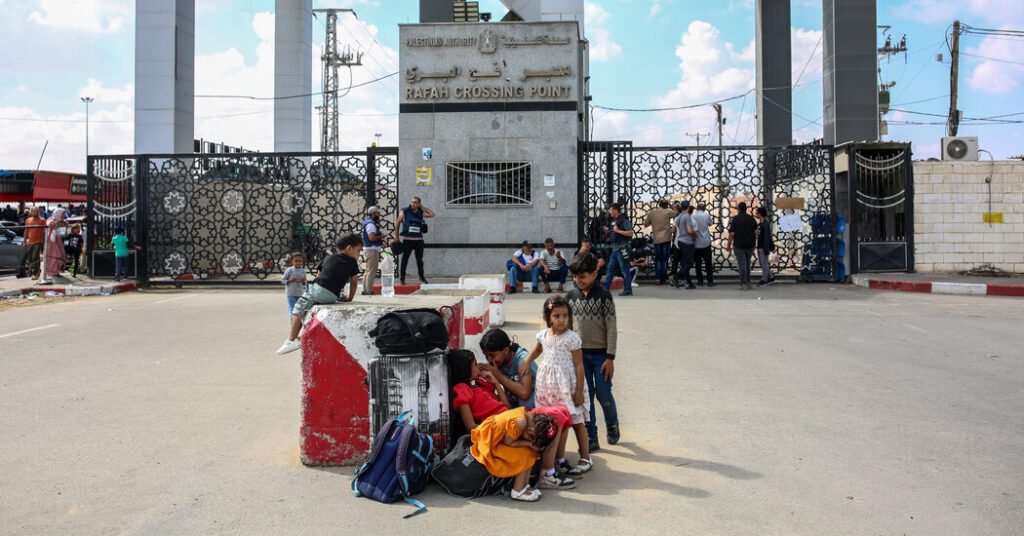
The sole border crossing between Gaza and Egypt reopened on Monday after being largely closed for 20 months, a step forward in Israel’s cease-fire with Hamas.
The reopening of the crossing, in the Rafah area of southern Gaza, will for the first time allow some Gazans who fled during the two-year war to return, but only in limited numbers for now. It is also expected to expedite the exit of thousands of sick and wounded people waiting for medical treatment abroad.
The hope is that the reopening of Rafah will be a move toward gradually improving conditions for Palestinians in Gaza.
The first groups of Palestinians started passing through the crossing on Monday morning in both directions, according to Israeli officials, who said they would have final numbers of how many crossed by the end of the day.
At a Palestinian Red Crescent Society hospital in Khan Younis, a minibus departed for the Rafah crossing shortly after 1 p.m. with five patients, each accompanied by two caregivers.
Mohammed Mahdi, 25, was escorting his father Akram Mahdi, 61, a mechanical engineer. The elder Mr. Mahdi was wounded in April 2024 in an Israeli airstrike near their home, in a refugee camp in central Gaza, according to his son. Shrapnel tore into his face, blinding him in his right eye and damaging his left one. Doctors in Gaza could do little more than stabilize him, his son said.
“Finally, we can get advanced treatment abroad,” Mohammed Mahdi said before boarding the minibus.
It was unclear by midday how many Palestinians had actually crossed the border in either direction. No returnees appeared to have arrived in Gaza as of early afternoon.
Israel and Egypt disagreed for months over the terms of the reopening, which is part of President Trump’s plan for ending the Gaza war. A shaky cease-fire took effect in October, but Israel kept the crossing closed as leverage until the last of the hostages seized in the Hamas-led attack of Oct. 7, 2023, were returned to Israel, alive or dead.
A week ago, the Israeli military said it had retrieved the remains of the last remaining captive, Master Sgt. Ran Gvili, a police officer who was shot during the Oct. 7 attack, which set off the war.
Underscoring the fragility of the cease-fire, the Israeli military launched a series of airstrikes on Saturday in Gaza that killed at least 26 people, including several children, according to local health officials.
The Israeli military said it had targeted militants and weapons facilities in response to what it called a violation of the cease-fire by Hamas fighters in the Rafah area the day before.
Before Israel seized the Rafah crossing in May 2024, it was a lifeline and a pressure valve for Gaza’s roughly two million residents. Israel and Egypt have tightly controlled the territory’s land borders for years, and Israel has long maintained a naval blockade on the enclave, citing a need to stop weapons smuggling. The passage opened briefly during a temporary cease-fire last winter, but only to allow some Gazans to leave the enclave to obtain medical treatment abroad.
Now that it has been opened again, the crossing will be strictly supervised and operated in a limited capacity, with dozens of people allowed at first to enter or exit each day, according to officials.
Prime Minister Benjamin Netanyahu said last week that Israel would be in charge of overall security, although Israeli forces would not be present at the crossing. He suggested that about 50 people might be let in daily, and that more would be allowed to leave.
“We are not going to prevent anyone from leaving,” he said.
At least initially, truckloads of goods will not be allowed in via the Rafah crossing.
A daily list of people planning to enter or leave Gaza will be submitted by Egypt to the Israeli authorities for vetting, according to officials familiar with the details of the arrangements.
They said a civilian security team from the European Union would monitor the crossing with the help of employees of the Palestinian Authority, which administers parts of the Israeli-occupied West Bank. That is a system similar to the one used in the past.
Because the Gaza side of the crossing is in the half of the enclave that Israel now controls, travel to and from the border on the Gaza side will be closely coordinated with the Israeli authorities. There will be an additional screening and identification process for people entering, they said, to take place in a designated corridor operated by Israeli security personnel in the area under Israeli military control.
For those wanting to leave Gaza, priority will be given to the sick and the wounded who have been approved for treatment abroad, said a member of the European border monitoring mission, who spoke on the condition of anonymity to discuss the delicate talks about the reopening.
Roughly 18,500 people, including 4,000 children, are on the list of patients to be evacuated, according to the United Nations. Patients are usually accompanied by at least one relative or caregiver.
Other Gazans are in Egypt, waiting to return. Manal Abu Ammouna left Gaza with her daughter, Hiba, 25, who was severely wounded in an Israeli airstrike near their home in February 2024. They went to Egypt to seek medical treatment. Ms. Abu Ammouna’s husband and their nine other children stayed behind.
“For two years, I’ve been alone with my daughter,” she said by telephone. She said they had been living on charity in Cairo, where they felt “like strangers.”
During their absence, she said, one of her sons, Mohannad, was critically injured in another Israeli strike.
“I want to go back to Gaza, even with all the rubble there,” Ms. Abu Ammouna said.
About 80 percent of the buildings in Gaza were damaged or destroyed in the war, according to the United Nations, and many civilians are living in tents among the debris. Mr. Netanyahu has said that Gaza will not be rebuilt until it has been demilitarized.
The next stage of the cease-fire agreement is fraught with uncertainties. It calls for Hamas to disarm, but the militants are reluctant to do so.
For the first nine months of the war, tens of thousands of Palestinians were able to flee to Egypt through the Rafah crossing. Many paid bribes to secure exit papers, using intermediaries connected with the Egyptian government, while others were sponsored by international aid groups.
After Israel seized the crossing, as part of a military campaign to seal off Gaza’s southern border, all traffic came to a halt. Operations at the crossing resumed briefly in January 2025, under the terms of a temporary cease-fire, but only for a limited amount of traffic out of Gaza. When Israel resumed fighting in March 2025, the crossing closed again.
Gaza has not been hermetically sealed. In September, the Israeli military unit responsible for coordinating with Palestinian officials over civilian affairs said that hundreds of Gazans in need of medical treatment, along with caregivers, had left the enclave, as well as some Gaza residents with dual citizenship. They passed through another land crossing at the juncture of the borders of Israel, Egypt and Gaza, then traveled overland to Jordan or flew out of an airport in southern Israel.
The World Health Organization says it has helped facilitate nearly 2,700 medical evacuations since the Rafah crossing closed in May 2024.
But the closure of the Rafah crossing cut off a key pipeline.
During the talks, Egypt insisted that the crossing reopen for traffic in both directions. Israel’s right-wing government has made no secret of its desire to see as many Gazans as possible leave and not return.
Abu Bakr Bashir contributed reporting from London, Iyad Abuheweila from Cairo and David M. Halbfinger from Jerusalem.
Isabel Kershner, a senior correspondent for The Times in Jerusalem, has been reporting on Israeli and Palestinian affairs since 1990.
The post Gaza Crossing to Egypt Reopens in Step Forward for Fragile Cease-Fire appeared first on New York Times.