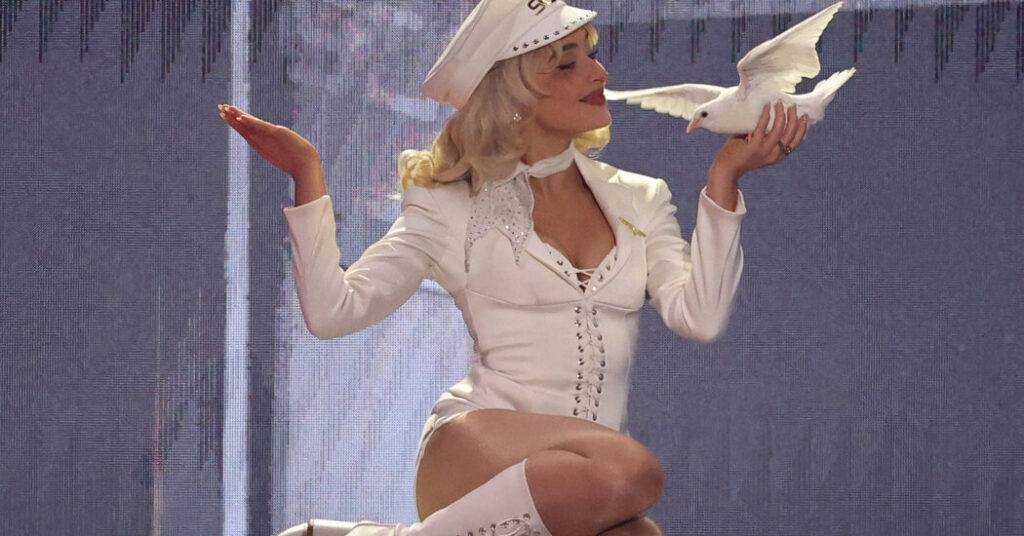
Bad Bunny and Kendrick Lamar both made history at the 68th annual Grammy Awards, on a night when artists made political statements throughout the ceremony. The Puerto Rican superstar took home the Grammy Award for best album for “Debí Tirar Más Fotos,” the first Spanish-language album to win the top honor on Sunday, while Lamar’s win for record of the year for “Luther,” his duet with SZA, made him the most honored rapper ever. But new artists also shined and generational talents re-emerged. Here are the show’s highlights and lowlights as we saw them.
Best VMAs Performances: Addison Rae & Katseye
As part of a best new artist showcase that spanned from traditionalist to futurist, the most thrilling performances of the eight were a pair sandwiched together that managed to be both, if the early aughts MTV Video Music Awards count as tradition. The TikTok influencer-turned-“main pop girl” revivalist Addison Rae might have been the junior varsity musician of the bunch — performing her sly “Fame Is a Gun” offstage on a semi-truck loading dock, in a segment that may have been pretaped and vocally doctored — but she sold the effortful staging with the right mix of sass and nonchalance. Then, the post-K-pop sextet Katseye exploded into the CBS mainstream with an acrobatic, glitchy rendition of “Gnarly” that took Rae’s Y2K reverence and raised it to the level of adult-confounding spectacle, like any good MTV throwback should. Pure pop’s not dead! JOE COSCARELLI
Best Grown-Up Reinvention: Justin Bieber
Any longtime observer of Bieber’s bumpy ride through child stardom knows that he didn’t always love these rooms, or any stage at all, and it was always plain on his face. To see his re-emergence on his own terms, amid the release of “Swag” and its sequel, has been heartening, but the molting didn’t feel complete until he appeared, shirtless and shoeless, on the Grammy stage to perform “Yukon.” A one-man band — armed with a guitar, a loop pedal, a microphone, glittery shorts and dark socks — Bieber was sturdy and soulful, forgoing the recorded version’s vocal effects and laying it all bare. As he grew in confidence throughout the performance, the whole room seemed to exhale. COSCARELLI
Best Live Vocals While Multitasking: Sabrina Carpenter
For the second straight year, Carpenter’s elaborate, Broadway-level onstage set-piece — this time, an airport-themed “Manchild” rendition — did not distract from her nailing the high notes on a microphone that felt very much on. In a night that seemed to divide even the pop stars between the Real Musicians (live instruments, stationary microphones) and Razzle-Dazzle Performers (backup dancers, pyrotechnics), Carpenter managed to be both: a total pro, with old-school production values, who could keep doing this for years to come. (Maybe she can host next year??? For real this time.) COSCARELLI
Best horse reference: Joni Mitchell
Big stars don’t always show up for the early ceremony where most of the awards are presented and which is only streamed online. But Joni Mitchell was there, glittering in gold lamé, to receive her award for best historical album for “Joni Mitchell Archives — Volume 4: The Asylum Years (1976-1980),” which chronicled her transition into working with jazz musicians.
After a long pause, during which she asked “Who won? Oh I won,” she offered a little of her history. “I had to make a transition for survival from folk music, which was killed by the British Invasion,” she said. Her record company’s initial suggestion as a studio band, the Section, had worked with James Taylor but “couldn’t play my music,” she recalled. She went to clubs searching for jazz musicians who could — and found the L.A. Express, which backed her in the late 1970s. She also recalled that she made her 1972 album “For the Roses” when she was “pissed off at the music business,” so she drew an album cover of a horse’s rear-end. Her record company vetoed it, but used it for a billboard, “so there was a big horse’s ass on Sunset for awhile,” she said. And, she added, “We’re putting it out that way now.” JON PARELES
Best Breakout Star: Lola Young
With the exception of the best new artist segment — which featured brief performances from all eight of the category’s nominees — it was a Grammy ceremony populated mostly with familiar faces and established superstars. One thrilling exception, though, was the 25-year-old British singer-songwriter Lola Young, who made a memorable impression both times she found herself onstage. Her first moment came during that best new artist showcase, when she sat at a piano and belted out a powerful, bare-bones rendition of her vulnerable but defiant pop-rock hit “Messy.”
Later, she pulled off what may have been the night’s only true upset, when that same song beat out tunes by Lady Gaga, Justin Bieber, Sabrina Carpenter and Chappell Roan for best pop solo performance. (“I don’t have any speech prepared,” Young admitted, in an endearingly flabbergasted speech that slipped at least one expletive past the censors. “It’s messy, you know what I mean?”) It was an especially triumphant night for Young, given that this was her first televised appearance since collapsing during a performance last September, a scare that prompted her to take some time off away from the spotlight. She couldn’t have asked for a more welcoming return. LINDSAY ZOLADZ
Best Intentions Gone Awry: Ms. Lauryn Hill and Guests
It was a savvy music-historical move to realize that Ms. Lauryn Hill was connected to two deep losses in 2025: D’Angelo (who was a guest on Hill’s Grammy-winning album of the year, “The Miseducation of Lauryn Hill”) and Roberta Flack (whose 1970s hit “Killing Me Softly With His Song” was a hit again for the Fugees in the 1990s, sung by Hill). Both musicians were so emotive and so deeply missed that the Grammys booked a swarm of guests for a medley that turned out to be hit-or-miss and, in “American Idol” terms, “pitchy.” Hill sang some lead vocals and introduced guest after guest in an extended medley that sounded under-rehearsed. Even so, the neo-soul singer Bilal riveted listeners with his rendition of D’Angelo’s “Untitled (How Does It Feel?).” For the rest … it was clear that they meant well. PARELES
Worst Short Shrift: Sly Stone
Titans of the psychedelic era died in 2025 and 2026, and two of them received brief video elegies as part of the lengthy and wildly uneven In Memoriam segment. Brian Wilson was praised by Bruce Springsteen and Bob Weir was remembered by John Mayer. But another vastly influential 1960s musician, Sly Stone, deserved equal respect and didn’t get it; Trevor Noah mentioned his name almost as an afterthought. Stone died in June; the Grammys had plenty of time to prepare something more fitting. PARELES
Best Proselytizing: Jelly Roll
Could a sermon be compressed into an acceptance speech? When he won the Grammy for best contemporary country album with “Beautifully Broken,” Jelly Roll took barely a minute to escalate from thank-yous to testifying to praise. “I was a horrible human,” he confessed. “There was a moment in my life that all I had was a Bible this big and a radio the same size in a six-by-eight-foot cell.” Seconds later, his voice was booming and he was preaching to the rafters. “Jesus is for everybody!” he proclaimed, with a follow-up: “Jesus is not owned by one political party!” PARELES
Worst Delayed Recognition: Billie Eilish’s 2024 Song “Wildflower” Winning Song of the Year in 2026
Last year, Grammy darling Billie Eilish went home empty-handed for once, as her eclectic album of the year contender “Hit Me Hard and Soft” failed to generate a win in any of the six categories for which it had been nominated. (Eilish also lost a seventh award for “Guess,” her raunchy duet with Charli XCX.) It was really only on a technicality, then, that one of the songs on that album, the lilting ballad “Wildflower,” was eligible this year: Eilish released it as a single in February 2025, after it had become a fan favorite and a streaming hit (and almost a full year after the May 2024 release of “Hit Me Hard and Soft”). The Grammys’ belated eligibility windows sometimes mean that the winners can feel stale, and this one felt especially so. Eilish did, however, give an impassioned speech with a potent political message that felt right on time: “No one is illegal on stolen land.” ZOLADZ
Worst Aesthetic Smorgasbord: Tyler, The Creator
Sometimes more is less. Tyler, the Creator’s bold and overly busy performance stitched together the disparate sounds and aesthetics of his two most recent albums, the heady hip-hop theatrical “Chromakopia” and the less-cerebral “Don’t Tap the Glass” (both of which were nominated in different categories) but failed to find a convincing through line. It was a relentless and exhausting performance that felt art-directed half to death. It also stood in stark contrast to the night’s more impactful moments of minimalism. Justin Bieber, for example, gave a mesmerizing performance that featured little more than a guitar, a loop pedal and an instantly iconic pair of basketball shorts. Tyler, on the other hand, got lost in all the details. ZOLADZ
Best Use of the Closing Slot: Clipse and Pharrell Williams, ‘So Far Ahead’
The veteran drug-rap duo Clipse — the brothers Malice and Pusha T — were, somehow, given the final performance of the show, likely on the strength of their longtime bond with Pharrell (who also received the “global impact” lifetime achievement award). Instead of playing it safe and performing “The Birds Don’t Sing,” a song dedicated to their late parents that features John Legend and the Voices of Fire choir, they opted for “So Far Ahead,” an extremely detailed record about selling cocaine that culminated in a subversive punchline: a snowstorm. COSCARELLI
Best Moment of Silence: Bad Bunny
What would Bad Bunny say? By some measure, that was the most interesting question going into this year’s Grammy broadcast, given the tension of the current political moment and the Puerto Rican superstar’s outspokenness around immigration rights. And during his two acceptance speeches — first for best música urbana album and then for the night’s most esteemed honor, album of the year — Bad Bunny certainly said plenty, with eloquence and verve.
But the most indelible image of the night found the 31-year-old musician in a moment of silence. Immediately after presenter Harry Styles read his name as the winner of album of the year, Bad Bunny covered his face with one of his hands and sat still for a solid 20 seconds as the crowd around him erupted in a standing ovation. Usually preternaturally cool and collected, the enormity of his achievement — the first artist to ever win the album of the year Grammy for an album sung entirely in Spanish — seemed to be washing over him in real time, as his chest heaved with suppressed sobs. It was a goosebump moment. As he made his way to the stage and finally gained the composure to speak, the first words he managed to get out — “Puerto Rico” — celebrated the collective joy of this win, for an album that is grounded in the rich cultural traditions of his beloved home. ZOLADZ
Jon Pareles, a culture correspondent for The Times, served as chief pop music critic for 37 years. He studied music, played in rock, jazz and classical groups and was a college-radio disc jockey. He was previously an editor at Rolling Stone and The Village Voice.
The post Best and Worst Moments From the 2026 Grammys appeared first on New York Times.