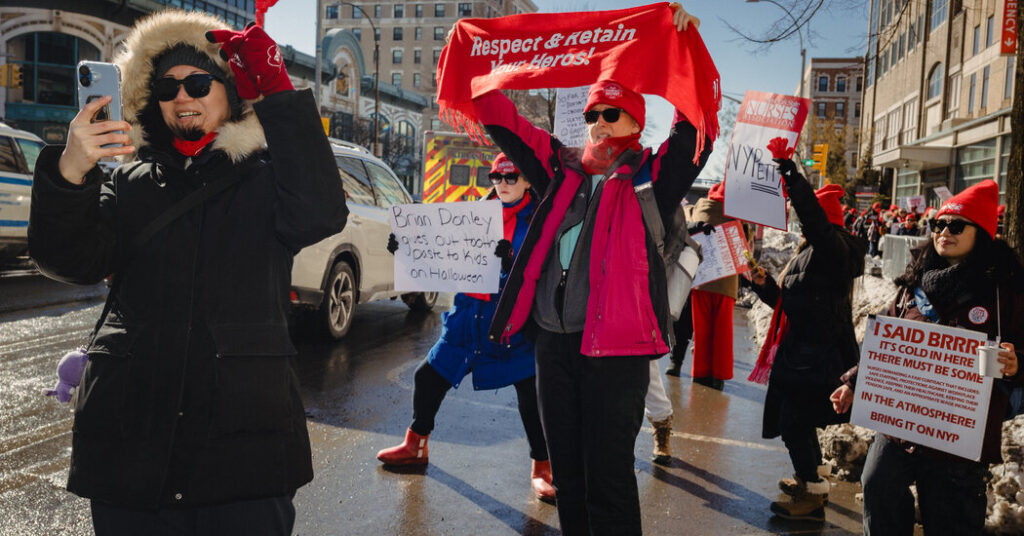
The nurses accused the hospital bosses of cowardice, claiming that the executives were hiding in an office, afraid to show their faces. Both sides called each other liars.
That is how a key day of negotiations between the New York State nurses’ union and several major hospitals ended recently, as the largest nurses’ strike in New York City history dragged on.
Until this past weekend, few signs of progress had emerged at the Javits Convention Center in Manhattan, where most of the negotiations have unfolded in lower-level offices.
“Both parties do seem to be really dug in,” said John August, the program director of health care labor relations at Cornell University’s School of Industrial and Labor Relations.
On Saturday, the 20th day of the strike, however, there were signs that the two sides were looking for a path forward. The hospitals and the union presented revised proposals and issued statements that sounded less antagonistic than before.
“We streamlined and revised our proposals in an effort to bring hospital executives back to the table to negotiate in good faith and settle fair contracts as quickly as possible,” the nurses’ union, the New York State Nurses Association, said in a statement on Saturday.
After three weeks of labor strife, it became clear that both sides had re-engaged, with the two sides each sharing new offers and agreeing to resume negotiations on Monday.
“I think things have gone into high gear in recent days,” said Kenneth E. Raske, the president of the Greater New York Hospital Association, a trade group that helped the hospitals prepare to weather the strike. “In negotiations, you always have fits and starts, so I’m not forecasting a conclusion right around the corner, but I am saying significant progress has been made.”
On Monday, the strike against some of the city’s leading medical institutions — NewYork-Presbyterian/Columbia, Montefiore Medical Center and the main campus of Mount Sinai Hospital along with two other major hospitals within the Mount Sinai system — enters its fourth week. From the start, there had been signs that the strike might persist for a long time. After all, many of the same issues — such as staffing levels — had precipitated a walkout just three years ago.
That strike, in January 2023, was resolved in three days, with big wins for the nurses. Back then, the hospitals had been caught by surprise, not expecting the nurses to follow through on vows to walk out.
This time, hospital executives took the threat seriously and spent much of December preparing. When the strike began, on Jan. 12, the hospitals had already transferred out many vulnerable patients and hired thousands of short-term contract nurses to replace the nearly 15,000 striking workers. The hospitals made a point of publicizing that they were ready and would not fold quickly.
Many nurses, however, expected a repeat of the last strike: a few days on the picket line, followed by victory.
“I did not think it would go to Day 9,” Zara Roy, a nurse at Mount Sinai Morningside, said more than a week ago. “I was not fully prepared for it,” she said of the length of the strike.
But each side remains convinced that it can outlast the other.
On Friday, Dr. Brendan G. Carr, the chief executive of the Mount Sinai Health system, offered fresh evidence that the hospitals are settling in for the long haul. He said that the three Mount Sinai hospitals affected by the strike were operating under the assumption that they would need replacement nurses for a few more weeks. So far, the affected hospitals collectively have spent more than $100 million on short-term staffing.
“At this point, given the slow progress at the table, we’ve extended our staffing contracts another few weeks to ensure that we won’t have an interruption in services,” Dr. Carr said in a message to employees on Friday.
The nurses, meanwhile, have been chanting, “One day longer, one day stronger.”
Despite a bitterly cold spell and heavy snowfall, the picket lines have been full of striking nurses and supporters. Outside Mount Sinai Hospital one recent day, hundreds of nurses held hands, forming a chain that snaked around several blocks. Nurses have gone on runs, jogging from one hospital to another.
Outside Montefiore Medical Center in the Bronx, union organizers and the father of one of the nurses have been serving soup to 200 strikers each day: mushroom beef barley one day, chicken lemon orzo another day.
The nurses have begun to receive unemployment pay. Some have secured per diem work at other hospitals. But the financial pressures have been mounting. Most have lost their health insurance because of the strike.
For three weeks, bargaining has been intermittent. When the two sides have sat down to negotiate, generally through mediators, unexpected roadblocks have appeared.
Three hospital systems are affected by the walkout, but there are, essentially, four different negotiations underway — two with the Mount Sinai system. The nurses at the flagship institution, Mount Sinai Hospital, are negotiating one contract, while those at two other hospitals, Mount Sinai Morningside and Mount Sinai West, are pursuing a separate deal.
That has led to a fractured process. While the negotiators for the nurses at Mount Sinai Hospital reached a tentative agreement with the hospital on the use of artificial intelligence, the negotiators at Mount Sinai Morningside and West rejected the same pact, according to information provided by the Mount Sinai Health System.
The bargaining sessions briefly took place at a Sheraton Hotel in Midtown before migrating west to the Javits Center. During lulls, the negotiators have checked out a boat show upstairs.
During the second week of the walkout, after several days passed with little contact between the two sides, Gov. Kathy Hochul and Mayor Zohran Mamdani urged the hospitals and the union to keep negotiating. That led to two days of shuttle negotiations in which the union lowered its wage demand and accused the hospitals of imperiling the nurses’ health by proposing changes to medical benefits, a claim the hospitals denied.
But the second week of bargaining ended with a dramatic moment — not a breakthrough but a breakdown. The union held a news conference at the Javits Center, saying it was severing negotiations.
The nurses declared that the possibility of changes to their health benefits — which the hospitals said were aimed at controlling costs — was a red line.
“The hospitals have been baldfaced lying and denying that they were threatening to drastically cut our benefits, but we see now that was their goal all along,” Nancy Hagans, the president of the New York State Nurses Association, said at the news conference last Friday night. “They have exhausted our good will.”
A union negotiator and nurse at Mount Sinai, Dania Munoz, then stepped up to the microphone.
“Here we are, ready to speak to them, while they hide downstairs,” she said of the hospital negotiators. “Cowards is what I call them. Show your faces.”
The hospitals, meanwhile, accused the nurses of trying to manufacture a crisis to distract attention from their pay demands, which the hospitals have characterized as unrealistic.
“They repeated their lies claiming that Mount Sinai is holding nurses’ health care benefits hostage — despite the fact that no Mount Sinai negotiator has made any proposal about cutting or discontinuing health care benefits,” the hospital said in a statement.
To observers, the pace of the negotiations suggests that a deal could still be far away.
“When people are locked in conflict, conflict becomes the issue as opposed to the root causes,” Mr. August said.
But the next few days could prove crucial. From the start, the two sides have remained far apart on wages: After initially proposing annual base pay increases of 10 percent, the nurses lowered their request two weeks ago to between 5 and 7 percent each year for three years, while the hospitals’ offer has not budged much.
Joseph Goldstein covers health care in New York for The Times, following years of criminal justice and police reporting.
The post After Weeks of Rancor, a Glimmer of Hope in N.Y.C. Nurses’ Strike appeared first on New York Times.