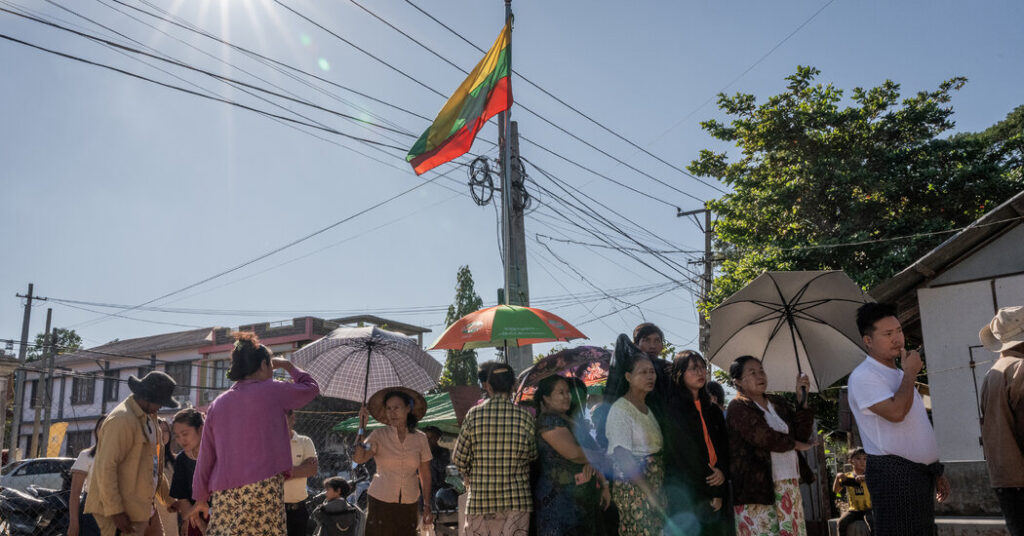
After the Myanmar military overthrew the elected government five years ago, politicians and civic leaders opposed to the junta formed a pro-democracy group that they hoped would be the country’s sole legitimate representative on the global stage.
They set up offices in places like Washington and London, and in some restive parts of Myanmar. They raised millions and pledged to field an army comprising various ethnic and rebel groups. They called themselves a shadow government and set up ministries. They chose a name that reflected their ambitions: the National Unity Government of Myanmar.
But this diffuse shadow government, with most of its members in exile, has had few major successes. It has failed to reverse international apathy toward the military’s brutal crackdown, which has left at least 7,700 dead since the junta usurped power on Feb. 1, 2021. It does not have full control of the local rebel groups and ethnic armies on the battlefield, where the resistance has made significant gains against the military government.
Now, as the junta is poised to put up what it calls a civilian government after a stage-managed election, the National Unity Government is looking increasingly irrelevant.
U Kyee Myint, one of Myanmar’s most prominent human rights lawyers, said the shadow government operated more like a civil society organization than a revolutionary one.
“They are disconnected from what the people actually want,” said Mr. Kyee Myint, 80.
The military, which has ruled Myanmar for most of its post-colonial history, remains ensconced in cities and controls just about half of the nation’s territory. Last year, the leader, Senior Gen. Min Aung Hlaing, announced that the military government would hold elections. But most opposition politicians, including the ones the junta deposed, are jailed, remain barred from politics or are in hiding.
The elections were held in three phases, only in areas under military control, and concluded last Sunday. They were widely derided as a sham and are expected to produce as the winner a political party that is a proxy for the junta.
The shadow government, which has been deemed illegal by the military, called for a boycott of the vote.
Voter turnout was 54.1 percent, according to the military, the lowest in decades. The N.U.G. said actual turnout in urban centers like Yangon and Mandalay was most likely closer to 20 percent.
David Scott Mathieson, an independent analyst on Myanmar, said the military had used the election to successfully shift the political ground and create a new reality that the shadow government failed to counter effectively.
Despite the polls being a “farcical process,” the regime established a semblance of procedure that allowed it to dictate the political agenda, Mr. Mathieson said. It bet on “widespread apathy” in urban areas, understanding that many exhausted civilians will vote simply so officials will leave them alone, he added.
“The N.U.G. literally couldn’t see that the ground was shifting beneath its feet,” Mr. Mathieson said.
Detractors say there is virtually no leadership within the shadow government, which is helmed by an acting president, Duwa Lashi La, and prime minister, Mahnn Win Khaing Than. Meetings are held over Zoom to discuss issues like responding to an election they call a sham but have few answers to.
Globally, the government in exile has at least 11 “representative offices,” but Myanmar’s biggest neighbors — China, India and Thailand — do not recognize it.
Like many others, Mr. Kyee Myint was an early supporter of the group.
It had proposed a fundamental reset of Myanmar’s society by ending the dominance of the Bamar-majority ethnic group. It said it wanted to include a diverse set of ethnic leaders to create a truly inclusive state. It notched some early wins when it raised tens of millions of dollars to fund its war efforts.
Now Mr. Kyee Myint is one of the shadow government’s most outspoken critics. Chief among his list of complaints is what he says is its lack of financial transparency, which he says prevents resources from reaching fighters on the ground.
He pointed to a case in November when the permanent secretary of the prime minister’s office was accused of nepotism, corruption and misuse of authority. She was suspended, but the results of the investigation have not been disclosed.
Daw Zin Mar Aung, the shadow government’s foreign minister, said the group was trying its best. “We started from zero,” she said, speaking by telephone from an undisclosed location.
Criticism, she said, should be constructive, to “support and encourage us to move forward.”
“We really understand the suffering of our people,” she added.
But in parts of Myanmar, where the fighting is most intense, rebels say they are not getting the funds that they need from the National Unity Government. A battalion commander for the People’s Defense Forces, a group of civilians who took up arms after the coup, based in Mandalay said his troops were surviving by relying on donations.
Tint Zaw Hein, who founded a group to raise funds for doctors and teachers who have joined nonviolent protests, said he had met some fighters throughout central Myanmar who say that they have only 50 to 100 bullets left.
He criticized the shadow government as failing to see how long the civil war would take.
“You can’t change the country from outside the country,” he said.
Nay Phone Latt, a spokesman for the shadow government, said it was in discussions with other revolutionary forces, including the ethnic armed groups, to come together under a new alliance.
Mr. Nay Phone Latt acknowledged that the National Unity Government could not fully equip everyone with weapons, “but it is not the case that we have abandoned them without any support,” he said.
He added, “While it is true that we have not achieved 100 percent success, it would be an exaggeration to say that nothing has been achieved.”
Last year, Tayzar San, one of Myanmar’s most prominent pro-democracy activists, set off a furor when he wrote on social media that he was “completely dissatisfied with the N.U.G.’s performance.”
A physician who is often described as Myanmar’s most wanted man for his opposition to the junta, Dr. Tayzar San said the shadow government needed stronger leadership and that it was time for the group to accelerate its efforts for reform.
In December, in response to growing criticism, the National Unity Government reduced the number of ministries from 17 to 12. But Dr. Tayzar San said the people of Myanmar were “still waiting for more effective, practical changes” such as the strengthening of local governments in the Sagaing, Mandalay and Magway regions, the epicenter of the armed struggle against the junta.
Still, Dr. Tayzar San said it was not practical to fully replace the shadow government, which is active in defense, education and health in much of central Myanmar. He cautioned that toppling one of the world’s most entrenched military dictatorships would take time.
“It’s not that the N.U.G. isn’t working at all,” Dr. Tayzar San said. “It’s just not meeting the people’s expectations.”
Sui-Lee Wee is the Southeast Asia bureau chief for The Times, overseeing coverage of 11 countries in the region.
The post Years After Coup, Myanmar’s Government in Exile Teeters on Irrelevancy appeared first on New York Times.