As Russian and Ukrainian negotiators reconvene in Abu Dhabi on Sunday for peace talks organized by the Trump administration, at least one core issue remains unresolved: the fate of the Donetsk region.
For months, Russian officials have suggested that Moscow will not stop fighting until Ukraine hands over the 2,082 square miles of the Donetsk region that Kyiv still controls.
Secretary of State Marco Rubio, testifying last Wednesday in the Senate, said the issue of the Donetsk region had become “the one remaining item” in the peace negotiations requiring attention, noting, “It’s still a bridge we haven’t crossed.”
A day later, Moscow disputed that. The Kremlin foreign policy aide, Yuri Ushakov, said other issues must still be addressed, including the security guarantees that Western nations have offered Ukraine.
Even so, it is clear that the Ukrainian-controlled swath of land in the Donetsk region, smaller than the state of Delaware, sits at the heart of the talks.
That has raised the question: Why does President Vladimir V. Putin of Russia care so much about this particular land, as opposed to other swaths of Ukrainian territory to which Moscow has laid claim?
Symbolism and State Propaganda
Ever since Russia invaded Ukraine in 2014, Donetsk has been central to Moscow’s attempt to break off and later annex the predominantly Russian-speaking industrial region of east Ukraine, which the Kremlin depicts as historically Russian.
Russia has crafted much of its state propaganda around saving the people of the Donetsk and Luhansk regions, referred to the area collectively as the Donbas. Russia has already wrested full control of the Luhansk region.
In late 2022, the Kremlin announced that it had annexed four regions of Ukraine — Luhansk, Donetsk, Kherson and Zaporizhzhia.
Russian negotiators seem to have given up on taking the parts of the Kherson and Zaporizhzhia regions that Russia does not already control. If Kyiv also held on to a large piece of Donetsk, Mr. Putin could face blowback from pro-war nationalist elements of his base.
The piece of the Donetsk region that Ukraine still holds has symbolic importance. It includes Sloviansk, the city where Moscow began what it called a pro-Russia “separatist” revolt in 2014. A failure by Moscow to take the city, which Russian propaganda depicts as the cradle of the “Russian Spring,” after 12 years of trying, could sharpen criticism from pro-war nationalists.
Taking the rest of Donetsk could also help Mr. Putin shape a narrative of victory.
“If you can get at the negotiation table something you have not achieved by force, the question of who won the war and who dictated the terms of ending the war will be answered,” said Alexander Gabuev, director of the Carnegie Russia Eurasia Center think tank in Berlin. “There will be possibly no credible way to spin that this has been a strategic Russian defeat and a victory for Ukraine.”
Mr. Putin knows that any decision by Kyiv to hand over the territory would be particularly contentious within Ukraine, where troops have been dying for that land for 12 years, Mr. Gabuev added.
“People have shed blood for that,” he said. “Lots of families lost their loved ones during the fighting in Donbas. Now you are surrendering it? It’s a ticking bomb under Ukrainian unity.”
President Volodymyr Zelensky of Ukraine said in comments on Friday that he was ready to make compromises to end the war but not compromise the territorial integrity of Ukraine.
In December, Mr. Zelensky said he was ready to pull his troops back from the part of the Donetsk region that Kyiv holds and turn those areas into a demilitarized zone. But he said Russia would have to pull its forces from an equivalent stretch of land in the Donetsk.
The ‘Anchorage Formula’
As the effort by President Trump to broker peace hit a wall last summer, his administration floated a territory swap idea involving Donetsk to try to reinvigorate the talks with the Kremlin. Mr. Putin is now clinging to that deal.
Last summer, Steve Witkoff, the president’s special envoy, flew to Moscow with the idea. Mr. Putin’s positive response led to the organization of the August summit in Anchorage.
Exactly what Mr. Trump and Mr. Putin agreed during that meeting hasn’t been made public. But since then, Russian leaders, without elaborating, have been insisting that any peace deal adhere to “the spirit of Anchorage” or “the Anchorage formula.”
The phrase is generally seen as Kremlin shorthand for the deal Mr. Putin agreed to with Mr. Trump in Alaska: He would stop the war if Ukraine handed over the rest of Donetsk (and agreed to a range of other nonterritorial demands).
Mr. Zelensky did not agree. He noted that the Ukrainian Constitution prohibited territorial concessions without a nationwide referendum.
The issue then reappeared in a new form in a 28-point plan drawn up last fall by the U.S. negotiators, with input from Mr. Putin’s special envoy, Kirill Dmitriev.
That plan proposed that Ukrainian forces withdraw from the part of the Donetsk region they still control and create a “neutral demilitarized buffer zone.” It would be recognized internationally as Russian territory, but Russian troops wouldn’t be allowed on the land.
Having agreed to the offer with Mr. Trump in Alaska, Mr. Putin may feel any deviation from that would be getting a raw deal.
“If you’re Russia and you’re offered this, are you going to accept that it has been walked back?” said Sam Charap, a senior political scientist at the Rand Corporation.
The problem was Ukraine never agreed.
Fortifications and Water
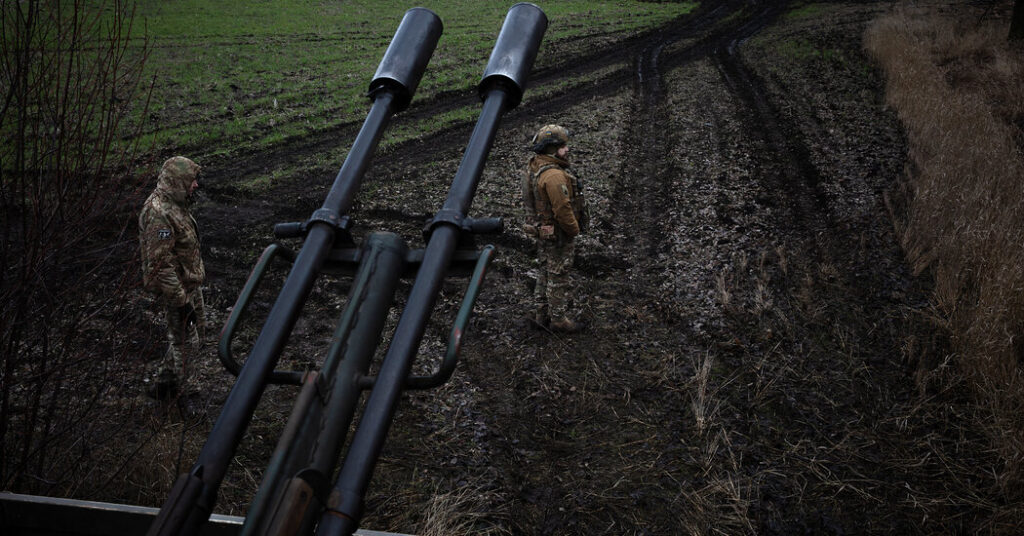
The part of the Donetsk region that Ukraine still holds is one of the most fortified parts of the front, because the defenses date to 2014, before Russia launched its full-scale invasion.
Losing those fortifications would make Ukraine more vulnerable to any future Russian attack, some analysts have said, positioning Moscow well to launch a new invasion if the peace agreement fails.
The Russian-occupied city of Donetsk, the capital of the Donetsk region, was also gripped last year by a severe water crisis and continues to face problems with water shortages.
A canal supplying water to the region, known as the Siverskyi Donets-Donbas Canal, was destroyed at the outset of the full-scale invasion in 2022. It also begins northeast of Sloviansk, on territory still controlled by Ukraine.
Mr. Putin was asked about the water shortages during his call-in news conference in December. He explained that the main water intake is in territory that is “unfortunately still controlled by the enemy.”
The Russian leader said the problem could be “fundamentally resolved” once “this territory is “under the control of our armed forces.”
Paul Sonne is an international correspondent, focusing on Russia and the varied impacts of President Vladimir V. Putin’s domestic and foreign policies, with a focus on the war against Ukraine.
The post Why Is Taking the Rest of the Donetsk Region So Important to Putin? appeared first on New York Times.