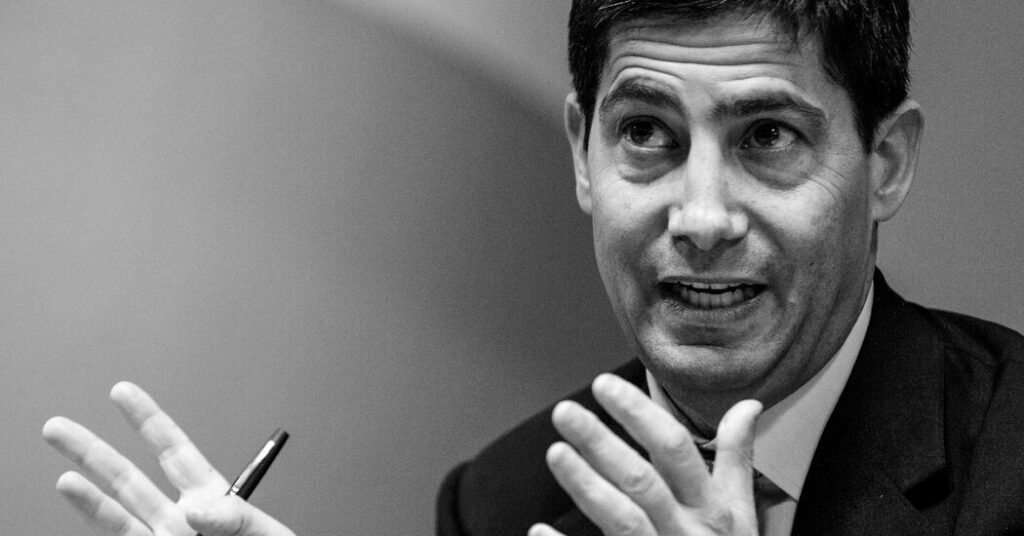
When President Trump announced his choice for Federal Reserve chair on Friday, many observers breathed a sigh of relief. Unlike some of the overtly partisan, sycophantic candidates for the gig, Kevin Warsh seemed pretty normal. Maybe even (hallelujah!) apolitical — a crucial trait if you care about the Fed’s ability to deliver low inflation.
They should not be so sanguine. Mr. Warsh’s record suggests that he may soon become one of the worst economic forecasters ever appointed to the chairmanship. Plus, he may be much more partisan than his boosters hope.
Let’s start with the good news: Mr. Warsh is a dramatically better option than some of the alternatives Mr. Trump was considering. Kevin Hassett, formerly seen as the top contender, kissed up to Mr. Trump so overtly that investors took his subservience for granted — and greatly feared what the loss of Fed independence would mean for the economy.
Mr. Warsh certainly looks the part of a conventional central banker: On Friday, Mr. Trump described him as straight out of “central casting,” later adding, “he’s got the look.” (A quality that matters to Mr. Trump, who in 2017 reportedly ruled out reappointing Janet Yellen as Fed chair in part because she was too short.)
Mr. Warsh is also a seasoned Wall Streeter and a former Fed governor, not to mention very well connected. His father-in-law is the billionaire cosmetics magnate Ronald Lauder, a Republican megadonor and a longtime personal friend of Mr. Trump. To give you a sense of Mr. Lauder’s influence: He’s the guy who apparently planted the idea in Mr. Trump’s head to buy Greenland.
The real litmus test, of course, is whether Mr. Warsh will do the president’s bidding. Mr. Trump has been clear that he expects his next Fed chair to slash interest rates and stimulate the economy. That could do wonders for Republicans in the fast-approaching midterm election cycle.
This expectation is a problem. The Federal Reserve must be politically independent in order to tackle inflation. It must be willing to do unpopular and inconvenient things, including raising interest rates when called for, rather than doing whatever is best for a particular politician or political party.
Mr. Warsh knows this. “If the Federal Reserve lost its independence, its hard-earned credibility would quickly dissipate,” he said in a 2010 speech titled an “An Ode to Independence.” “The costs to the economy would be incalculable: Higher inflation, lower standards of living and a currency that risks losing its reserve status.”
But there are reasons to wonder if he still heeds those words. Among them: He has abandoned some of his long-held views just in time to audition for Fed chair.
For most of his career, Mr. Warsh has adopted positions that are roughly the opposite of what Mr. Trump now demands. Mr. Warsh is seen as an inflation hawk, someone who fixates on inflation and usually wants tighter monetary policy, via higher interest rates and a smaller Fed balance sheet. In the darkest depths of the financial crisis and the Great Recession, when nearly every economist on earth worried about extensive job losses — an environment in which interest rate cuts are usually warranted — Mr. Warsh was a rare voice in his scaremongering about inflation.
The day after Lehman Brothers filed for bankruptcy in 2008, Mr. Warsh, who was then a Fed governor, was still concerned about the possibility of spiking inflation. Instead, the Fed’s preferred measure of inflation immediately turned negative, thanks to cratering demand. Unbowed, Mr. Warsh continued sounding the alarm on inflation even in 2010, when inflation was ultralow but unemployment hovered around 10 percent.
It’s a good thing the Fed didn’t act on Mr. Warsh’s advice. The tighter monetary policy he petitioned for would have likely triggered an even more protracted and painful recession. You don’t need to take my word for it: This is exactly what the European Central Bank did, worsening the crisis.
The Fed also hiked interest rates in 1929, a decision that helped to plunge the country into the Great Depression. (As the former Fed chair Ben Bernanke once said of the Great Depression, “We did it. We’re very sorry,” adding, “We won’t do it again.”)
Of course, plenty of people get predictions wrong. But not usually this wrong, without acknowledgment or explanation of how they’d avoid a similarly catastrophic error next time, particularly when expecting a promotion.
This brings me to the political expedience that seems to sway Mr. Warsh’s choices. He seems more interested in slamming the brakes on the economy when a Democrat is in the White House than when a Republican is.
To wit: He has twice made an abrupt about-face on his usual demands for tighter money, and both occurred when Mr. Trump was in office. The first time was in 2018; the second was after the 2024 election. As recently as September 2024, Mr. Warsh was admonishing the Fed for cutting interest rates, only to reverse himself not long after Mr. Trump took office.
The first time Mr. Warsh interviewed with Mr. Trump for the job of Fed chair was in 2017. He lost out to Jerome Powell. After their conversations, Mr. Warsh later recounted that Fed independence was “not an obvious feature” to the president, and chalked up his rejection to the fact that he hadn’t told Mr. Trump what he wanted to hear. “I did not put my ambitions ahead of my principles,” he said in an interview.
Mr. Warsh then spent the next several years reportedly attempting to position himself as somewhat more pliable.
In May he defended Mr. Trump’s public attacks on the Fed, once considered beyond the pale for any president. Fed officials shouldn’t be “pampered princes,” Mr. Warsh asserted.
Then, when Mr. Trump moved from mere jawboning to actually weaponizing state powers against Fed officials who didn’t toe the line, Mr. Warsh dismissed his former colleagues’ concerns about what this might do to curtail the Fed’s independence. In the fall, after Mr. Trump made the unprecedented decision to try to fire the Fed governor Lisa Cook, every living Fed chair signed an amicus brief warning the Supreme Court that the move would “erode public confidence in the Fed” and “threaten the long-term stability of our economy.”
Mr. Warsh’s response? “I did not know that senior economic officials at the Treasury and the Federal Reserve expertise went all the way to constitutional jurisprudence,” he sniped.
Since then, the Trump administration has opened what seems to be a bogus criminal investigation into the outgoing Fed chair, Mr. Powell. This is Mr. Powell’s apparent punishment for resisting Mr. Trump’s pressure to reduce interest rates.
Mr. Warsh has been stridently — and unusually — caustic toward Mr. Powell, describing Mr. Powell’s Fed in the fall as having the “wrong track record, wrong operating framework, lack of curiosity and lack of credibility.” Mr. Warsh has, however, since been mum on the political persecution of the man he hopes to succeed.
Markets have shrugged off any prospect of Mr. Warsh becoming Mr. Trump’s puppet. Plenty of economists I respect have vouched for him, including his former Fed colleagues. But part of their public nonchalance may simply be relief that Mr. Trump didn’t give the nod to Mr. Hassett.
Mr. Warsh still has much to prove about his own independence, and his commitment to safeguard the Fed’s. A cynic might say he simply found a more polished, less demeaning way to ingratiate himself with Mr. Trump and prove his loyalty than Mr. Hassett did: by making the president’s enemies his own.
Catherine Rampell is the economics editor of The Bulwark and an anchor for MS NOW.
The Times is committed to publishing a diversity of letters to the editor. We’d like to hear what you think about this or any of our articles. Here are some tips. And here’s our email: [email protected].
Follow the New York Times Opinion section on Facebook, Instagram, TikTok, Bluesky, WhatsApp and Threads.
The post What Worries Me About Trump’s New Fed Pick appeared first on New York Times.