Last February I wrote an essay about the Trump administration’s strategy of “muzzle velocity.” Muzzle velocity, in its literal sense, describes the ferocious speed of a bullet at the moment it exits the front end of a gun. The term came from an interview that Steve Bannon, President Trump’s former chief strategist, gave in 2019. “All we have to do is flood the zone,” Bannon said. “Every day we hit them with three things. They’ll bite on one, and we’ll get all of our stuff done. Bang, bang, bang. These guys will never — will never be able to recover. But we’ve got to start with muzzle velocity.”
Trump world has an affection for analogies that glorify the combination of violence and speed. After Trump’s second Inaugural Address, Taylor Budowich, then one of the White House’s deputy chiefs of staff, tweeted, “Now, comes SHOCK AND AWE.” “Shock and awe” refers to the bombing campaign that launched America’s invasion of Iraq in 2003. It was an awesome demonstration of initial force that belied a catastrophic absence of information, planning and wisdom. It was the belief that an immediate show of dominance would lead to a society’s submission rather than its revolt. Both Bannon and Budowich’s metaphors have proved more grimly apt than they intended.
The strategy of the Trump administration over the last year has been to move so fast, to do so much, that the opposition could never find its footing. This was Bannon’s insight, and it was real: Attention is limited. The media, the opposition, the electorate — they can only focus on so much. Overwhelm their capacity for attention and you overwhelm their capacity to think, organize and oppose.
But what you are doing to the opposition you are also doing to yourself. “It is a strategy that forces you into overreach,” I wrote last year. “To keep the zone flooded, you have to keep acting, keep moving, keep creating new cycles of outrage or fear. You overwhelm yourself.” And that is what happened. The Trump administration is overwhelmed — by its own violence, its own cruelty, its own lies, its own chaos.
There is nothing unusual about a presidency being overwhelmed by crises. What is unusual about the Trump administration is that it has created those crises itself. The Trump administration chose to create a regime of ever-shifting tariffs; it chose to threaten to take Greenland through force or through tariffs; it chose to investigate its political enemies, leading up to its effort to intimidate Jerome Powell, the chair of the Federal Reserve; it chose to alienate our closest allies, encouraging both Canada and Britain to seek closer ties with China; it chose to stage quasi-invasions of blue cities, setting the scene for the horrifying killings of Renee Good and Alex Pretti in Minneapolis. And that’s just a partial accounting of the disasters and diminishments of the last few weeks and months.
Muzzle velocity was built on the idea that the Trump administration had reserves of attention and focus that the rest of us did not. The reality is just the opposite. The White House has demands on its attention and focus that the rest of us do not. We are not responsible for managing or controlling everything from the labor market to A.I. policy to immigration enforcement and vaccine approvals. We will not be blamed for a measles outbreak or a recession. But the president will.
That is why most White Houses pay such close attention to policy processes and chain of command: These are all ways of filtering the torrent of information and decisions in order to conserve the focus and attention of the president and his top aides. Well-managed White Houses — and personally disciplined presidents — are ruthless in their pursuit of prioritization. “You’ll see I wear only gray or blue suits,” President Barack Obama told Vanity Fair in 2012. “I’m trying to pare down decisions. I don’t want to make decisions about what I’m eating or wearing. Because I have too many other decisions to make.”
But this White House — and this president — have treated freneticism as a virtue and discipline as a vice. Instead of seeking to limit the number of crises and conflicts that they need to remain on top of, members of the Trump administration, from their first day, sought to multiply them. They spent their initial months in office ripping the wiring out of the federal government, including gutting internal teams, like the National Security Council, that are meant to help process information on behalf of the president. They have treated caution and restraint as an admission of weakness.
In January Stephen Miller, the deputy chief of staff who, in practice, acts as Trump’s prime minister, delivered a message to ICE agents: “To all ICE officers: You have federal immunity in the conduct of your duties, and anybody who lays a hand on you or tries to stop you or tries to obstruct you is committing a felony,” he said. That message was part of a broader effort to change the culture at ICE and the Border Patrol, Caitlin Dickerson, a journalist at The Atlantic who covers immigration, told me:
I was talking to one former ICE official who told me that you would always fear discharging your weapon in an interaction, even a potentially violent and dangerous one. Usually the concern was that officers would be too unwilling to use their gun because they worried about potential repercussions. And there were all these layers of investigation that would take place after a shooting. His fear when he was in ICE for 30 years was that he wouldn’t use his gun in a moment when he needed to.
And now it’s almost as if the opposite fear is true. We’ve seen in ICE people losing their jobs, high-level officials losing their jobs because they’re not delivering enough deportations, they’re not being aggressive enough. I think Miller is just underscoring that argument that you’re not going to get in trouble for being too aggressive and, in fact, the only thing you will get in trouble for is not being aggressive enough.
It is hard not to see a straight line from that change in culture to the tragic killings on the streets of Minneapolis.
Every organization comes to resemble its leader. Trump himself is easily distracted, desirous of flattery rather than counsel, impressed by crude displays of dominance and violence and obsessed with social media and cable news — and so too is his White House. The sycophancy among Trump’s aides is so crude as to be indistinguishable from mockery. Miller, speaking to a New York magazine reporter about Trump’s health, said, “The headline of your story should be ‘The Superhuman President.’” When Miller says this, does he realize he is making his boss look ridiculous? Does he intend it?
But it’s not just Miller. Trump’s cabinet meetings take the form of totalitarian kitsch. Here is Lee Zeldin, head of the Environmental Protection Agency, wrapping up remarks in December:
If you were to ask me what I’m grateful for, whether it’s a Thanksgiving, it’s a Christmas, a Hanukkah, a New Year’s, anytime of year the fact that this president, after four years serving in office, he could have just left it in the rearview mirror and went on to really enjoy retirement, but he is willing to take a bullet for all of you tuning in at home, because he believes in his flag, our freedom, our liberties and to save the greatest country in the history of the world. So I’m grateful this holiday season for you, Mr. President.
The joke of Trump’s cabinet meetings is that no one is joking. These meetings are not just a performance; they are a culture. Trump’s favor is won through demonstrations of loyalty rather than competence. The president wants parades, not process, and that is what he gets.
The irony of Trump’s second term is that he was much better served by the advisers in his first term, who understood that part of their job was to protect him — and the rest of us — from his worst impulses. In 2020, when Trump reportedly responded to the George Floyd protesters by asking the military to “just shoot them, just shoot them in the legs or something,” his advisers weren’t protecting only us when they refused. They were also protecting him.
Trump’s second White House was built to ensure that no one would ever tell Trump no again. He wanted a culture of lies and sycophancy, and he got one. “I hear stories from my predecessors,” Susie Wiles, Trump’s chief of staff, told Vanity Fair in December, “about these seminal moments where you have to go in and tell the president what he wants to do is unconstitutional or cost lives. I don’t have that.”
Trump’s aides flatter him and lie to us. They indulge his constant distraction and so they too are constantly distracted. They are dominated by him and so they seek to dominate us. What they believe to be their strengths are their weaknesses. You can see it in their metaphors. The shock and awe bombing campaign was the prelude to catastrophe, not to victory. And so it is here.
This is a presidency that is, by any measure, failing. Trump is unpopular; his brutality and his tariffs have turned immigration and affordability, once among of his strongest issues, into liabilities. Trump’s opposition is increasingly united and mobilized; Democrats are besting Republicans in elections all across the country and disciplined, brave, beautiful protest movements have emerged in the cities ICE has sought to occupy. I cannot do better here than to quote Adam Serwer’s dispatch from Minnesota:
Every social theory undergirding Trumpism has been broken on the steel of Minnesotan resolve. The multiracial community in Minneapolis was supposed to shatter. It did not. It held until Bovino was forced out of the Twin Cities with his long coat between his legs.
The secret fear of the morally depraved is that virtue is actually common, and that they’re the ones who are alone. In Minnesota, all of the ideological cornerstones of MAGA have been proved false at once. Minnesotans, not the armed thugs of ICE and the Border Patrol, are brave. Minnesotans have shown that their community is socially cohesive — because of its diversity and not in spite of it. Minnesotans have found and loved one another in a world atomized by social media, where empty men have tried to fill their lonely soul with lies about their own inherent superiority. Minnesotans have preserved everything worthwhile about “Western civilization,” while armed brutes try to tear it down by force.
We are watching an administration that is not only retreating in key areas — dropping its demand for all of Greenland, sending Greg Bovino back to Border Patrol’s El Centro region, meekly backing off its trade war with China — but finding itself cornered by its own cruelty and lies. Miller’s slander of Pretti as a “domestic terrorist” and an “assassin” could not stand even the barest contact with the video of Pretti trying to protect a nearby woman or the quiet heroism of his daily life.
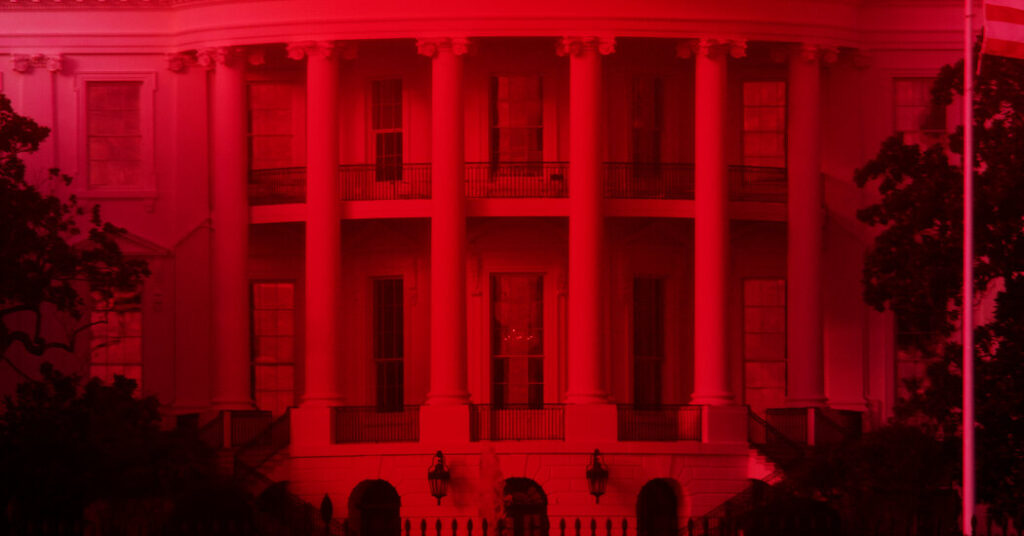
Trump appears to be trying to course correct, but he has neither the discipline nor the personnel to truly change his presidency’s direction. This administration is a reflection of who the president is and what he wants. This White House is not beset by crises. This White House is the crisis.
The Times is committed to publishing a diversity of letters to the editor. We’d like to hear what you think about this or any of our articles. Here are some tips. And here’s our email: [email protected].
Follow the New York Times Opinion section on Facebook, Instagram, TikTok, Bluesky, WhatsApp and Threads.
The post The White House Is the Crisis appeared first on New York Times.