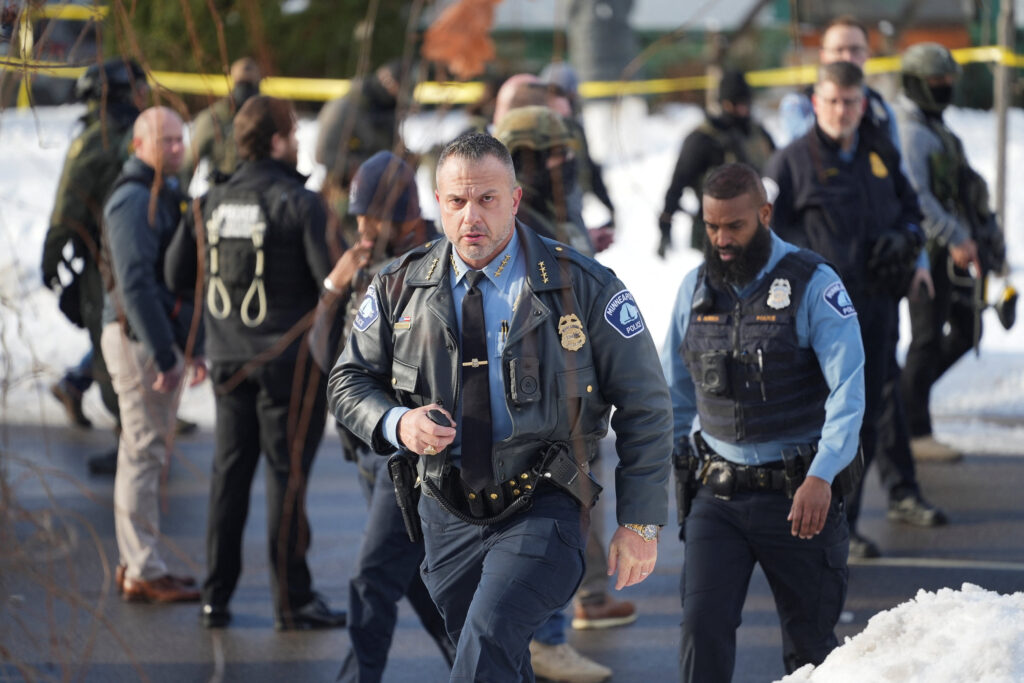
MINNEAPOLIS — It was a brisk night last week when Brian O’Hara, the Minneapolis police chief, stood in front of his newest crop of officers and acknowledged the tough assignment ahead.
The Minneapolis police force had “faced extraordinary challenges,” O’Hara said. He did not list them, but people in the room and beyond knew: An officer murdering George Floyd in 2020, sparking unrest and damaging riots; plummeting morale, a flood of departures and a federal investigation detailing rampant civil rights abuses.
“You will not receive deference that other officers in other places automatically receive,” O’Hara told two dozen new officers, including police academy graduates and other hires, during a ceremony Wednesday evening in a Gothic downtown basilica. “Every day, you’re going to be expected to show up in a way that earns trust, to prove who you are.”
Outside, a mammoth immigration crackdown had flooded Minneapolis with several thousand federal officers, presenting O’Hara and his department with its biggest crisis since he took over in 2022.
O’Hara fears immigration agents’ tactics and behavior — including fatally shooting two people — could exacerbate residents’ lingering wariness of law enforcement, imperiling a years-long push to improve community relations.
But according to law enforcement veterans, experts, residents and even some elected officials critical of Minneapolis police in the past, O’Hara and his force have threaded a narrow needle, responding when needed but maintaining a distance from the federal surge to avoid ramping up tensions. And for now, they say, that seems to be working.
“The MPD is still acting like a police department,” said Michelle Phelps, author of “The Minneapolis Reckoning: Race, Violence, and the Politics of Policing in America” and a sociology professor at the University of Minnesota. “But they’re doing so with what seems to be as much restraint as possible to try and not provoke an escalation.”
“In a funny way, this has been an opportunity for the MPD to build their public legitimacy,” Phelps said. “Compared to what DHS is doing on the streets, the MPD looks so incredibly reasonable.”
The Trump administration, meanwhile, has accusedthe police of failing to protect federal agents who officials say have been threatened and attacked by protesters.
Throughout the federal operation, O’Hara has taken on a very public role, appearing alongside community leaders to appeal for calm after federal forces shot and killed residents Renée Good and Alex Pretti. He has also given extensive interviews expressing concern about the way federal agents have operated locally.
Federal forces’ actions captured in widely circulated videos do not appear to show them de-escalating situations, O’Hara said.
“I think it’s very obvious from a lot of these videos that this is not what professional policing looks like in this country today,” he told The Washington Post in an interview.
“It should not be too much to expect the federal government to be able to enforce federal law without causing chaos or widespread violation of constitutional rights,” O’Hara said. “That shouldn’t be too much to ask.”
‘O’Hara loves challenges’
When O’Hara arrived in Minneapolis in November 2022 as the city’s 54th police chief, the physically imposing career police officer with a blunt New Jersey accent joined a department familiar with public outrage.
Fatal shootings by Minneapolis police officers and other uses of force had prompted protests, anger, pleas for reform and, in one case, a weeks-long occupation outside a police precinct.
Then Officer Derek Chauvin was recorded killing Floyd, a Black man, in May 2020. The city became ground zero for a nationwide racial justice movement, and the department effectively became the public face of police abuse. The police force shrank significantly, dropping from almost 900 sworn officers in 2019 to about 600 in 2023. Minneapolis, like other communities across the country, also spent years grappling with a pandemic-era surge in killings and violence.
After Chauvin was convicted of murder, the Justice Department launched an investigation into the Minneapolis police and concluded that the agency discriminated against residents, used excessive force and failed to properly discipline officers.
President Joe Biden’s administration and Minnesota officials agreed to a consent decree, a court-enforced pact that would mandate changes to the Minneapolis police force. President Donald Trump’s administration last year abandoned that agreement. The city also entered into a similar agreement with a Minnesota state agency that remains in place.
O’Hara came to Minneapolis while the Justice Department investigation was underway and brought experience in dealing with such situations. He had worked in Newark, rising through the ranks to become public safety director and deputy mayor, helping that department navigate its own consent decree. An independent monitor last year wrotethat Newark police had “made significant strides” in implementing widespread reforms, and in November, a judge agreed to terminate the consent decree.
“O’Hara loves challenges,” said the Rev. Ronald Slaughter, deputy director of community relations with Newark police, a civilian position. “He had ushered Newark through the consent decree. That prepared him for whatever challenge Minnesota would have presented.”
O’Hara has said he arrived in Minneapolis to find a department where officers were deeply depressed following the backlash to Floyd’s killing.
He has emphasized reform while also trying to rebuild, publicly touting the number of recruits and their diversity, most recently at last week’s academy graduation, where he noted they are on track to meet city staffing mandates.
And he has pushed his force to learn from mistakes. After a woman with a restraining order was shot and killed, allegedly by her boyfriend, O’Hara ordered his entire department to undergo trainingon how to respond to domestic violence calls.
Rebecca Lucero, commissioner of the Minnesota Department of Human Rights — which oversees the state’s consent decree — wrote in a January letter that police had made “important progress,” including developing use-of-force training focused on de-escalation, but added that significant work remained.
O’Hara said federal agents’ actions captured on video in Minneapolis seem chaotic and uncoordinated, which he contrasted with his own department’s approach.
“Minneapolis was the center of the world for all of these issues five years ago,” O’Hara told The Post in an interview the day after Pretti was killed. “And our cops have been very, very intensely training to ensure that they’re tactically sound, which makes them safer, it protects their safety, as well as the safety of people in the community.”
The federal crackdown that started in December has severely taxed O’Hara’s force, he said. Late last month, the Trump administration said it had sent about 3,000 officers and agents from the U.S. Immigration and Customs Enforcement (ICE) and Customs and Border Protection (CBP) to the Minneapolis area — outnumbering O’Hara’s force by 5-to-1.
“It is absolutely not sustainable,” O’Hara told The Post. “I keep having to do emergency recalls, extended tours, holding people over, canceling days off. The cops here are tired.”
Jim Michels, an attorney for the Minneapolis Police Federation, said officers feel worn down by the heavy workload and “caught in the middle” of a situation they did not create.
Some people believe “local police should be doing more” to help immigration agents, Michels said. “And then there’s also people who believe that local law enforcement should be looking at and arresting ICE agents that are doing things that are illegal and unconstitutional.”
O’Hara said his department was facing such a high volume of calls stemming from the federal operation, he had devoted a lieutenant to screening them.
“We can’t just constantly drop everything that we’re doing and run around to literally every single call without triaging things,” O’Hara said.
If another agency is carrying out an action “but there’s no public safety risk, we’re not going to go,” he said. “We just don’t have the ability to. We have a job we have to do here in the city.”
‘You’re part of us’
Residents offered cautious praise for how the Minneapolis police have acted amid the federal operation, keeping their distance from ICE, but also said they wished the department had taken a firmer stand against the crackdown.
Marne Gerdes, who was protesting in South Minneapolis on Wednesday, said police could have done more to show residents “that they’re in it for us.”
“I’m still very distrustful of them since George Floyd,” said Gerdes, 54, who noted that her brother-in-law is an officer in another city. Gerdes said she appreciated that O’Hara had tried to improve the department. “He has really tried to make changes,” she said, “and it’s tough to change a system that’s so broken.”
Elliott Payne, the City Council president, who has been critical of the department, described O’Hara as a reformer and said he wished changes could take effect even more quickly.
“I am very frustrated at the pace of change,” Payne said. “But looking at where we are today compared to how ICE operates, we at least have the mechanisms in place.”
Latonya Reeves, chair of the Community Commission on Police Oversight, an independent body created after Floyd’s killing, said O’Hara was “doing his best in an environment that is sometimes very, very challenging.”
Minneapolis police community service officers have delivered food to people sheltering at home during the crackdown, said Todd Barnette, the city’s commissioner for public safety, who praised O’Hara’s work promoting trust with residents.
Veterans of the Minneapolis police force who shared O’Hara’s fear that gains might be squandered amid the federal surge noted with relief that has not happened so far.
“What was unique, and I have not seen in certainly my tenure, not only as chief but my entire time on the Minneapolis police department, is I saw the community members rally behind the Minneapolis Police Department and for the first time, see them as part of the community,” said Janeé Harteau, a former Minneapolis police chief, who traveled to the city amid the federal surge.
“I saw them look at them as, ‘No, you’re part of us, you’re different from them,’” she said. “That was shocking to me, actually. But they clearly knew the difference.”
As the ceremony for new police recruits concluded Wednesday evening, less than two miles from where Pretti was killed, O’Hara offered his newest officers some advice about what awaited them on the streets outside.
“Treat every person, every interaction, the way you would want your family members behind you to be treated,” he said. “It’s as simple as that.”
Berman reported from Washington.
The post The Minneapolis police chief tried to repair his force. Can it survive ICE? appeared first on Washington Post.