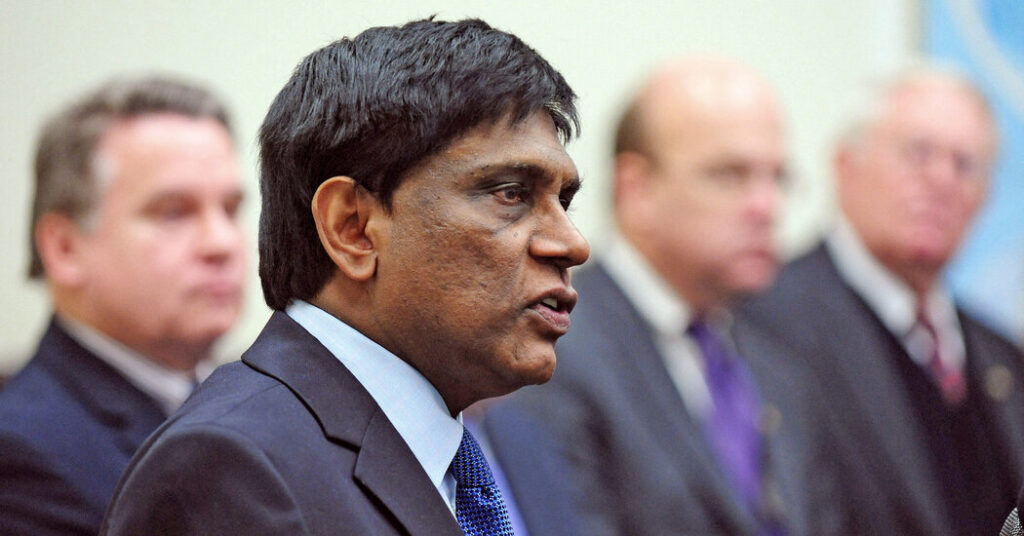
Thambithurai Muthukumarasamy, a human-rights activist who went by T. Kumar and whose advocacy for victims of governmental repression around the world was inspired by his years spent in Sri Lanka’s prisons for his work as a resistance leader, died on Jan. 19. He was 76.
His death was confirmed by Amnesty International, where Mr. Kumar worked for over 20 years, including serving as director for international advocacy and advocacy director for Asia. The cause was complications of sarcoidosis, an inflammatory condition, his sister Krishnal Muthukumarasamy said in an interview. He lived in the Washington, D.C., area but it was unclear where he died.
For years Mr. Kumar spoke out, in congressional testimony, at the United Nations and elsewhere, against China, Vietnam, Afghanistan and other countries whose governments, justice systems and prisons had violated their citizens’ rights.
After the Sept. 11 attacks, he told a congressional committee that the “Taliban’s Shariah courts and religious police” in Afghanistan “impose cruel, inhuman and degrading punishment.” He told another committee in 2017 that in Vietnam, “prisoners of conscience were tortured and otherwise ill-treated, and subjected to unfair trials.”
Many people listening to him were unaware that Mr. Kumar spoke about these issues from personal experience.
As a young man, he spent more than five years in various stints in the prisons of his native Sri Lanka — repeatedly arrested, beaten and ferried from jail to jail because he was an outspoken student leader for the persecuted, predominantly Hindu Tamil minority.
After his death, the online news site Tamil Guardian called Mr. Kumar “a key organizer and political thinker” of the early Tamil resistance movement.
Mr. Kumar’s resistance efforts and imprisonment in the 1970s foreshadowed the bloody civil war in Sri Lanka that began in earnest in 1983 and lasted over a quarter-century, ending in a 2009 massacre in which hundreds of Tamils were killed in the country’s north by the largely Buddhist Sinhalese regime. By then Mr. Kumar had long since emigrated to the United States.
He had a fervent belief in the law — so much so that he spent years in tiny prison cells studying for admission to law school in Sri Lanka, an effort that finally paid off.
“I don’t doubt that what drove him to being such a great advocate was his own experience,” Mona Dave, a senior program officer for Asia at the National Endowment for Democracy, said in an interview. “He truly believed in the rule of law, and justice, and that people deserve justice from their elected governments.”
Thambithurai Muthukumarasamy was born on Feb. 23, 1949, one of eight children of Thambiturai Muthukumaraswamy and Maruthapraveegavalli Muthukumaraswamy.
He was born in Thirunelveli, the town where, 34 years later, a deadly Tamil attack on Sri Lankan Army soldiers triggered the start of the civil war. As a child he lived in the cities of Jaffna, Batticaloa, Kandy and Colombo, moving around since his father was a traveling senior judge on the Sri Lankan judicial circuit.
According to Mr. Kumar’s 2025 memoir, “From Political Prisoner to U.N. Advocate: The Extraordinary Story of T. Kumar,” written (in the third person) with Omar Ahmed, his political consciousness was awakened by witnessing discrimination against Tamils from an early age.
When he was a young engineering student in northern Sri Lanka, the government began restricting ethnic Tamils’ access to higher education. Mr. Kumar gave a speech attacking the discriminatory policies.
He “was among those involved in the formation of the Students’ Council, which played a foundational role in transforming spontaneous resistance into organized political activity,” according to Tamil Guardian.
Though the students’ protest was peaceful, Mr. Kumar, as the president of the council on an increasingly restive campus, was repeatedly questioned by the police and was finally arrested and imprisoned without charge in 300-year-old Fort Hammenhiel. For the young prisoner, it was less brutal than it might have been.
“All of the students were treated like heroes in the prison when we walked in,” Mr. Kumar said in a 2013 interview with WAMU radio, adding, “I was very well taken care of by the guards, because they were also ethnic Tamils.”
His case attracted attention beyond Sri Lanka’s borders. Amnesty International named him a prisoner of conscience, a special designation for nonviolent political prisoners, and organized a worldwide campaign for his release.
Amnesty singling him out “had a role in him coming to understand that there is a global movement for human rights,” John Sifton, the Asia advocacy director at Human Rights Watch, said in an interview.
Mr. Kumar was released from Fort Hammenhiel after six months thanks to the attention from Amnesty. But he continued to speak out about the plight of the Tamils, and was rearrested within months.
This time, he was imprisoned in southern Sri Lanka, far from his home. There were no Tamil guards looking out for him.
“We were abused,” he said in the 2013 interview. “We were tortured, beaten up.”
He became more religious and began to focus on studying the law. After going on a hunger strike, and after pressure from other Tamil leaders, Mr. Kumar was released after more than two years, according to his memoir.
More activism followed, until he was again arrested. After he was admitted to law school while still in jail, members of Sri Lanka’s parliament argued for his release, pointing out that technically he was merely under administrative detention.
He was finally allowed to begin his law studies, finished after three years, entered private practice and focused on defending Tamils. But intensifying repression forced him to flee Sri Lanka; he traveled through Malaysia and Africa, staying with relatives, and procured a U.S. visa from a sympathetic American ambassador in Botswana.
In the United States, he entered the law school at the University of Pennsylvania, earning a law degree there in the early 1990s and beginning his work with Amnesty.
Mr. Kumar is survived by his wife, Sivaneswari Muthukumarasamy; his sister; and five of his other siblings.
In addition to his advocacy work with Amnesty, he lectured at the Foreign Service Institute, the U.S. government’s training center for diplomats and other members of the foreign service, and monitored elections around the world with former President Jimmy Carter.
Adotei Akwei, a senior adviser at Amnesty International, said in an email that Mr. Kumar was “the human rights survivor who had the grace and strength to continue fighting without fear or bitterness and went on to shape almost anyone who encountered him.”
Adam Nossiter has been bureau chief in Kabul, Paris, West Africa and New Orleans and is now a writer on the Obituaries desk.
The post T. Kumar, Rights Activist Who Was Shaped by Time in Prison, Dies at 76 appeared first on New York Times.