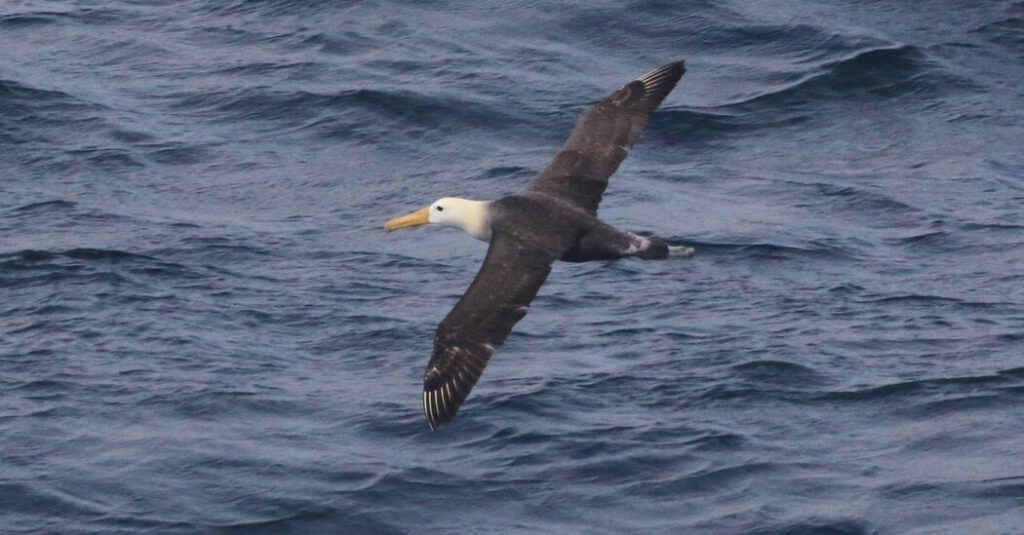
The bird came out of the blue shortly after noon, wheeling low over the Pacific as a research vessel pressed on and as dolphins and humpback whales breached the water.
Tammy Russell, a marine ornithologist on board the research vessel Reuben Lasker was standing on the boat’s deck on Jan. 23 when something crossed her field of vision, no more than 30 feet away, that did not belong there.
“I yelled, ‘waved albatross’ and got out my phone to take a video, which turned out horribly because I was tripping over everything in utter shock at what I had just seen,” said Dr. Russell, a postdoctoral scholar at the University of California in San Diego and a contract scientist at the Farallon Institute in Petaluma, Calif., which advances the study and preservation of marine ecosystems.
This bird’s yellow bill and dark eyes were unmistakable. Its wings were long and its flight unhurried.
Dr. Russell had spent years studying seabirds’ patterns and ranges and the ocean.
The wave albatross, which is known to inhabit the Galápagos Islands and other parts of South America, was there, 23 miles southwest of Piedras Blancas, about 90 miles south of Monterey, Calif.
Geography, in that instant, seemed optional.
The bird that Dr. Russell spotted had traveled about 3,300 miles, as the crow flies, from its typical range, earning it a label ornithologists reserve for the unexpected: an avian “vagrant.”
“Nobody’s ever seen a waved albatross off anywhere north of Costa Rica previously,” said Marshall Iliff, project leader of eBird at the Cornell University Lab of Ornithology, a database that allows bird-watchers to document their sightings.
The American Bird Conservancy lists the waved albatross, also known as the Galápagos albatross, as “critically endangered.”
Fewer than 70,000 remain, and their numbers are declining, threatened by fisheries, plastic pollution and changing climate that alters the locations of squid and fish, which they feed on, according to the conservancy.
The bird, which is the largest in the Galápagos, is named for the faint, wavelike pattern that ripples across its brown body.
What the bird is not known for is appearing off the California coast.
There had been one other sighting, in October 2025, off Northern California. Dr. Russell and others believe it was the same bird.
But why was it so far from home?
“The ‘why did it come here?’ question is impossible to answer,” she said.
If more waved albatrosses began appearing in northern waters, scientists could look at whether ocean temperature or changes in food distribution were nudging them off their typical routes.
Albatrosses are built for roaming. Using wind to travel vast distances with little effort, they can search large stretches of ocean for food.
Shifts in sea-surface temperature or large climate patterns can redraw the lines they follow, said Jason Weckstein, an associate curator of ornithology and associate professor at Drexel University.
“That’s kind of the cool thing about sea birds,” he said. “They can show up in weird places.”
After several passes, the albatross that Dr. Russell was watching caught a stronger band of wind and lifted higher, its wings hardly moving as it drifted southwest, back toward open water.
It did not return.
“I collapsed to the ground laughing and crying,” Dr. Russell said. “It was incredible.”
Mark Walker is a Times reporter who covers breaking news and culture.
The post Rare Albatross Coasts Above California Waters Far From Home appeared first on New York Times.