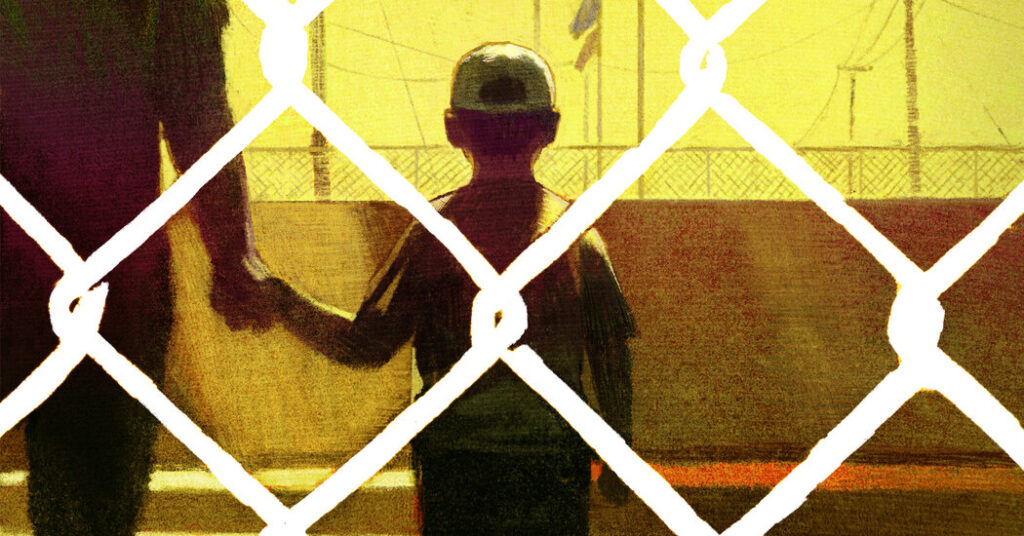
The arrest and detention of Liam Conejo Ramos, the Minnesota 5-year-old in a blue bunny hat and a Spider-Man backpack, has drawn the attention — and the ire — of the nation. As an immigration lawyer who has worked with dozens of families at the immigration detention facility in Dilley, Texas, where Liam and his father are now detained, I know he is far from exceptional. In March 2025, the Trump administration resumed the long-term detention of families, holding them for weeks or months, a practice that the Biden administration had halted in December 2021. I’ve spent the past seven months trying to restore freedom to these families and to give them a fair opportunity to stay in the United States.
Children all across the country are being arrested and detained. They are being arrested at airports, at the border, at immigration courts, at immigration check-in appointments, on their way to and from schools, at parks, on the street and anywhere else they can be found. From January to October 2025, at least 3,800 children under the age of 18, including 20 infants, were arrested and detained by U.S. immigration authorities. Since March 2025, many hundreds of families with children who are minors have been detained in federal immigration custody, with more than 1,700 children in custody since family detention centers reopened. Many have been detained for long periods of time, some for nearly half a year.
The children at Dilley with whom I’ve worked over the past year range in age from 2 to 16 years old. They are citizens of Afghanistan, Azerbaijan, Colombia, Honduras and Russia. A 2-year-old boy was breastfeeding in detention. One 6-year-old boy had leukemia. An 8-year-old girl began wetting the bed. A 14-year-old girl engaged in self-harm. All of these children and their parents were detained despite being eligible for release — ICE has the authority to release these families, who are not flight risks, on parole — and while seeking asylum and other humanitarian protections in the United States. None of these children or their parents had a criminal history anywhere in the world.
The family detention facility at Dilley is a hellhole. Children and parents consistently report not having access to sufficient potable water, palatable food (both children and parents have told me they found worms in their meals), adequate medical care or meaningful educational opportunities. Lights are left on 24 hours a day, making it difficult to sleep. Officers have repeatedly threatened to separate families, including those I represent.
Many of the children detained at Dilley had been living in the United States for years, before they were apprehended and taken to Texas. I have encountered the stories of three high school students from Detroit. Kerly Sosa Rivero dreamed of going to college. Antony Peña Sosa, a violin player, excelled in an Advanced Placement art course. Santiago Zamora Perez, a star baseball player with excellent grades, hoped to play in college. Then there were the stories of a 7-year-old second grader from Winooski, Vt., taken apparently with his mother, and a set of siblings, ages 12 and 15, arrested on their way to school in Durango, Colo. One family that had been living in the United States for a decade was detained at Dilley; their children had just completed elementary school. One of my clients, the 6-year-old Maria Paola, a first grader living in New York City, showed up at her ICE check-in in her school uniform.
Child interaction with immigration authorities isn’t supposed to look like this. More than 40 years ago, a 15-year-old girl named Jenny Lisette Flores became the lead plaintiff among a group of immigrant children who took the federal government to court, alleging that detention conditions for children were inhumane, degrading and abusive. That suit eventually led to a settlement agreement, in 1997, requiring the federal government to provide “safe and sanitary” conditions for children in its custody and to prioritize the prompt release of children.
The Trump administration has sought to terminate in court the protections for children in federal immigration custody that were allocated by the Flores settlement agreement. If the administration is successful, ICE will have the authority to indefinitely detain children as their immigration proceedings play out, a process that can take months or years. A federal appeals court is expected to rule on this issue in the coming months. The administration isn’t waiting. The One Big Beautiful Bill Act, signed into law on July 4, allocated an additional $45 billion to expand the U.S. detention system over four years.
In the absence of the Flores settlement agreement, detention conditions for children in federal immigration custody would surely deteriorate further. The Department of Homeland Security and this administration cannot be trusted to ensure that anyone — including children — is treated with the basic human dignity that law and morality require. Even with the settlement agreement in place, the first Trump administration insisted in 2019 before a federal appeals court that it was “safe and sanitary” to detain immigrant children for days in facilities without soap or toothbrushes and to make them sleep on concrete floors under bright lights without blankets in cold temperatures. Indeed, the most likely result of the end of Flores would be the indefinite detention of children in dangerous, unlicensed facilities for months or years, until they are deported from the United States.
Detaining immigrant children is unjust, and it is unnecessary to ensure their compliance with immigration proceedings. Under previous administrations, immigrant children have participated in highly successful Alternatives to Detention programs, such as the Family Case Management Program, which provides support to immigrants navigating the immigration court system. According to ICE, for families enrolled in the Family Case Management Program in 2017, “overall program compliance for all five regions is an average of 99 percent for ICE check-ins and appointments, as well as 100 percent attendance at court hearings.” In other words, ICE itself recognized that immigrant families in this program overwhelmingly comply with all aspects of their proceedings.
The cost of Alternatives to Detention programs is far less than the cost of detention. A news release from ICE in 2022, now archived, stated that the “daily cost per ATD participant is less than $8 per day versus the cost of detention, which is approximately $150 per day.” The cost differential between the Family Case Management Program and family detention is even more dramatic. In 2016, the Family Case Management Program cost about $36 per day for a family, compared with more than $900 per day to detain an immigrant parent with two children. During the first Trump administration, detaining just one unaccompanied immigrant child cost roughly $750 per day.
Of course, detention is harmful for children. The American Academy of Pediatrics has condemned the government’s reliance on detention for immigrant children accompanied by their parents, explaining that detention can stunt child development, cause psychological trauma and result in long-term mental health risks, including depression and post-traumatic stress disorder. Family detention has likewise been condemned by the American Medical Association, the American Psychiatric Association, the American College of Physicians, D.H.S.’s own Advisory Committee on Family Residential Centers and doctors employed by D.H.S.
Representative Joaquin Castro visited Liam and his father on Jan. 28. In a photo posted by the congressman, Liam now looked listless and pale. His mother told Minnesota Public Radio on Jan. 26 that her son was sick from the food in Dilley.
On Saturday, a federal court judge ordered Liam and his father to be released by Tuesday. Hundreds of other law-abiding children and parents who are detained at Dilley should also be released. These families can and should be enrolled in alternatives to detention programs that are far more cost effective and humane. It is not an enormous ask that we protect children from needless cruelty. Our humanity demands it of us.
Elora Mukherjee is a clinical professor of law at Columbia and the director of the immigrants’ rights clinic there.
The Times is committed to publishing a diversity of letters to the editor. We’d like to hear what you think about this or any of our articles. Here are some tips. And here’s our email: [email protected].
Follow the New York Times Opinion section on Facebook, Instagram, TikTok, Bluesky, WhatsApp and Threads.
The post Liam Ramos Is Just One of Hundreds of Children at This Detention Center. Release Them All. appeared first on New York Times.