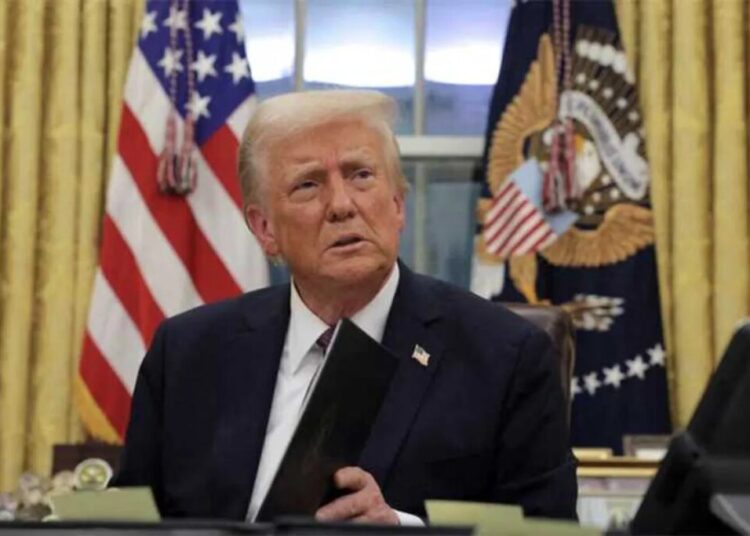
When the Washington National Opera announced its decision to leave the Kennedy Center last month, many interpreted the move as a repudiation of President Trump and his efforts to seize control of the arts complex.
In fact, the repudiation came from the Kennedy Center. By imposing an economic model on the company that makes opera impossible to produce, it was effectively disowning the art form and by extension all nonprofit performing arts and their profound contribution to our national life.
The new mandate set forth by the Kennedy Center requires that every performance break even through only ticket sales and corporate sponsorships that have been confirmed before the curtain rises — a system that the leadership considers revenue neutral. But that system simply doesn’t work for nonprofit arts, and especially for opera, because it ignores the vital role of donations.
Like all other nonprofit performing arts organizations, opera companies depend on two main income streams, earned and contributed. Earned income flows largely from ticket sales, with smaller amounts of money drawn from endowments. Contributed income — mostly from individuals but also from foundations, corporate sponsorships and small government grants — provides more than half of overall income. At most opera companies, contributions of all sizes from individual donors exceed box-office income — as they do for many organizations in other disciplines.
That contributed income isn’t making up for a loss, a misunderstanding held by many; rather, it’s the lifeblood of an opera company. Most companies balance their yearly budgets by generating as much income as possible and managing expenses. Opera and all the arts operate at a loss only if income from contributions plus that from ticket sales falls out of balance with expenses. This model is uniquely American in the arts world. It has prevailed through the dynamic expansion of opera companies, orchestras, dance companies, theaters, choruses and presenting organizations across the country over the past 50 years.
Opera is enormously expensive to produce. Soloists, choristers, orchestral musicians, dancers, stagehands and backstage artisans all told can number in the hundreds. The costs of sets and costumes are rising steadily. Opera companies have sophisticated fund-raising and marketing departments that work every year to bring in money to cover the expenses of each performance.
All of this is in the service of one of the world’s greatest forms of artistic expression — drama intensified through exquisite music made even more compelling with visually arresting sets and costumes. The stories of opera span the centuries and come in different languages, but they all set out to explore the deepest emotions and complexities of the human condition.
The Washington National Opera was on an upswing in recent years. Since 2018, its endowment has increased from $8 million to almost $30 million. The company fulfilled the budgetary obligations of its agreement with the Kennedy Center every year since, thanks in part to the generosity of its donors. Covering expenses only through ticket sales and corporate contributions would be impossible even in the most stable of circumstances.
Current circumstances are not stable. Ticket sales declined significantly through 2025. Individual contributions have fallen, too. The reluctance of Washingtonians to participate in activities at the center since Trump’s takeover is well documented. Staff members have either resigned from marketing and development departments or been fired, and many positions remain open. Cutting staff to reduce costs almost always leads to revenue losses greater than anticipated savings.
In effect, the leadership of the Kennedy Center has told the Washington National Opera that the inherited masterpieces of Mozart, Verdi and Puccini and works from the new American canon by Mason Bates, Kevin Puts and Jeanine Tesori are no longer wanted at the nation’s performing arts center.
Demonstrating the innate resourcefulness of artists, the company has announced that planned performances will take place at Lisner Auditorium at George Washington University, the company’s original home. Francesca Zambello, the company’s artistic director, said it would put on three American works “that explore themes at the heart of what makes our country great.”
The works are Scott Joplin’s “Treemonisha”; “The Crucible,” by Robert Ward, based on the Arthur Miller play; and Leonard Bernstein’s “West Side Story.”
“‘Treemonisha’ celebrates the triumph of education over ignorance, while ‘The Crucible’ is a cautionary tale about a righteous mob that murders innocent women and tears families apart,” Ms. Zambello said. She noted that Bernstein called his musical, created with Arthur Laurents, Stephen Sondheim and Jerome Robbins, “‘an out-and-out plea for racial tolerance.’”
There is no indication that the Kennedy Center had any issues with those specific works and themes, but depriving the opera company of the resources to produce them rejects them by other means.
The Kennedy Center professes that its mission is partly to “celebrate the cultural heritage by which a great society is defined and remembered.” Repudiating one of the nation’s greatest musical institutions in its capital city contradicts this mission. The company’s success in supporting our rich cultural fabric should be celebrated — not abandoned — especially during the year of our nation’s 250th birthday.
Marc A. Scorca served as the president and chief executive of Opera America, a service organization, from 1990 to 2025.
The Times is committed to publishing a diversity of letters to the editor. We’d like to hear what you think about this or any of our articles. Here are some tips. And here’s our email: [email protected].
Follow the New York Times Opinion section on Facebook, Instagram, TikTok, Bluesky, WhatsApp and Threads.
The post How Trumpworld Sent Opera Packing appeared first on New York Times.