The seventh in an occasional series of profiles on Southern California athletes who have flourished in their post-playing careers.
Tai Babilonia’s life changed forever when she was asked to hold a boy’s hand.
At first she resisted.
“I didn’t want to,” she remembered. “He’s a yucky boy.”
But Mabel Fairbanks, Babilonia’s skating coach, wouldn’t take no for an answer, bribing the 8-year-old with stickers and a Barbie doll if she would just reach out and grab the hand of 10-year-old Randy Gardner.
It would be another 40 years before she let go.
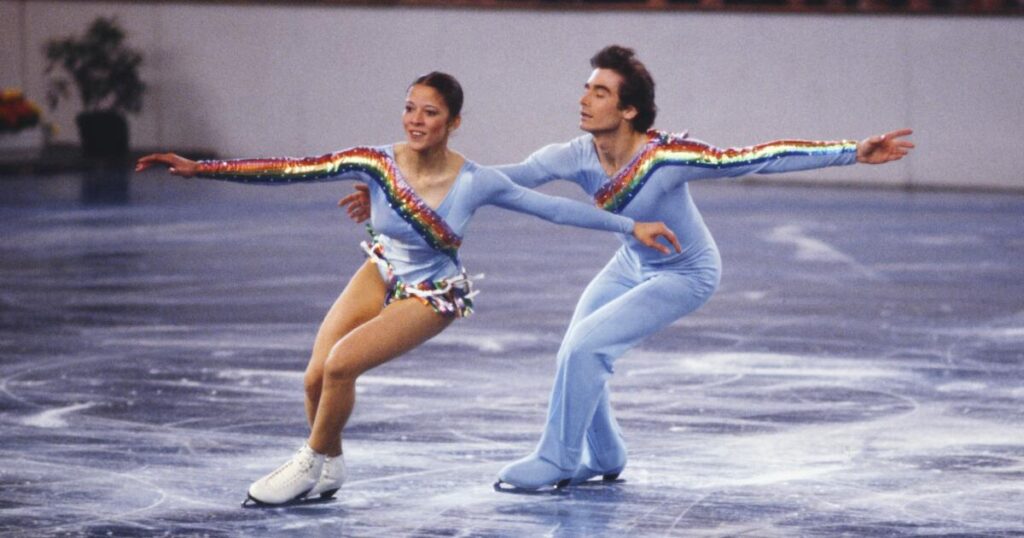
By then Tai Babilonia and Randy Gardner had become one of the most decorated pairs in U.S. figure skating history, their individual names eventually melding into one.
“My last name is ‘and Randy,’” Babilonia said. “And I embrace it.”
As a pair “Tai and Randy” won five U.S. championships, medaled in three world championships and qualified for the Olympics twice, all before Babilonia’s 21st birthday. Their success also pushed open doors that had long been closed since Babilonia, Black on her mother’s side and part Filipino and Native American on her dad’s side, was the first U.S. skater from any of those ethnic groups to compete in the Olympics or win a world title.
Among those to follow her were Debi Thomas, a two-time U.S. champion and a bronze medalist at the 1988 Winter Olympics, and Elizabeth Punsalan, a two-time Olympian and five-time national champion in ice dancing.
At about the same time Babilonia and Gardner were moving from competitive skating and the Olympics to the Ice Capades, another young girl was just starting to pursue her own Olympic dreams. Tiffany Chin would go on to win a national championship, two Skate America titles and just miss a medal in the 1984 Winter Games, retiring before she was old enough to legally drink.
In that brief but brilliant career, Chin changed U.S. figure skating forever. She was the country’s first Asian American national champion and first Chinese American Winter Olympian, paving the way for Olympic medalists Kristi Yamaguchi, Nathan Chen, Michelle Kwan and siblings Alex and Maia Shibutani.
After retiring from skating, Babilonia, now 66, dabbled in coaching and sportswear design, became a motivational speaker, an activist and, most importantly, a grandmother. But the legacy Babilonia and Chin created will be on display in Italy this month when the U.S. fields one of the most eclectic Olympic figure skating teams ever, with 12 of the 16 athletes having immigrant parents.
Five of the six singles skaters — Alysa Liu, Isabeau Levito, Ilia Malinin, Maxim Naumov and Andrew Torgashev — are first-generation Americans while the other, women’s national champion Amber Glenn, identifies as pansexual. Pairs skaters Emily Chan, Spencer Howe and Ellie Kam and ice dancers Anthony Ponomarenko, Christina Carreira, Vadym Kolesnik and Emilea Zingas are also immigrants or first-generation Americans while Madison Chock, the reigning Olympic champion in ice dancing, has Hawaiian, Chinese, German, English, Irish, French and Dutch ancestry.
At a time when diversity, equity and inclusion programs are being dismantled, immigrants are being attacked and diversity is labeled a weakness, America’s Olympic figure skaters have come to mirror the country at large.
“It’s wonderful and so important,” said Babilonia. “Especially now.”
Nearly 60 years after Babilonia and Gardner skated together for the first time, the decision to pair them seems inspired, even providential.
It was neither. Fairbanks, Babilonia learned later, simply needed a couple to skate in a club show at the Culver City Ice Arena.
“We just happened to be similar in height. And I guess we were cute,” Babilonia said last month during a lengthy interview at the Colonial Revival-style mansion in the West Adams District that houses the LA84 Foundation.
Gardner was already an excellent skater, as strong and athletic as he was outgoing and friendly; Babilonia was shy and far less steady on the ice. But that wasn’t the only thing that made their pairing unusual.
Gardner was white and Babilonia was Black. And in 1968, asking them to hold hands in public was scandalous, even in Culver City. However, Fairbanks, a legendary coach who had spent much of her life pushing back against convention, didn’t see color. She focused only on talent.
“Mabel was the coach who taught all races, Hispanic, Black, mixed, Jewish,” Babilonia said. “Mabel broke down that wall.”
Fairbanks, who was Black and Seminole, was born in the Deep South at a time when ice rinks were segregated. Even after moving to New York, where she bought a pair of skates for $1 at a pawn shop, then taught herself how to use them, she skated mostly in nightclub shows, where she was limited to jumps and moves that wouldn’t show up the white skaters.
She soon moved to Los Angeles, touring internationally with the Ice Capades and Ice Follies, before becoming a coach and mentoring hundreds of young skaters, including Olympic medalists Scott Hamilton, Yamaguchi and Thomas.
“If it weren’t for Mabel Fairbanks, you wouldn’t have any color in the predominantly white skating world,” said Babilonia, who is shopping a biopic of Fairbanks, who died in 2001.
“People don’t really know her. She’s like a hidden figure.”
Yet three years after Fairbanks made Tai and Randy a pair, they left her for John Nicks, who was coaching at the Paramount Iceland.
“He took our skating to a whole different level. And it happened really quick,” said Babilonia, who still calls her former coach Mr. Nicks. “That’s when we started winning and improving and just really became a great pair of skaters.”
Two years later Babilonia and Gardner won the U.S. junior nationals and three years after that they won the first of five national championships, qualifying for the 1976 Winter Olympics in Austria, where they finished fifth. Gardner wasn’t old enough to vote and Babilonia didn’t have a driver’s license. But together they were holding their own against the best pairs skaters in the world.
“Such an incredible year,” Babilonia said. “We won our first U.S. title, became Olympians, I got my learner’s permit and had a crush on Peter Frampton.”
But they were just getting started. Gardner and Babilonia wouldn’t lose in the U.S. championships for the rest of the decade. And 11 months before the next Olympics, they won their first world championship, then celebrated by skating for the queen of England at Wembley Stadium.
With the Winter Games coming back to the U.S. at Lake Placid, the Americans were favored to keep the Soviet Union off the top step of the medal platform for the first time since 1960, the last time the Olympics were held in the U.S.
Only they never made it to the ice.
Hicks had moved his skaters from Paramount to the Ice Capades Chalet, a buff-colored concrete-block building in Santa Monica, five blocks from the Pacific Ocean. During a training session there, Gardner inflamed a groin injury that had plagued him for months.
It got worse when they got to Lake Placid and Gardner had a Xylocaine injection, but the anesthetic was too strong and it only made things worse; the pain was gone, but now Gardner couldn’t feel his leg at all. They pulled out of the competition moments before it was supposed to begin.
The next morning, with the skaters, their parents and their coach perched on the stage at a high school auditorium for a hastily arranged news conference, hundreds of reporters tried to get a shattered Babilonia to turn on her partner. She didn’t take the bait.
“She totally had my back,” Gardner said. “There was so much camaraderie and trust and love between the two of us. She understood that it was a major injury and it was devastating. It changed the path of our career.”
“I’m not going to say it ruined it,” he added. “It just changed the path.”
Two months after leaving Lake Placid in sorrow, Gardner and Babilonia, who had gone from “Tai and Randy” to the “Heartbreak Kids,” turned pro, signing a three-year contract with the Ice Capades that included endorsement deals.
They never skated in the Olympics again. And while the money was good, the pace was punishing, with eight shows a week on a 30-week tour.
“You’re performing every night, weekends two shows a day,” Babilonia said. “If you don’t pace yourself, which I didn’t, it will rock your world in a negative way.
“You can’t do all the tricks you did as a teenager every night.”
Babilonia had never truly dealt with the emotional pain of the Olympic withdrawal. Now she was also dealing with the strain and fatigue of the ice show schedule as well as an identity crisis.
“Randy figured out how to put Tai and Randy in a box and leave them there and go on with his life,” Babilonia said. “I didn’t know how to separate them from me.”
So she sought answers in amphetamines, heavy drinking and a number of brief but high-profile romances before hitting rock bottom just before her 29th birthday, when she tried to kill herself with an overdose of sleeping pills. Her recovery started seven months later with an emotional first-person account of her fall in People magazine.
“I did it because I knew I had to,” Babilonia, still fit and youthful, said of a confession in which she blamed no one but herself. “I had to stop what I was doing and this was part of my recovery process. I couldn’t say yes quick enough.
“Something inside of me said, ‘This is your moment. Get it out. It may help some people,’” she continued. “And it did.”
The magazine cover story was followed 19 months later by the prime-time NBC movie “On Thin Ice,” which went over much of the same territory, with Babilonia and Gardner playing themselves in many of the skating scenes.
“It took me a while to watch the whole thing. Some scenes were hard,” said Babilonia, who speaks in a confident, careful cadence. “It was just part of my recovery process.”
She’s been sober 17 years and her relationship with Gardner, who came out as gay in 2006 — also in People magazine — has lasted longer than her marriage. Along the way, Babilonia matured from the shy withdrawn child who refused to hold a boy’s hand into a bold, strong and confident woman.
“She’s totally mature. She is worldly. And she’s an advocate for equality in sports, people of color and all that,” said Gardner, 68, whose home in Manhattan Beach is about 10 miles from the Culver City ice rink where he and Babilonia learned to skate once stood.
The former teammates still meet at least once a month and talk on the phone frequently, although they haven’t been on the ice together since Gardner underwent surgery on his back a year ago.
When she stopped skating Babilonia tried coaching, but that didn’t work because she didn’t know how to teach the moves she had so easily mastered. Instead, she launched a clothing line, became a motivational speaker, volunteered with various groups promoting diversity on and off the ice, co-hosted a TV interview show taped in Santa Barbara and, for the last nine years, has co-hosted a holiday skate party for kids from the Union Rescue Mission. She also continues to skate in charity events.
All that in addition to her work with Atoy Wilson, a former U.S. novice champion, on the Mabel Fairbanks biopic, tentatively titled “Black Ice: The Mabel Fairbanks Story.”
“I want to try everything,” she said. “I want to experience everything.”
But her real job, she quickly adds, is being a grandmother to Ryett, her son’s 2-year-old boy in Arizona.
“I love being a grandmother,” she said. “Absolutely love it.”
She is also a prolific presence on social media, where most of her posts are either trenchant comments on the politics of today or black-and-white photos from back in the day, when she and Gardner — Tai and Randy — were winning medals and opening doors, helping to change U.S. figure skating forever.
“I appreciate what we did more as I get older,” Babilonia said. “We were pretty good and we made our mark. We worked hard. We became two-time Olympians. We met the queen of England.
“It’s just wild.”
The post How Tai Babilonia’s groundbreaking career shattered barriers for U.S. figure skaters appeared first on Los Angeles Times.