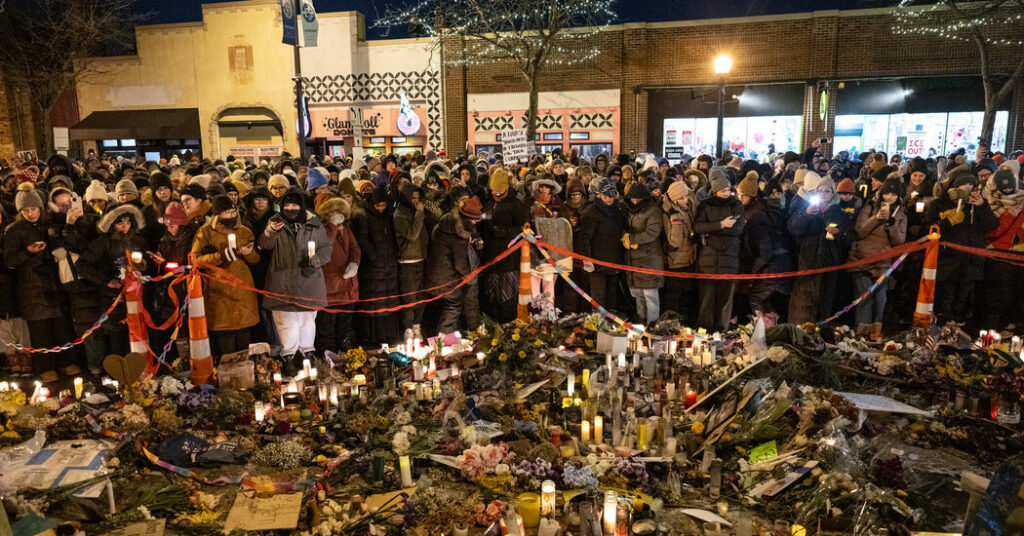
Renee Good was killed on Jan. 7. Alex Pretti on Jan. 24. Federal agents killed both of them, and the administration labeled both of them terrorists — labels that quickly fell apart when the public learned more about each case and saw videos of the shootings.
Yet it was Mr. Pretti’s death that broke the dam, galvanizing public sentiment against the federal government’s tactics and forcing a remarkable retreat by the Trump administration.
Gun-rights groups turned on the White House. Republican senators called for investigations. One poll found that support for abolishing ICE had nearly doubled among independent voters.
Both deaths provoked outrage. But Mr. Pretti’s reached further — into conservative circles that had defended the crackdown, and among independents, who had been willing to look away. Why did his death cross political lines that Ms. Good’s, for all the anger it generated, didn’t?
It is never possible to say with certainty why one tragedy widens the circle of outrage and another does not. History offers precedents.
George Floyd was not the first Black man to die at the hands of police in 2020. The searing video of his death, however, and the moment it arrived — during heightened unease around police misconduct — turned his killing into a movement. Rosa Parks was not the first person to refuse to give up her seat on a Montgomery bus; a 15-year-old named Claudette Colvin had been arrested after performing the same act months earlier. But it was Parks, for reasons both strategic and circumstantial, whose case became a catalyst. Tipping points are often visible only in hindsight.
Kevin Drakulich, a criminologist at Northeastern University who studies race, crime and public opinion, put it simply: “Renee Good’s death was tragic. Alex Pretti’s is a trend.”
The federal crackdown had already produced casualties elsewhere, including a Mexican immigrant who was shot and killed by ICE agents in Chicago in September. The death did not draw sustained national attention. Minneapolis was different — two killings of American citizens, at close to the same time, in a city that had become shorthand for protest and police violence.
Ms. Good’s death brought doubts about what federal agents were doing in Minneapolis into national view, with protests, headlines and the first serious fractures in President Trump’s public credibility on immigration. Then, four days before Mr. Pretti was killed, a photograph circulated widely: a 5-year-old boy named Liam Conejo Ramos, wearing a blue bunny hat and a school backpack, being led away by federal agents in a Minneapolis suburb. A child, detained with his father, shortly after being picked up from school. The image widened the cracks.
The accumulation of images and tragedies does not alone explain the difference in responses.
Ms. Good was in her car when an agent shot her. Administration officials thus declared her vehicle a weapon, and said she had posed a threat to the agent. Video analysis challenged that account, but could not rule out the agent’s claim that he had feared for his safety.
Mr. Pretti left far less room for speculation. He was on foot, filming with his phone, helping a woman who had been shoved to the ground. The administration called him an “assassin,” who had intended to massacre law enforcement officers.
Within hours, video from multiple angles showed him holding a phone, not a weapon, then being tackled, pinned face down and shot multiple times in the back. An agent had already pulled the gun from Mr. Pretti’s waistband. Video analysis concluded that the shots had come after Mr. Pretti was disarmed and restrained — a sequence that, under standard use-of-force guidelines, may be difficult to justify.
Many viewers saw an execution, not defense against a domestic terrorist. The government’s story collapsed. Still, it is not enough to account for what followed. But a look at who the victims were and how the public perceived them may help explain how opinion was changed.
Mr. Drakulich uses a term for the kind of victim the public instinctively sympathizes with: the “ideal victim.” Two attributes make someone fit. “Someone whose life and well-being is broadly valued,” he said, “and someone who people can judge as not bearing any responsibility for their victimization.”
Consider the details that circulated in the days after Mr. Pretti’s death. He was not a so-called criminal immigrant, whom officials say they were targeting, but a white American citizen. He was an intensive care-unit nurse at a V.A. hospital, caring for veterans. A video of him saluting a deceased patient had circulated months earlier. He was a legal gun owner, with a gun permit, and no criminal record. On camera, in the moments before he was killed, he displayed what a former student called his “familiar stillness and signature calm composure.”
He did not run. He came to the aid of a stranger. Masked federal agents killed him nonetheless.
Sarah Gaither, an associate professor of psychology and neuroscience at Duke who studies identity and perception, wrote in an email that Mr. Pretti’s profile “fit widely held cultural cues associated with respectability and being nonthreatening.”
She added that those cues “lowered resistance to empathy among people who might otherwise dismiss criticism of ICE.”
It was not that Mr. Pretti generated more sympathy. It was that his profile removed barriers. For people who had needed permission to criticize the agency, Mr. Pretti granted it.
For one constituency, Mr. Pretti’s death did more than grant permission to criticize. It confirmed a long-held fear.
For decades, the conservative case for the Second Amendment has rested largely on the premise that an armed citizenry is the last defense against government tyranny. N.R.A. fund-raising letters once warned of “jackbooted government thugs.” The language was apocalyptic, the scenario hypothetical.
Minneapolis made it real. Masked federal agents killed a legal gun owner who had never drawn his weapon.
Gun rights groups pushed back. Gun Owners of America posted on social media: “Peaceful protests while armed isn’t radical — it’s American. GOA will hold any administration accountable.”
Mr. Pretti was exactly the kind of American such groups were built to protect: a law-abiding citizen, legally armed, killed by government agents.
But new footage emerged on Wednesday that may yet complicate the narrative. The video shows Mr. Pretti on Jan. 13, 11 days before he was killed, in a confrontation with federal agents. He spits at them and kicks their vehicle, breaking a taillight. Agents tackle him. A gun appears to be visible in his waistband. He is released without arrest.
Earlier this week, President Trump had signaled a desire to turn down the temperature. He called Mr. Pretti’s death “very unfortunate” and said he wanted to “de-escalate a little bit” in Minnesota.
On Friday morning, the president reversed course. “Agitator and, perhaps, insurrectionist, Alex Pretti’s stock has gone way down,” Mr. Trump posted on social media, describing the video as “quite a display of abuse and anger, for all to see, crazed and out of control.”
The post drew swift condemnation. Some critics called it a smear of a dead man.
The Pretti family had already commented on the release of the video. “Nothing that happened a full week before could have possibly justified Alex’s killing at the hands of ICE on Jan. 24,” it said in a statement.
The tide had already turned. Even Tom Homan, the Trump administration’s border czar, had acknowledged that the Minneapolis operation was flawed, a rare concession from an official who had long defended aggressive enforcement tactics. Days later, an immigration operation in Maine was abruptly called off.
What had happened on that frozen Minneapolis street was reverberating far beyond the city where Mr. Pretti died.
Kurt Streeter writes about identity in America — racial, political, religious, gender and more. He is based on the West Coast.
The post How Alex Pretti’s Death Became a National Tipping Point appeared first on New York Times.